





 Portuguese
  English
  Spanish
  6 min of reading
  0 comments


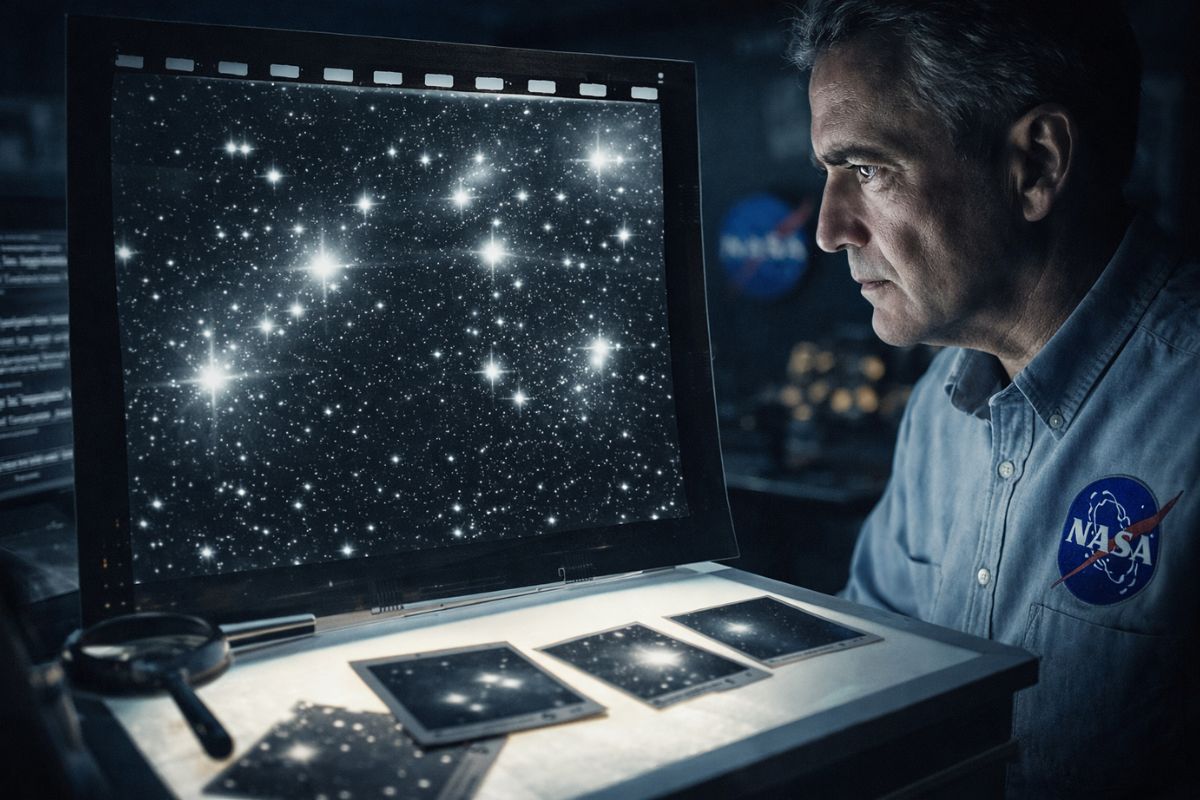
Scientists of the VASCO project and a retired NASA researcher independently identified thousands of unexplained luminous flashes in photographs of the sky taken in the 1940s and 1950s, before the launch of the first artificial satellite, and the objects that produced these flashes have characteristics consistent with reflective artificial surfaces in rotation above the Earth’s atmosphere
Scientists identified thousands of unexplained luminous flashes in photographs of the sky taken before 1957, the year the Soviet Union launched Sputnik-1, the first artificial satellite in history. The bright spots appear in one image and disappear in the next, lasting less than a second, and cannot be explained as a result of human activity because no country had placed any object in orbit at that time. The discovery was made by the VASCO project, led by astronomer Beatriz Villarroel, and has now been independently confirmed by Ivo Busko, a retired NASA researcher.
According to Daily Mail, what makes the case more disturbing is that scientists found a pattern: the flashes increased in the days following nuclear tests conducted by the United States, the United Kingdom, and the Soviet Union. The likelihood of detecting the objects was greater the day after a nuclear bomb detonation, which eliminates the possibility that the flashes were caused by the explosions themselves. Scientists describe the evidence as consistent with reflective artificial objects in rotation above the Earth’s atmosphere, and Villarroel stated that she cannot find any other explanation other than that we are facing something artificial.
What scientists found in photographs of the sky taken before the space age

The VASCO project (Vanishing and Appearing Sources during a Century of Observations) was created by astronomer Beatriz Villarroel from the Nordic Institute of Theoretical Physics in Sweden to analyze historical photographs of the sky in search of objects that appear and disappear without explanation.
-
There is a gap of hundreds of kilometers between weather observation points in the United States, and now drones flying at 6,000 meters altitude in strong winds are filling this gap to predict tornadoes before they kill.

-
The most famous volcano in the world could paralyze one of the largest metropolises on the planet: Japan accelerates emergency plans for the eruption of Mount Fuji, which could bury Tokyo in ash for over two consecutive weeks.

-
The United States has a serious problem with its F-35s: China is already producing fighters at a pace that exceeds American capacity and could manufacture up to 300 aircraft per year before the end of the decade, shifting the global military balance.

-
Remains with battle wounds of over 100 soldiers from the Roman Empire are found beneath a football field in Vienna, leaving everyone surprised.


The scientists analyzed photographic plates from the Palomar Observatory in California, taken during the 1940s and 1950s, and found over 100,000 transient objects, bright spots that appear in one exposure and are completely absent in previous and subsequent exposures.
These flashes were recorded years before any country had launched a satellite into space. Sputnik-1, the first artificial satellite, only entered orbit in October 1957.
The scientists ruled out explanations such as known stars, natural cosmic sources, defects in photographic plates, and human aircraft, because no man-made object was orbiting the Earth at that time. The resulting study was published in the journal Scientific Reports, with peer review, in October 2025.
The NASA researcher who confirmed the flashes independently

Ivo Busko, a retired NASA developer who worked at the Space Telescope Science Institute, conducted an independent analysis to verify whether the VASCO project’s findings were real.
He used his own analytical method and a different set of photographs: 98,000 photographic plates from the Hamburg Observatory in Germany, taken with a 1.2-meter camera at the same time.
Busko found dozens of transient flashes exhibiting the same unusual characteristics reported by the VASCO scientists.
From an initial batch of 41 plates examined, Busko identified 70 candidate flashes, which were refined to 35 strong candidates after careful visual analysis. He published the results on arXiv and stated that the findings independently confirm the presence of these transient phenomena.
The fact that two groups of scientists using different methods, different photographs, and observatories on different continents found the same types of flashes gives considerable weight to the hypothesis that something real was producing these flashes in the sky before the space age.
The connection between nuclear tests and the flashes that scientists cannot explain
The scientists of the VASCO project analyzed 124 above-ground nuclear bomb tests conducted by the United States, the United Kingdom, and the Soviet Union between 1949 and 1957.
What they found was a statistical pattern that does not appear to be random: the total number of transient objects seen in photographs of the sky increased by 8.5% on days when nuclear tests occurred.
The most intriguing detail is that the likelihood of detecting the flashes was greater the day after the test, not on the day of the explosion. This eliminates the hypothesis that the flashes were directly caused by the detonations, such as light streaks or particle clouds.
The scientists found nearly 60 of these objects in orbit on nuclear test days, a number that dropped to about 40 on days when only one of the two events occurred. The pattern suggests that something in space was responding to the nuclear tests on the Earth’s surface.
Why scientists say the flashes are consistent with artificial objects
The flashes found by the scientists do not resemble anything that conventional astronomy can explain. Villarroel noted that some of the objects appeared highly reflective, similar to mirrors, and exhibited signs consistent with flat rotating surfaces.
Busko confirmed that the flashes last less than a second and produce sharper and more circular profiles than stellar images, exactly what one would expect from optical reflections caused by sunlight reflecting off flat surfaces of rotating objects above the atmosphere.
The scientists found about 35,000 of these objects just in the northern hemisphere. Villarroel stated that she cannot find any other consistent explanation other than that we are facing something artificial.
If the objects existed before any human satellite, they could not have been manufactured by humanity.
And if they are artificial, the implication is that some form of non-human intelligence placed them there. Busko reinforced this line by stating that the findings have clear implications for research related to SETI (Search for Extraterrestrial Intelligence).
What happens now with the evidence collected by scientists
Busko plans to digitize more plates from the archive and expand the analysis to collections from other observatories in Europe. The goal is to confirm and expand the evidence base regarding the transient objects already identified by the VASCO project.
The scientists recognize that the findings are extraordinary and that extraordinary claims require extraordinary evidence, which is why Busko’s independent verification was so important: it shows that the flashes are not artifacts from a single observatory or a single method of analysis.
Villarroel did not assert with certainty whether the objects sighted in the 1950s still exist, but noted that if they were built by a non-human intelligence, they could still be orbiting the Earth.
If the findings are confirmed by future analyses, scientists believe that the objects may represent some of the earliest recorded evidence of unidentified structures operating above the Earth’s atmosphere, decades before any nation sent anything into space.
Something was up there before us and scientists now have the photos to prove it
Scientists found over 100,000 unexplained flashes in photographs of the sky taken before 1957.
The objects appear and disappear in less than a second, have characteristics of reflective artificial surfaces, and increase in number in the days following nuclear tests.
A NASA researcher independently confirmed the findings using photographs from another observatory on another continent, and the question that scientists now face is the most disturbing possible: if no one had launched anything into space at that time, what was that?
Do you believe that something was orbiting the Earth before the space age? Do you think scientists will find a natural explanation or are we facing real evidence of non-human intelligence? Leave your thoughts in the comments and share this article with those who are fascinated by mysteries of space and science.









Seja o primeiro a reagir!