





 Portuguese
  English
  Spanish
  3 min of reading


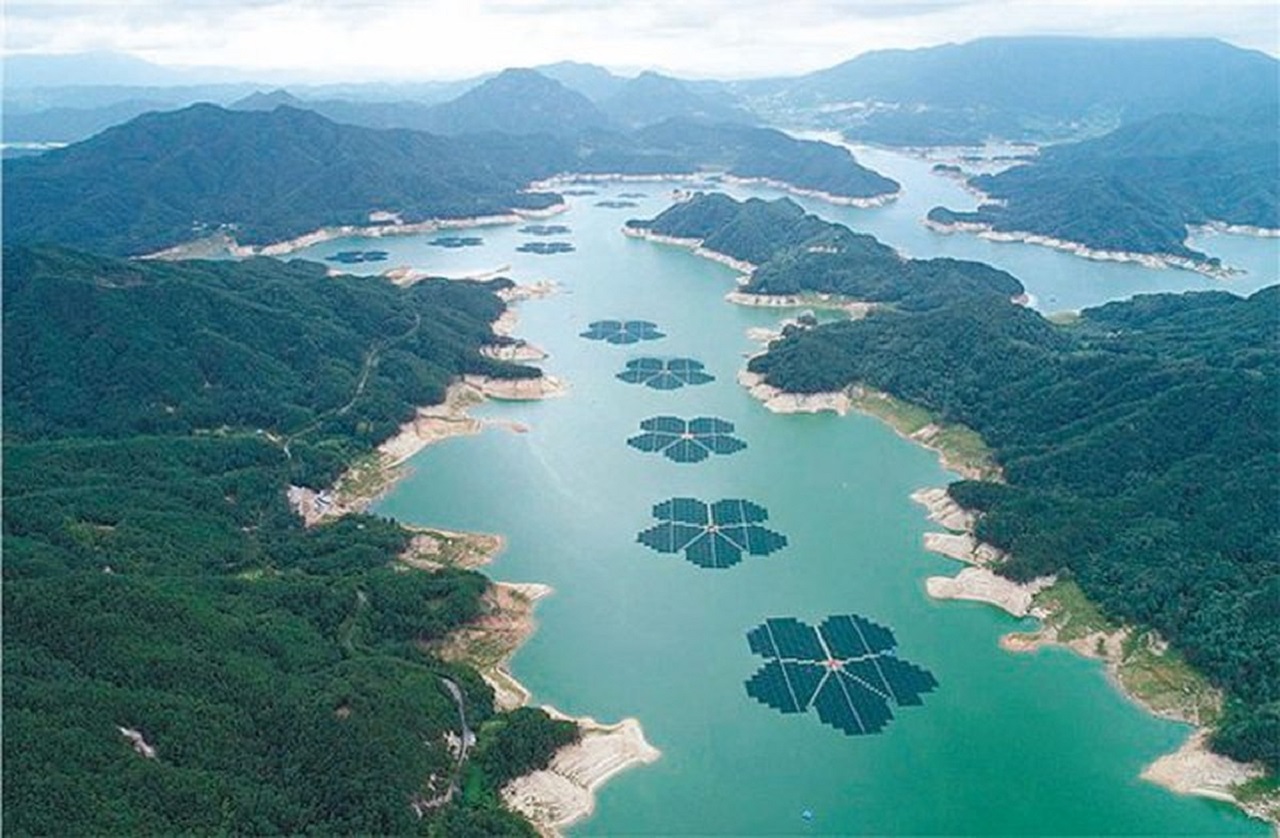
The Solar Energy Project Aims to Reduce Carbon Emissions and Dependence on Coal for Electricity Generation. Furthermore, the Solar Panels in the Shape of Cherry Blossoms Make the Region Even More Beautiful and Attractive
South Korea highlighted the inauguration of a floating solar farm that, in the eyes of the public and everyone who has seen its structure, looks like a huge piece of outdoor art. In the floating solar farm, about 92,000 solar panels unite in 17 blocks shaped like giant cherry blossoms. The solar panels were installed in a 20-km-long reservoir in the city of Hapcheon, located in the south of the country.
Read Other Related News
Floating Solar Farm in South Korea Aims to Reduce the Country’s Dependence on Coal
The project for the farm in Hapcheon is already considered one of the largest in terms of floating solar energy generation in the world, and the main mission of South Koreans is to reduce South Korea’s dependence on a severe pollutant: coal.
South Korea is extremely dependent on coal for electricity generation and, therefore, is investing in a new and promising pathway, through which it will be able to reduce greenhouse gas emissions.
-
The Brazilian state accelerates industrial competitiveness with a focus on the extraction of strategic minerals to boost the energy transition in Goiás.
-
Seagri’s headquarters invests in solar energy with Neoenergia Coelba and promises to cut electricity costs, highlighting a strategic advance in sustainability and energy efficiency within state public administration.
-
A Canadian retiree creates a hydroelectric system on a real river, generating energy continuously throughout the day and demonstrating how the power of water can supply a house with stability even in a simple structure.

-
Solar Pyramid draws attention by converting solar energy into million-dollar savings and repositioning the City Hall of Curitiba as an example of innovation, sustainability, and intelligent use of public resources.

The goal is to achieve carbon neutrality by 2050. Regarding the farm itself, the idea arose after the lack of land in South Korea, preventing other large projects from coming to fruition, projects that would be of great utility for all of South Korea and, perhaps, for other countries as well.
Potential of the Floating Solar Farm
According to Hanwha Solutions Corp., the company responsible for constructing the farm, the solar panels in the shape of cherry blossoms are capable of generating enough energy to supply around 20,000 homes.
Furthermore, according to the company, the potential for floating solar energy in South Korea could reach 9.4 gigawatts, equivalent to about 9 nuclear reactors. In an interview with Bloomberg, Kim Jiseok, a Climate and Energy Specialist from Greenpeace Korea, said that South Korea needs a large amount of renewable energy to meet its climate goal.
Finally, the company stated that the floating solar farm could be part of the solution to this problem, as it faces much less opposition from the population and does not use land.
Job Creation and Income in South Korea
Job creation and income for older South Koreans is another major challenge addressed within the project, which is under the administration of the state-owned Korea Water Resources Corp.
When the floating solar farm was proposed, the local population had the opportunity to invest and also participate in the construction of the farm, which is located in an area where the average age is nearly 60 years.
About 1,400 residents of the area collectively invested around 3.1 billion won (estimated at US$ 2.6 million), or about 4% of the total cost, where they expect to receive an estimated annual return of 10% over 20 years.










Seja o primeiro a reagir!