





 Portuguese
  English
  Spanish
  3 min of reading
  4 comments


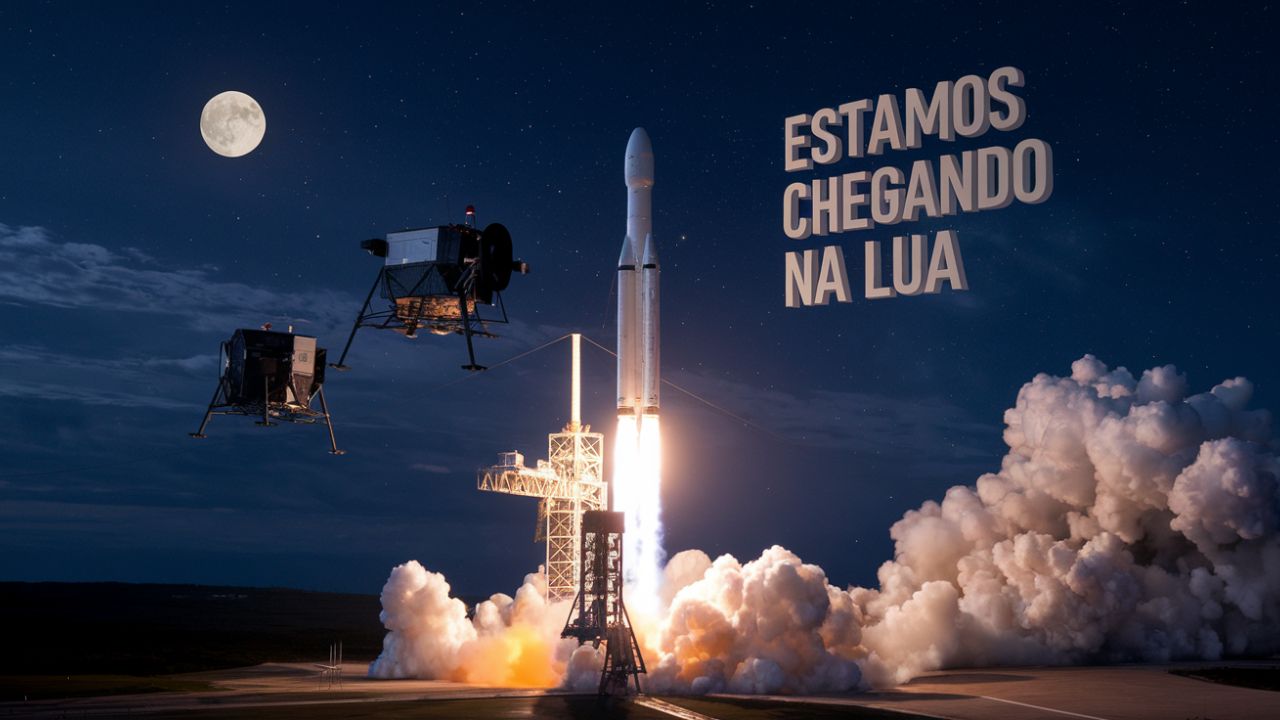


With Three Historic Missions Scheduled for January, SpaceX Launches Modules from Intuitive Machines, Firefly, and i-space to the Moon, Promising Advances in the Search for Ice, Scientific Studies, and New Technologies.
What could three different lunar landing modules bring to science in a single month? January 2025 promises to be a milestone for lunar exploration, with SpaceX leading the launches of three distinct companies in pursuit of a historic achievement. Let’s explore what each mission represents and how they could change the course of space exploration.
January 2025: A Month of High Expectations for the Moon from SpaceX
In recent years, the space race has gained new protagonists: private companies. SpaceX, with its Falcon 9 rocket, has become the favorite choice to transport landing modules to the Moon, boosting the ambitions of various organizations to reach Earth’s natural satellite. But what is so special about 2025?
NASA, seeking faster and more economical alternatives, has partnered with companies like Intuitive Machines and Firefly Aerospace. Both have crucial missions planned for January, in addition to the Japanese i-space, which is returning after a failed attempt in 2024. With so many launches in one month, all eyes will be on the sky.
-
In a flooded well, archaeologists found a 1,700-year-old Roman egg that still contains clear and yolk intact inside the very thin shell.

-
Something is happening around the Earth: Inside the huge explosion of fireballs in 2026

-
A hot air bubble coming from Argentina expands over Brazil, causing thermometers to exceed 38 degrees with a thermal sensation of 40 degrees in late March, affecting 6 states at once.

-
The radish leaf that almost everyone throws away has more polyphenols, flavonoids, and fiber than the consumed root, and a 2025 study showed that the leaf contains compounds that protect the intestine, combat inflammation, and may inhibit the growth of cancer cells.


The Challenge of IM-2 and the Search for Lunar Ice
Intuitive Machines has big ambitions for the IM-2 mission. Its main objective? To find ice at the lunar South Pole. Why does this matter? Ice is essential for sustaining future human missions on the Moon, providing water, oxygen, and even fuel.
To achieve this feat, the mission carries two innovative technologies: PRIME-1, a drill that will penetrate the surface in search of ice, and a micro-rover that can jump to shaded areas, where the chance of finding frozen water is higher. It’s like searching for a needle in a haystack – but with cutting-edge tools from SpaceX.
Firefly with Blue Ghost: First Attempt and High Hopes

Firefly Aerospace will make its lunar debut with the Blue Ghost landing module. The mission, titled “Ghost Riders in the Sky,” will have a frenzy of scientific payloads on board. Unlike IM-2, which has a clear focus, Firefly will explore various aspects of the Moon, from its surface to solar impacts and terrestrial observations.
Despite being the company’s first attempt, SpaceX’s Blue Ghost is a symbol of innovation. If successful, Firefly will pave the way for new opportunities in the space sector.
Japan in the Lunar Race: The Second Module Hakuto-R
After a failed attempt in 2024, i-space returns with its second module Hakuto-R. This time, the technological improvements are significant. The rover, which previously faced difficulties, now has more advanced wheels to handle the lunar terrain.
The mission is not only technical but also symbolic. Japan seeks to solidify its position in space exploration, showing that despite the challenges, persistence is the key to success.
What Is the Probability of Success for the Three Missions?
Experience places Intuitive Machines a step ahead in the race. Having survived a lateral landing on the Moon, the company demonstrates greater confidence. SpaceX’s Firefly, on the other hand, is a newcomer, but with extensive research and development behind its module.
Meanwhile, i-space is reinventing itself. Learning from mistakes is essential, and Japan seems determined to show that it is ready to overcome adversities.
The missions planned for January 2025 mark a turning point in lunar exploration. SpaceX, in its role as enabler, reinforces its position as a key player in the sector. Intuitive Machines, Firefly, and i-space are names we should watch closely.
Will we see a successful triple landing on the Moon? If that happens, space exploration will never be the same.







Grande piada! 😄😄😄😄
Na verdade, está frase estra errada ” estamos chegando na lua”, o certo seria: estamos chegando à lua, pois o verbo chegar pede preposição a, e não a preposição em.
E você escreveu errado kkkkk
Professor com TDAH é ****