





 Portuguese
  English
  Spanish
  5 min of reading
  0 comments


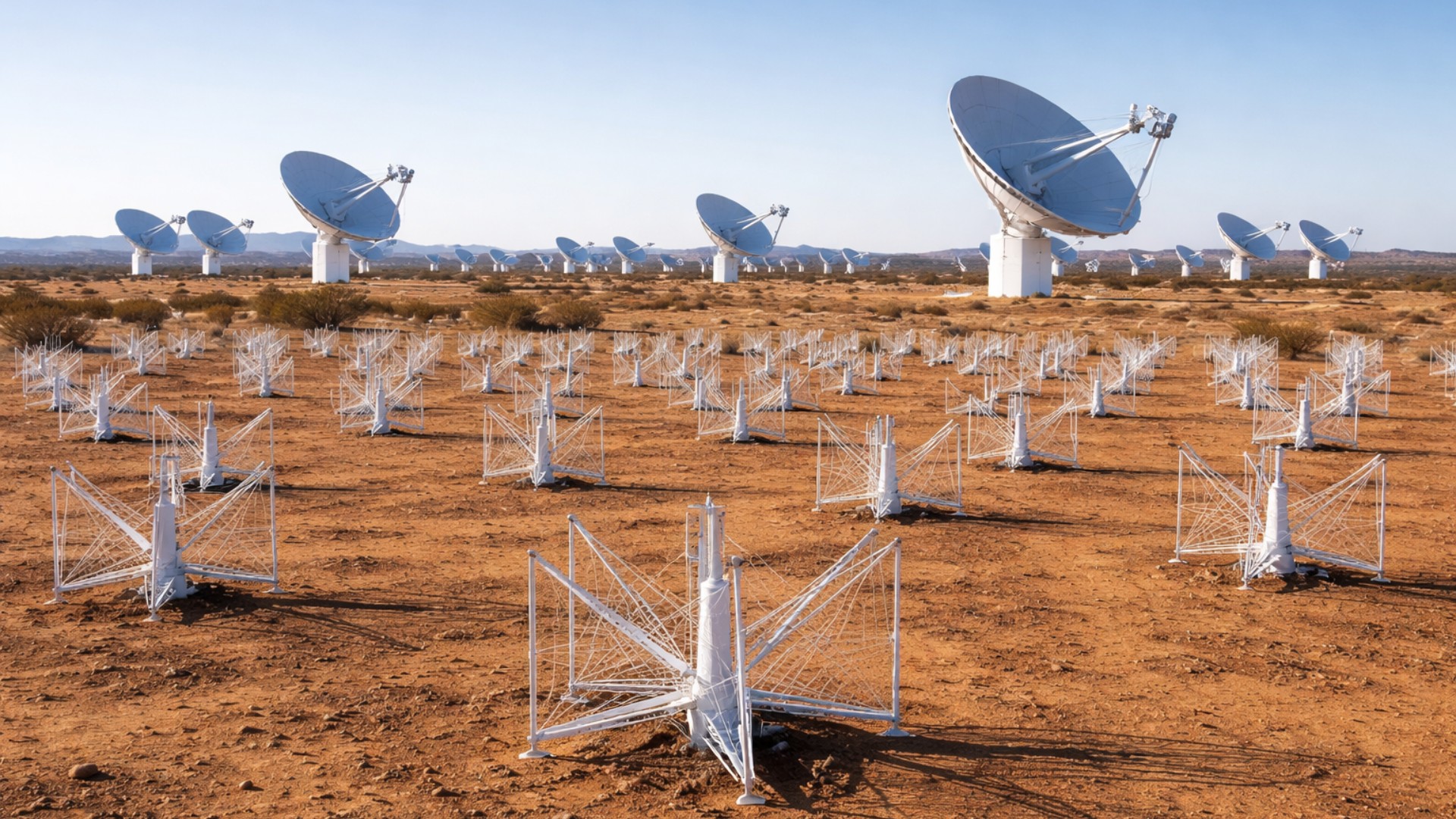
Global infrastructure, advanced technology, and unprecedented observation mark a new phase of the world’s largest radio telescope, expanding the capacity to detect extremely weak cosmic signals and investigate from black holes to the first galaxies formed in the Universe.
The SKA, short for Square Kilometre Array Observatory, has begun to transition from a megaproject to an operational instrument.
The observatory, distributed between Australia and South Africa, has already reached technical milestones that demonstrate the transition from the construction phase to the observation phase.
Among these advancements are the release of the first image from the Australian arm and the recording of the so-called first fringes in the South African array.
-
Researchers in the U.S. have created a flying robot that transforms into a land vehicle while still in the air. The technology, based on aerodynamic transition, converts landing into a scene worthy of Transformers and redefines mobility between sky and ground.

-
Goodbye batteries: a new sensor created by Japanese scientists uses sweat as an energy source and points to a promising path for more sustainable devices, with greater autonomy and less need for frequent recharging.

-
The Brazilian Army inaugurated the assembly line for the Guaicurus armored vehicle with a contract for 420 units by 2033, and the same vehicle has already been tested in combat in Afghanistan and Lebanon by European armies.

-
Xiaomi launched a 10-kilogram washing machine for less than R$910.00, so slim that it fits inside a kitchen cabinet with only 15 millimeters of clearance, featuring 24 washing programs and voice control.


This moment occurs when two or more antennas begin to work together as a single observation system.
Structure of the SKA: two continents and thousands of antennas
According to the SKA Observatory itself, the structure consists of two complementary telescopes.
The SKA-Low is being installed in a remote area of Western Australia, in the traditional territory of the Wajarri Yamaji people.
The system will have 131,072 metallic antennas about 2 meters tall. Meanwhile, the SKA-Mid is under construction in the Karoo region of South Africa.
It will gather 197 steerable parabolic antennas, including the MeerKAT radio telescope. These structures will be distributed over a maximum distance of 150 kilometers.
How interferometry works in the SKA
The logic of the project deviates from the classic image of a telescope concentrated in a single gigantic piece. Instead, the SKA uses the principle of interferometry.
In this model, signals captured by antennas spread over large distances are combined through fiber optic networks and high-performance processing systems.
According to the observatory, this arrangement allows the arrays to function as if they were a single instrument.
In practice, the equivalent dimension corresponds to the separation between its most distant elements.
Moreover, the chosen regions offer radio silence in the southern hemisphere, an essential factor for sensitive observations.
First image of SKA-Low reveals potential of the system
On the Australian side, the most visible advancement occurred when the SKA-Low produced its first image from an initial version of the system.
The result was obtained with 1,024 antennas distributed across four stations, representing less than 1% of the planned configuration.
Even at this preliminary scale, the image covered an area of the sky of about 25 square degrees, equivalent to approximately 100 full moons.
The record revealed about 85 bright galaxies, all with supermassive black holes at their centers.
Integrated system marks operational advancement
The same Australian front also reached a construction milestone. The first set of four stations completed the verification stage and began to be treated as an operational arrangement.
The initial configuration already integrates antenna stations, synchronization and timing, correlator, beamformer, data network, and computing infrastructure.
These systems operate at the Pawsey Supercomputing Research Centre.
In practice, this indicates that the observatory has moved from testing isolated components to validating the complete operation.
This advancement is considered crucial for transforming the planned scale into effective scientific capacity.
First fringes in South Africa confirm joint operation
In South Africa, the most symbolic step was taken with the milestone called first fringes. In January 2026, two 15-meter antennas from the SKA-Mid observed a radio galaxy together.
The object is about 2.6 billion light-years away. This result demonstrated for the first time that the array can operate as an interferometer.
The observatory described the moment as the first real test of the integration between the telescope’s systems. Prior to this, the assembly of the first SKA-Mid antenna at the site had already been announced.
What the SKA aims to investigate in the Universe
The interest surrounding the SKA goes far beyond its physical size.
In the low-frequency arm, the SKA-Low was designed to explore the first billion years after the so-called dark ages of the Universe.
The goal includes tracking the birth and death of the first stars and galaxies.
In the medium-frequency arm, the SKA-Mid was designed for various studies.
Among them are monitoring pulsars, tracking gravitational waves, observing fast radio bursts, and analyzing the distribution of gas in galaxies.
Detection of complex organic molecules is also planned.
On another front, the system is expected to open new windows to investigate extreme environments around black holes.
Additionally, there is an expectation to search for signatures of life in other regions of the galaxy.
SKA scale expands the number of detectable galaxies
The numbers released by the SKAO help to quantify the expected leap. The first image from SKA-Low was produced with antennas spread over less than 6 kilometers.
Yet, it already demonstrated performance above what was projected for this initial stage.
According to the observatory, the same area of the sky could reveal more than 600,000 galaxies when the instrument is complete.
This data reinforces that the scale of the project is not just for impressing.
It enhances sensitivity, resolution, and data volume to levels that conventional telescopes cannot reach.
Technology and computing drive a new generation of telescopes
It also weighs the fact that the project combines ground infrastructure, international industrial production, and cutting-edge computing.
The SKAO describes its telescopes as next-generation instruments. They will utilize some of the fastest processing technologies in the world.
The goal is to study galaxies, fundamental physics, and extreme phenomena of the cosmos. In the case of SKA-Mid, the 197 antennas can operate together or in sub-arrays.
The SKA-Low, on the other hand, can grow modularly, expanding through stations.
This combination of gigantism, modularity, and progressive capacity gain sustains global interest in the project. The most curious image of this observatory may be precisely the least intuitive.
Instead of a single “eye” pointed at the sky, the SKA presents itself as a network spread across remote landscapes.
The tree-like metal antennas in Australia and the parabolic dishes in southern Africa work together. The goal is to capture signals that have traveled for billions of years.
When further advanced, the observatory promises to observe more deeply from the most distant galaxies to processes related to black holes, gravitational waves, and the formation of the first structures in the Universe.







Seja o primeiro a reagir!