





 Portuguese
  English
  Spanish
  3 min of reading
  0 comments


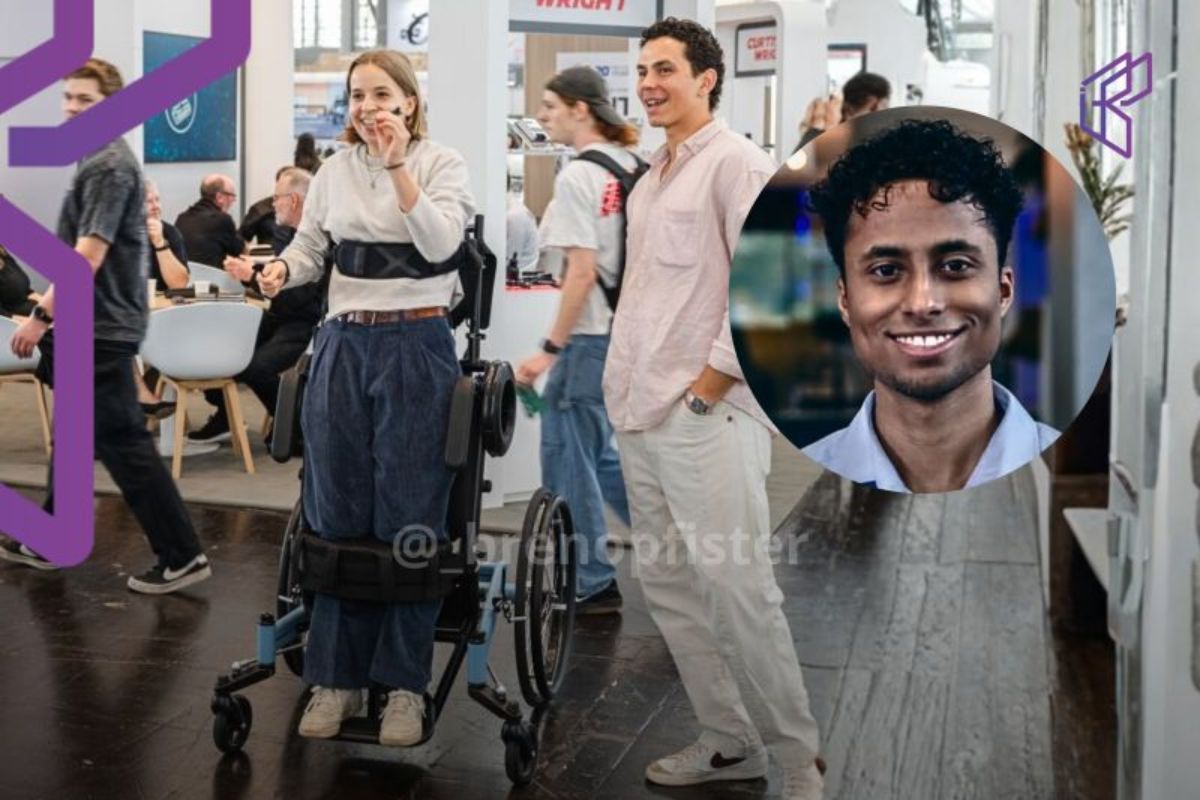
International Startup Launches Mechanical Wheelchair That Allows Users to Stand and Move Without Batteries, Offering a New Form of Inclusion and Autonomy
Access to cutting-edge mobility technologies is still limited for most people with disabilities, especially in emerging countries. The mechanical wheelchair created by the startup J58, co-founded by Brazilian Gabriel, represents a milestone in this scenario. The model, named Ezer, is the first in the world capable of allowing users to stand and move in that position without the use of batteries or electronic systems.
As Breno Pfister explains, the proposal is simple and disruptive: use pure mechanics to restore independence and dignity. With a gas spring system calibrated according to each person’s weight, the wheelchair offers smooth transitions between sitting and standing positions, without electric effort and without the need for recharging, which reduces costs and expands accessibility globally.
Mechanical Engineering Applied to Inclusion
The functioning of the wheelchair is based on principles of balance and leverage, with personalized adjustments that ensure comfort and stability throughout the movement.
-
While restoring a historic mansion from 1910, a brick structure with an old turbine that generated energy from the Rio do Testo emerged, along with a hidden door and a rare floor concealed under layers of wax.

-
Italian researchers have detected what appears to be a second Sphinx buried under the sands of Egypt, and satellite scans reveal a gigantic underground megastructure hidden beneath the Giza Plateau for over 3,000 years.

-
There are 4,223 drums and 1,343 metal boxes concreted with 50-centimeter walls that store the radioactive waste from Cesium-137 in the worst radiological accident in Brazil, just 23 kilometers from Goiânia, with environmental monitoring every three months.

-
Giant Roman treasure found at the bottom of Lake Neuchâtel in Switzerland reveals an advanced trade system, circulation of goods, and armed escort in the Roman Empire about two thousand years ago.


By eliminating the use of batteries, motors, and electronic components, the design of the Ezer reduces technical failures, maintenance costs, and total weight, making it suitable for diverse environments, from corporate spaces to outdoor areas.
Another highlight is the patented safety system, which expands the wheelchair’s base during the transition of position.
This structure prevents tipping and maintains a stable center of gravity, allowing users to participate in activities standing, such as meetings, presentations, events, or simple social interactions safely and naturally.
Physical and Social Benefits Beyond Mobility
The innovation of the mechanical wheelchair is not just in movement but also in its physiological and emotional impact.
Standing regularly improves blood circulation, reduces the risk of pressure ulcers, helps strengthen muscles, and contributes to better posture.
From a social perspective, the equipment breaks the logic of immobility and dependence, allowing people with disabilities to participate in activities at levels similar to those of people without motor restrictions.
The startup argues that the ability to switch between sitting and standing positions reinforces the sense of presence, autonomy, and self-esteem of its users.
Expansion and Technological Adaptation
J58 plans to expand the global production of the Ezer and is already exploring partnerships with universities and rehabilitation centers.
The modular design of the wheelchair allows for the integration of motorized components for longer distances, as well as adaptable accessories for different body types and age groups.
Focusing on financial accessibility, the company is developing a scaled manufacturing model and seeking government and private incentives to make the product available in countries with lower purchasing power.
The goal is to democratize access to high-performance assistive technologies without electrical dependency, maintaining the central proposal: freedom of movement and real inclusion.
A Symbol of Autonomy and Human Innovation
More than a tool for mobility, J58’s mechanical wheelchair represents a new paradigm in the relationship between technology and inclusion.
Its concept reaffirms that engineering and empathy can work together to solve historical accessibility challenges.
The project is already attracting interest at international innovation fairs and in inclusive design communities, consolidating Brazil as an active part of the development of global social impact solutions.
The creation of the mechanical wheelchair that allows standing redefines the meaning of mobility and independence.
Do you believe that mechanical innovations like this can replace more expensive and complex electronic technologies? Share your opinion in the comments – we want to hear from those who live, study, or closely follow the challenges of accessibility and inclusion.









-

-

-

-

11 pessoas reagiram a isso.