





 Portuguese
  English
  Spanish
  3 min of reading
  12 comments


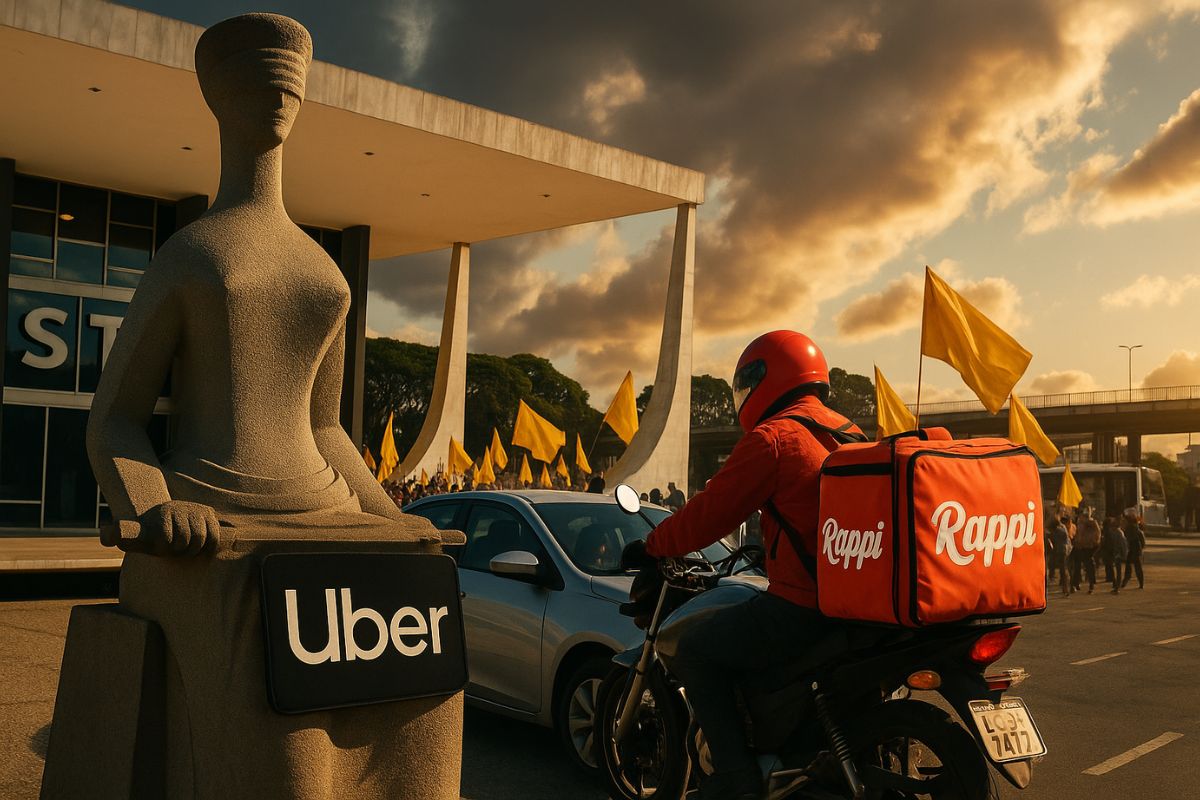


Supreme Court Begins to Analyze Employment Relationship in Uber and Rappi Lawsuits, Decision Will Have Implications for Thousands of Cases and May Redefine the Future of Platforms, According to O Globo
The Supreme Federal Court (STF) started a historic trial on Wednesday that could profoundly change labor relations in Brazil. The Court will decide whether app drivers and deliverers should be recognized as formal employees of digital platforms.
The case, which directly involves giants like Uber and Rappi, is being closely monitored because it affects more than ten thousand cases that are already on hold in lower courts. The decision could redefine not only the labor rights of these professionals but also the business model of technology companies in the country.
What Is at Stake in the STF
The actions under review were presented by the companies themselves, which challenge labor court decisions in favor of employment relationships.
-
The Senate approves a bill that criminalizes misogyny, hatred, or aversion towards women, and includes the crime in the Racism Law with a penalty of up to 5 years.

-
Chamber Approves Bill That Allows Pepper Spray for Women Over 16 and Imposes Strict Rules for Purchase, Possession, and Use as Self-Defense

-
Chamber Approves Law to Combat Leucaena, Fast-Growing Plant That Dominates Land and Threatens Native Species in Various Regions of the Country

-
Asset Division: Know What Cannot Be Divided in Case of Divorce


For Uber, it is a technology company, not a transportation one, and recognizing a formal relationship would compromise free initiative.
Rappi, in turn, argues that previous decisions violate understandings already established by the Supreme Court.
On the other side, workers’ organizations argue that there is subordination, regularity, and fixed remuneration, points that, according to the CLT, characterize an employment relationship.
The argument is that, in practice, these professionals do not have full autonomy, being subject to the rules and algorithms of the platforms.
The Role of the Attorney General’s Office
Just before the trial, the Attorney General’s Office (PGR) presented an opinion against recognizing the employment relationship.
The Attorney General Paulo Gonet cited precedents from the STF that validate alternative forms of contracting, reinforcing that the Constitution does not require that every employment relationship be governed by the CLT.
This positioning strengthens the companies’ arguments but does not end the discussion.
The final decision of the ministers could establish a thesis of general repercussion, creating mandatory parameters for all judicial instances in similar cases.
Impacts on Companies and Workers
If the STF recognizes the relationship, companies like Uber and Rappi will have to bear labor charges, vacations, FGTS, and 13th salary, which may increase costs and alter the dynamics of the sector.
Experts assess that, in this scenario, part of the impact may be passed on to consumers, with increased prices for rides and deliveries.
For workers, the decision could mean greater social protection and stability, but also risks reducing flexibility and even decreasing job availability.
The current model of “autonomy” allows many to choose when and how to work, even without minimum guaranteed remuneration.
A Judgment of General Repercussion
The trial also marks Edson Fachin’s debut as President of the Court.
Still this week, the ministers are expected to hear oral arguments from the parties involved and begin drafting votes.
The expectation is that the process will be closely monitored by the private sector, unions, and labor law experts.
According to O Globo, the decision could set a benchmark for the future of the entire digital economy in Brazil, serving as a reference for other categories that operate under similar models.
This is a debate that goes beyond the companies mentioned and touches on the very definition of what work is in the era of platforms.
The STF’s judgment could redefine the lives of millions of app drivers and deliverers, in addition to transforming the business model of companies that have become part of urban daily life.
The decision promises to divide opinions between social protection and preservation of flexibility.
And you, do you believe that the STF should recognize the employment relationship or maintain the current model of autonomy? How would this decision impact your routine? Leave your opinion in the comments — we want to hear from those who live this in practice.










Brasileiro gosta de estragar tudo que é bom, fala sério.
O Uber nunca foi criado para ser comparado a um trabalho formal com vínculo CLT. A proposta inicial sempre foi oferecer uma renda extra, com flexibilidade, sem os mesmos custos e obrigações de uma contratação tradicional. No Brasil, muitos motoristas acabaram transformando o aplicativo em sua principal fonte de renda, o que é uma escolha legítima, mas diferente da proposta original.
É importante lembrar que, se o Uber for obrigado a se enquadrar nos moldes da CLT, a empresa inevitavelmente terá de repassar os custos para os passageiros. Isso pode tornar as corridas mais caras, reduzir a demanda e, em última instância, até levar a empresa a deixar o país. Nesse cenário, quem mais sai prejudicado são justamente os motoristas que hoje dependem do aplicativo e que pedem esse vínculo trabalhista, já que poderiam perder a própria fonte de renda.
Só precisamos ter nossos direitos reconhecidos, e mais nada! Ninguém se propõe a ir fazer entregas no nosso lugar, mas se a gente não for, as plataformas é que saem perdendo! Então temos que ter os direitos reconhecidos! As plataformas ganham bilhões por ano graças aos entregadores, que ganham uma mixaria e trabalham exaustivamente, sendo que nem os pontos de apoio que tanto prometeram, nem sequer existem!
Vai trabalhar fichado então passa fome,tá assim pq vc que,afinal não tá contente e só não ligar o aplicativo.
Eu, como motorista um pouco mais de 6 anos, em São Paulo, prefiro o modelo atual, porém, resolvo que devemos ter mais autonomia, melhores ganhos, recebemos solicitações de corridas que chega a ser piada. Tanto eu, como milhares não queremos CLT, mas alguns ajustes precisam ser feitos.