





 Portuguese
  English
  Spanish
  4 min of reading
  79 comments





Historic Ruling In The Supreme Court May Force The INSS To Refund Amounts Paid By Those Who Retired Before The Real Plan, Opening The Way For Benefit Revisions And Billion-Dollar Reimbursement
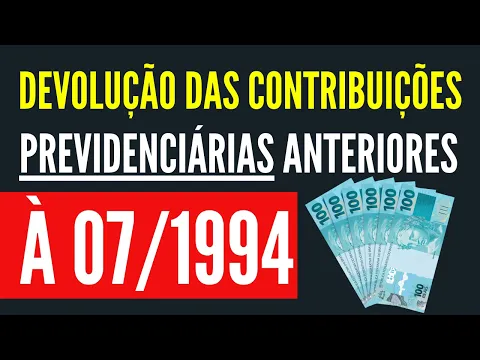
The Supreme Federal Court’s decision on the refund of contributions from retirees prior to July 1994 reignites a legal and social debate with significant impact for thousands of INSS policyholders. The ruling may recognize the right to a refund of amounts paid to the social security system that were not considered in the calculation of benefits.
According to the expert Professor Carlos Mendes, the STF’s analysis may represent a milestone in correcting historical distortions caused by the transition to the Real Plan. The focus is on those who retired before July 1994 and saw their previous contributions simply disregarded by the transition rule imposed after the pension reform.
What Is At Stake In The Refund Of Contributions
For decades, retirees who contributed high amounts before 1994 faced a rule that excluded those contributions from the retirement calculation.
-
The Senate approves a bill that criminalizes misogyny, hatred, or aversion towards women, and includes the crime in the Racism Law with a penalty of up to 5 years.

-
Chamber Approves Bill That Allows Pepper Spray for Women Over 16 and Imposes Strict Rules for Purchase, Possession, and Use as Self-Defense

-
Chamber Approves Law to Combat Leucaena, Fast-Growing Plant That Dominates Land and Threatens Native Species in Various Regions of the Country

-
Asset Division: Know What Cannot Be Divided in Case of Divorce

The logic was to protect the system from distortions caused by hyperinflation, but in practice, thousands of policyholders were harmed by having paid more and received less.
The current discussion revolves around the so-called full life review, a thesis that advocates the use of all contributions made throughout life, and not just those made after July 1994.
But the new chapter now is different: the possibility of effective refund of paid and ignored amounts, as argued by lawyers and organizations advocating for retirees.
Why The STF May Change The Understanding
The Supreme has already analyzed the constitutionality of the full life review, but now the issue of reparation for the effects of excluding contributions prior to 1994 comes into play.
For Professor Carlos Mendes, the Court’s recent jurisprudence favors a broader interpretation of pension rights, especially in light of violations of the principle of equality.
The possible decision of the STF could open a precedent for retirees to request a refund of the amounts deducted and not used in the final benefit calculation, something that until now was considered irreversible.
This would cause direct impact on the INSS accounts, but it would also correct what experts consider a structural injustice.
Who Has The Right To Refund And What Can Change
The refund of contributions, if approved, would benefit retirees who meet three main criteria: having retired before July 1994, having significant prior contributions, and not having those contributions utilized in the benefit calculation.
For these policyholders, the amount to be refunded could be substantial.
Carlos Mendes highlights that the refund would not apply to all retirees, but rather to those who prove real losses caused by the transition rule.
“It is not an automatic review, but rather an individual right that will need to be litigated in many cases,” says the professor.
Impacts For The INSS, Government And New Retirees
The recognition of the right to a refund could generate a billion-dollar liability for Social Security, according to preliminary estimates from lawyers and associations of retirees.
The Union, in turn, argues that the measure could jeopardize the financial balance of the general regime, but no official data has been released by the government so far.
From a political standpoint, the STF’s decision rekindles the pressure on the National Congress to discuss a more transparent and fair pension reform.
For new retirees, the case serves as a warning about the importance of a complete contribution history and the need for more stable rules for benefit calculations.
What Do The Defenders Of Retirees Say

Representative entities point out that policyholders were forced to contribute without receiving fair returns, which constitutes illegal enrichment of the State.
For Professor Carlos Mendes, the refund of contributions would be a way to restore confidence in Social Security and recognize the effort of those who paid for decades and were ignored in the calculation.
Despite this, there is no consensus in the STF, and the decision may include limitations, such as deadlines for requests or criteria for documentary proof.
The trial is being closely monitored by social security lawyers and is likely to generate a new wave of lawsuits if the Court validates the refund.
Do you know someone who contributed before 1994 and was harmed in retirement? Do you think the refund of contributions would be a fair or dangerous measure for public finances? Share your opinion in the comments — we want to hear from those who experience this in practice.









Eu me aposentei em 2013 e meu cálculo para aposentadoria só contou a partir de 1994 sendo que comecei a contribuir para previdência a partir de 1975, então contribui 19 anos em vão, ou seja apenas fui mais um trabalhador que por 19 anos fiz uma contribuição mensal descontada do meu salário para os cofres da previdência.E uma injustiça se tivesse guardado esse dinheiro na poupança hoje teria uma boa reserva financeira. A REVISÃO DA VIDA TODA NEGADA FOI A MAIOR PROVA QUE O INSS ficou indevidamente com o dinheiro de vários contribuintes, é como fazer uma aplicação financeira em um banco e não receber juros nem o capital aplicado.Maior injustiça da própria justiça
Se considerar as contribuições de 1971 a 1988 claro que teríamos uma aposentadoria mais justa, por exemplo contribuímos para INSS e tivemos no período de nove a dez salários por mês tivemos descontos para o INSS
Então seria justo calcular o nossos maiores salários, não é verdade???
Mesmo que tendo aposentadoria no ano 2017.
Esse assalto as contribuições previdenciárias de 1994 para trás,feitas pelo governo FHC e congresso,e o STF TBM diz bem o que a elite brasileira faz com a população de um modo geral, qualquer leigo sabe que desconto previdenciário têm que ter a contra partida na mesma proporção.o congresso não é para o bem do povo,o governo se esconde na mesma coisa e o STF e igualmente desonesto, quando fica julgando um roubo tão claro, recorrendo, recorrendo infinitamente,os membros desses poderes são todos desonesto, e pensa que enganam a população.resumindo acabou a paciência,todos ****, todos canalhas, não estamos pedindo nenhum favor ou que nós beneficie, só o que é nosso por direito adquirido com trabalho digno.