Portuguese
  Spanish


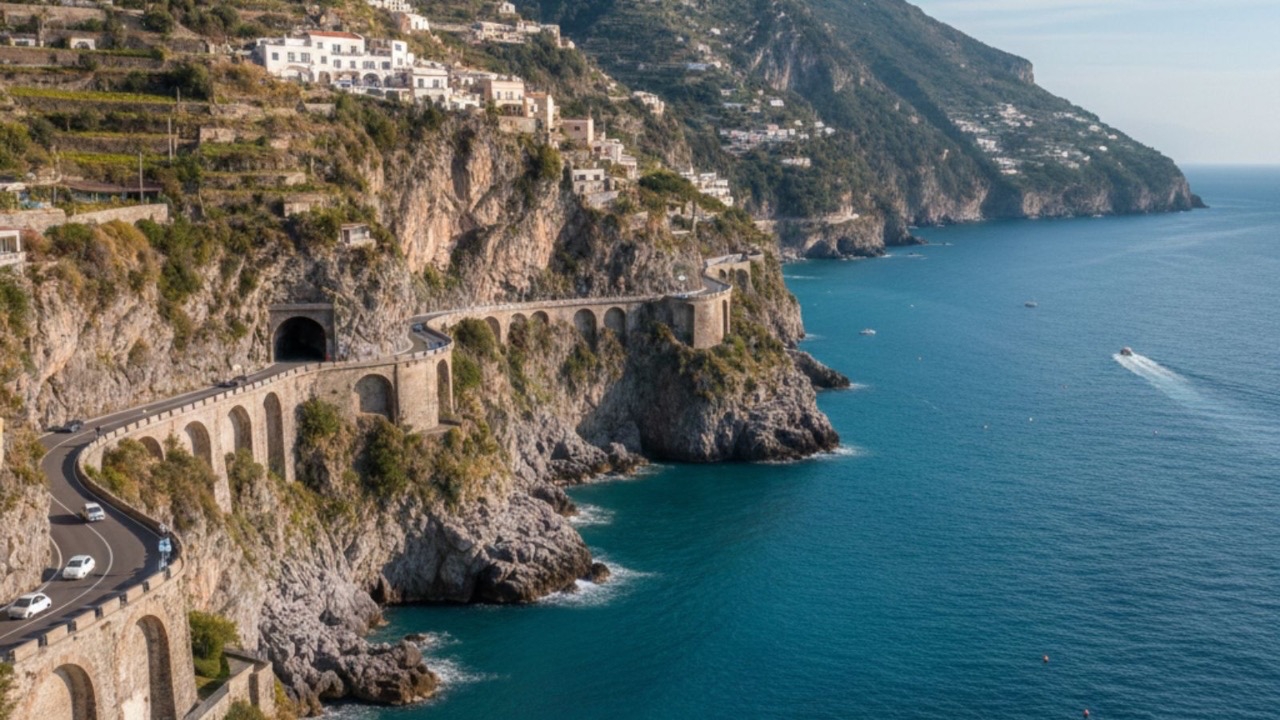

Built in the 19th Century, the Italian Road Combines Extreme Engineering, Dramatic Landscape, and Heavy Traffic That Transforms Each Journey Into a Memorable Experience
Strada Statale 163 is a coastal road in Italy built between 1832 and 1850, carved directly into the cliffs of the Amalfi Coast in the south of the country, to connect isolated towns, facilitate overland transport, and boost the local economy, but it has become one of the most scenic and challenging routes in the world, attracting tourists who face narrow turns, constant heights, and heavy traffic in exchange for unique views of the Tyrrhenian Sea.
With a length of about 50 kilometers, the road connects Meta di Sorrento to Vietri sul Mare, passing through historic villages like Positano, Amalfi, Minori, and Praiano. The route closely follows the natural shape of the coast, without major straightening, which explains the winding layout and the constant feeling of proximity to the abyss.
A Road Carved in Rock That Challenges Geography and Engineering to This Day
A large part of the Strada Statale 163 was literally sculpted into the limestone rock of the hillside. At various points, the road is about 100 meters above sea level, creating natural viewpoints that open directly onto the Italian coast.
-
China Constructs 5.1 km Undersea Highway in Dalian Bay, Reducing Travel Time from 1 Hour to 5 Minutes

-
Massive Transporters Otto and Lore Move ALMA Radio Telescope in Chile’s Atacama Desert
-
Singapore Turns Incinerated Waste Ash into Construction “Sand” in Ambitious Project to Revolutionize Megacity Waste Management
-
Brazilian Entrepreneur Turns Passion for Amazonian Cocoa into a Million-Real Chocolate Business After Studying in France



The average width of the road varies between 6 and 7 meters, but there are even narrower stretches, just enough for the careful passage of two small vehicles. Tourist buses often need to drastically reduce their speed or wait in specific areas to allow for safe crossings.
Tight Turns, Heavy Traffic, and Little Protection Increase the Sense of Risk
The Strada Statale 163 maintains practically the same route as in the 19th century. There have been no significant widenings or large escape areas, as the rocky terrain and environmental preservation prevent deep structural changes.
In several stretches, the guardrail is low or nonexistent. In other areas, the separation between the asphalt and the cliff is minimal. This combination turns any distraction into a real risk, especially during the European summer when thousands of tourists vie for space with local residents.
The speed limit varies between 30 and 50 km per hour, well below the Italian standard, as a way to reduce accidents. Even so, traffic jams are common, especially between May and September, the peak tourist season. The information comes from the Citta di Amalfi portal of the Italian government.
World Heritage and Essential Route for Historic Coastal Cities
The Amalfi Coast has been recognized as a UNESCO World Heritage Site since 1997. The title was granted by UNESCO due to the rare integration of natural landscape, historical architecture, and continuous human use of the territory.
The Strada Statale 163 is the centerpiece of this landscape. In addition to serving tourism, it ensures supplies, the movement of residents, and access to basic services. Without this road, many towns would again depend solely on maritime transport.
Along the route, visitors observe centuries-old agricultural terraces, lemon groves, historic churches, and colorful houses embedded in the hillside, creating a scenery that seems to unfold little by little with each turn.
Why Is Strada Statale 163 Considered One of the Most Scenic Roads in the World
The experience of traversing the Strada Statale 163 goes beyond the landscape. The constant sound of the sea below, the proximity of the cliffs (steep or vertical walls along the coast), and the alternation between tunnels carved into the rock and fully open stretches create a continuous visual narrative.
Anyone crossing its 50 kilometers does not just find a path, but a sequence of challenges, stories, and views that explain why this road remains, nearly two centuries later, as impressive as on the day it was inaugurated.