





 Portuguese
  English
  Spanish
  4 min of reading
  0 comments


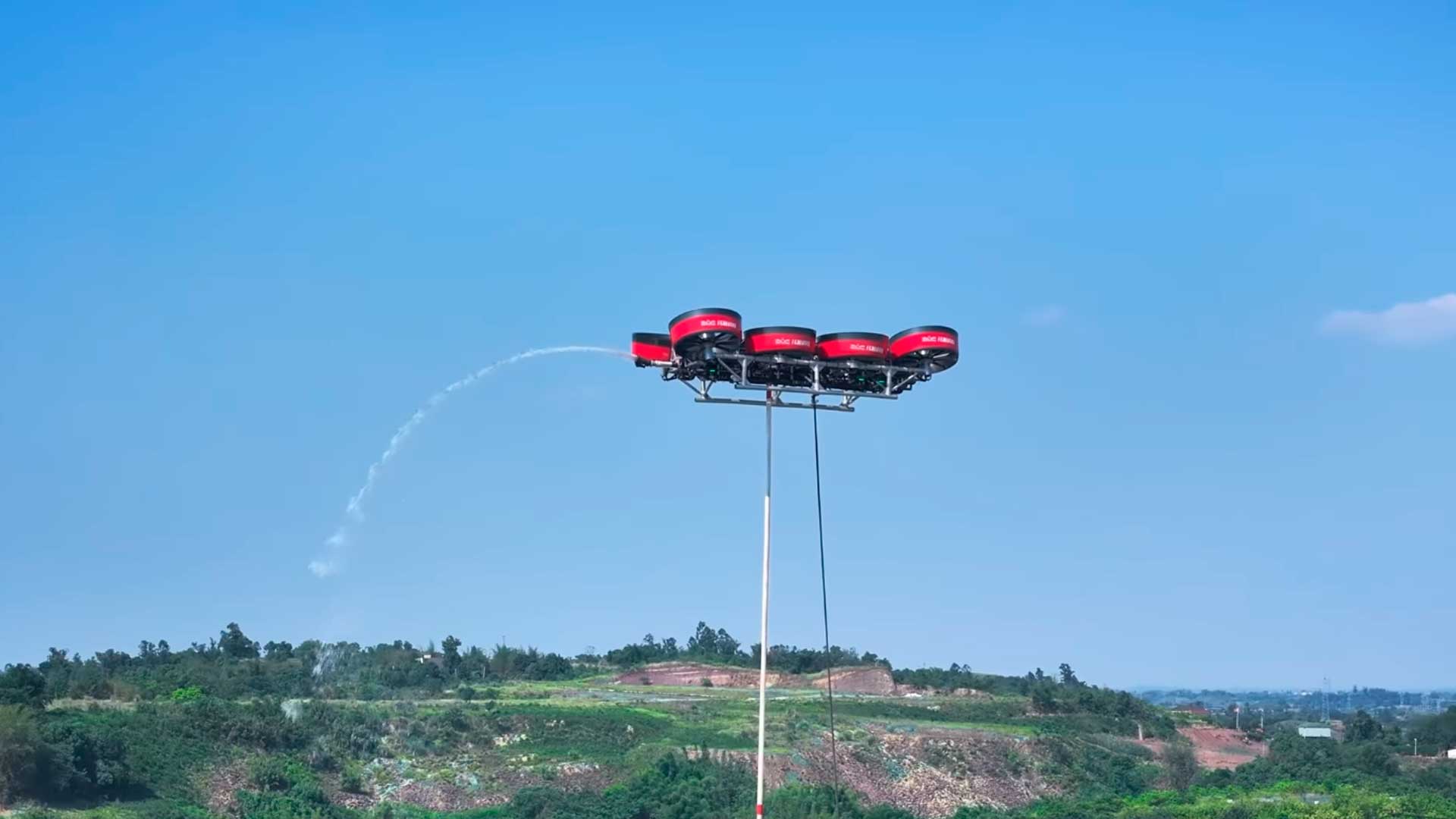
A Coupled Truck System Rises In About 1 Minute To 100 M And Launches Water Or Foam More Than 45 M, Proposal Aims Where Ladders Fail And Divides Firefighters
A new firefighting system for tall buildings is attracting attention by promising to deliver water jets to where many ladder trucks cannot reach. According to a statement from CIMC, the solution integrates a fire truck and a large cable drone capable of rising to 100 meters in about one minute and operating for hours in continuous operation.
The proposal is straightforward; if the fire in a skyscraper occurs above the reach of most aerial ladders, why not bring the water to the height using a specialized UAV, more stable and with a directed jet.
The idea emerges as a response to a known pain point in high-rise fire operations. Technical reports indicate that when a fire occurs on floors beyond the reach of aerial equipment, access tends to be limited to internal stairs, restricted-use elevators, and fixed systems like standpipes and sprinklers, which makes everything more complex and time-consuming.
-
He started running at 66 years old, broke records at 82, and is now a subject of study for having a metabolic age comparable to that of a 20-year-old, in a case that is intriguing scientists and inspiring the world.

-
Oldest tree on the planet reappears after 130 years of searches: Wattieza, 385 million years old, was 10 meters tall and had no leaves or seeds; Gilboa fossils in New York solved the mystery in 2007.

-
A 48-square-meter house assembled in hours with 4,000 bricks made of recycled plastic that does not absorb moisture, has natural thermal insulation, and costs less than 90,000 reais in a complete kit.

-
Luciano Hang revealed that Havan’s air fleet has already accumulated more than 20,000 landings, 10,000 flight hours, and 6 million kilometers traveled, and he says that without the planes, the company would never have grown so quickly.

Still, “replacing the fire truck” is a tall order. Technology may fill a real gap in reach, but experts remind us that operations at height involve evacuation, ventilation, available water, coordination, and risks around the building—points that a drone alone cannot resolve.
Why Fires In Tall Buildings Have Become A Reach And Time Problem
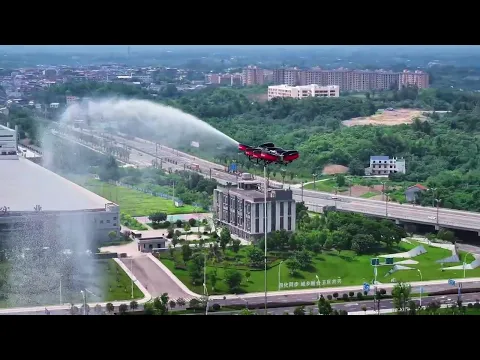

In tall buildings, external firefighting often loses efficiency quickly. A report from the NFPA Foundation notes that few cities have modern equipment with 100 m ladders and therefore concludes that it is not possible to fight fire from the facade from the outside when the building exceeds about 30 m.
In practice, the limit appears in real situations. In a fire at a 28-story residential building in Hsinchu, Taiwan, public debate erupted precisely because local trucks could only reach about 52 m, equivalent to 15 floors, leaving part of the building out of reach and necessitating alternatives.
How The Firetruck Drone System Works In Skyscrapers
The system described by CIMC combines a compact truck and a large drone with multiple ducts, designed for stability and to withstand the force of the jet. The company claims that the set has a total length of less than 10 m and a width of less than 2.5 m, to navigate through narrower urban areas and begin operations quickly upon arrival.
The difference lies in the cable operation mode. The statement describes a cable-powered drone that can operate for more than 6 hours on a mission, withstanding winds of level 6 while carrying an effective load indicated in the range of 250 to 400 kg, something beyond the standard for common inspection or reconnaissance drones.
In terms of suppression, CIMC states that the drone can apply water, foam, and other agents, with an effective spraying distance above 45 m. The text also cites a sustained flow rate of 20 to 30 liters per second, a figure closer to heavy equipment than to lightweight drones.
The circulating video on YouTube details the operating pressure of the jet in the range of 0.3 to 0.6 MPa, reinforcing the intention to act as a kind of “aerial hydrant” for scenarios where ladders cannot reach.
The proposal, according to CIMC itself, is not merely to film from above or deliver small extinguishers. The company presents the solution as an attempt to position the drone as the primary firefighting force, in a model of integrated operation between ground and air.
What Technology Solves And What It Still Does Not Replace In Firefighters’ Work
The clearest gain is reach with speed. An operational report on fires in tall buildings emphasizes that when the floor is beyond the reach of aerial equipment, access tends to be limited to internal stairs, resulting in longer times to reach the source and to move hoses, teams, and equipment.
Another point is combating fires on facades and in external areas that are difficult to access. The same report from the NFPA Foundation points out that above certain heights, there is greater reliance on internal resources and strategies such as phased evacuation, which helps explain why a dedicated aerial platform is of such interest.
However, talking about total replacement is more controversial. The London Fire Brigade, for example, notes that airborne devices are seldom used to combat fires in residential high-rise buildings, because the response heavily relies on internal measures and because external jets require caution to avoid endangering lives.
Moreover, fires in skyscrapers require more than just “throwing water.” Evacuation coordination, communication, smoke control, and reliability of sprinklers and standpipes remain critical to prevent an incident from turning into a disaster, as highlighted in the operational report.
Safety And Regulation
CIMC states that the system was presented after TV coverage in China and that the technology is expected to migrate from development to production and sales, with expectations of going into frontline use as early as 2025.
The decisive test, however, tends to be the real world. Flying close to flames, dense smoke, gusts, and thermal currents, along with operating cables, jets, and safety perimeters, requires specific protocols and training, and may vary greatly between cities and types of buildings.
Do you think this type of drone could become the new standard and reduce deaths in high-rise fires, or is it just another expensive piece of equipment that increases risk and complexity? Leave your opinion in the comments and let us know if you would trust this solution in a skyscraper.








-

Uma pessoa reagiu a isso.