





 Portuguese
  English
  Spanish
  3 min of reading
  0 comments


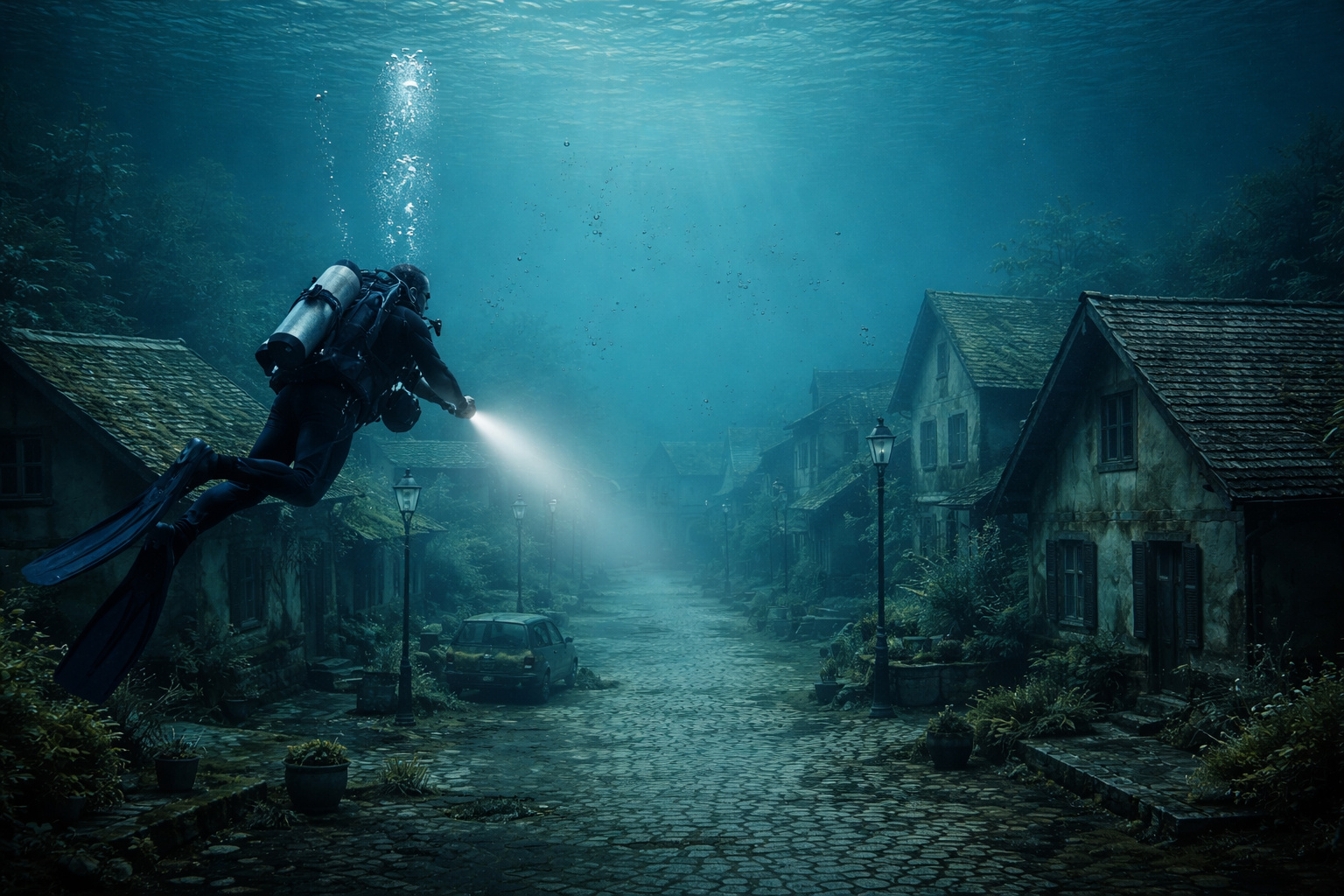
Divers explore complete structures, find objects of daily life, and reveal real stories of flooded cities since 1963 in South Minas Gerais
An impressive discovery draws attention in South Minas Gerais: entire cities remain preserved beneath the waters of Lake Furnas, revealing complete streets, structured houses, and even vehicles forgotten in time.
The portal g1 South Minas disclosed the information during a special expedition that traverses the largest freshwater reservoir in the Southeast, highlighting not only its economic importance but also the stories hidden beneath the surface.
The construction of the Furnas Dam in 1963 flooded ancient cities and rural areas. Since then, the lake has kept a submerged landscape that conserves impressive remnants of the past.
-
Yellowstone has started to rise again in an area of the caldera, and the movement rekindles fears surrounding the U.S. supervolcano, as scientists monitor the deformation and try to understand what is happening underground.
-
Woman arrested after receiving $1.2 million due to banking error and not returning the amount.

-
Beneath Mexico City lies an entire buried Aztec capital, and it all began when workers discovered a 3.25-meter stone disk featuring a dismembered goddess, revealing temples, skulls, and palaces beneath 22 million people.
-
How to build a 35,000-liter cistern with 60 by 50 cm panels and rainwater for drinking and cooking without relying on water trucks or the city hall.
Diver dedicates 10 years to map an entire city at the bottom of the lake

Diving instructor Roberto Obvioslo has been leading this work for about 10 years. He started in childhood when he accompanied his father during the construction of the dam and began to question what had been left behind.
As an adult and professional, he decided to investigate. Based on accounts from former residents, he began searches in the region of São José da Barra (MG).
Over time, he found:
- A corral still standing
- Isolated structures
- And, mainly, an entire preserved street
“We found a complete street. From there, we started to map everything,” he explains.
Additionally, the dives revealed wood stoves, original floors, and houses practically intact. In some cases, only part of the roof gave way, while the rest remains preserved.
Vehicles, intact bridge, and objects reveal a frozen past in time
As he advanced in the explorations, Roberto found even more surprising elements. Among the finds are:
- A sunken schooner
- A Kombi
- A bus
- Equipment lost over the years
In a search for a submerged car, he found something unexpected: a completely preserved bridge.
“We had been looking for this bridge for a long time. When we went after the car, we found it intact,” he reports.
Despite its historical value, the team does not remove the objects. They document everything with photography to preserve the heritage.
Still, they rescued some specific items, such as a chamber pot, as well as tiles, bricks, and wood, with the aim of creating a possible museum of the old city.
Dives reach 80 meters and require high technical level
Exploring these areas requires advanced preparation. The dives reach 80 meters deep, potentially reaching nearly 90 meters in certain situations.
“The shallowest dive here is around 40 meters,” explains Roberto.
Additionally, visibility changes drastically. The water remains clear in shallow areas, but from 15 meters, natural light disappears quickly, requiring flashlights.
Aquatic life also varies. Fish such as mandi, tilapia, peacock bass, and pike appear in higher regions but disappear in deeper areas.
Residents report chaos, losses, and reconstruction after flooding
The stories of those who lived through the flooding make everything even more impactful.
Retiree Abrão Alves Andrade, now 86 years old, remembers when he warned neighbors that the water was coming.
“I sent word, but no one believed,” he recounts.
Meanwhile, Father José Ronaldo Rocha, who was 12 years old at the time, witnessed the evacuation of families.
“People were being taken to higher places,” he reports.
Teams conducted rescues with boats, rafts, and even helicopters. Meanwhile, tractors were demolishing houses before the water advanced.
Additionally, entire crops of corn and rice were lost. Many residents improvised rafts to recover food before everything was flooded.
Lake transformed economy, but memory still remains alive
Despite the initial impact, the region has transformed over time.
Lake Furnas boosted tourism, modernized agriculture, and brought economic development. Today, the lands are more productive, and the region attracts visitors from all over Brazil.
On the other hand, those who lived through that period still hold strong memories.
What was once loss, chaos, and uncertainty now also represents reconstruction and adaptation.
And at the bottom of the lake, silently, these stories continue to be preserved.
Would you have the courage to explore an entire submerged city at dozens of meters deep?





Seja o primeiro a reagir!