





 Portuguese
  English
  Spanish
  5 min of reading
  0 comments


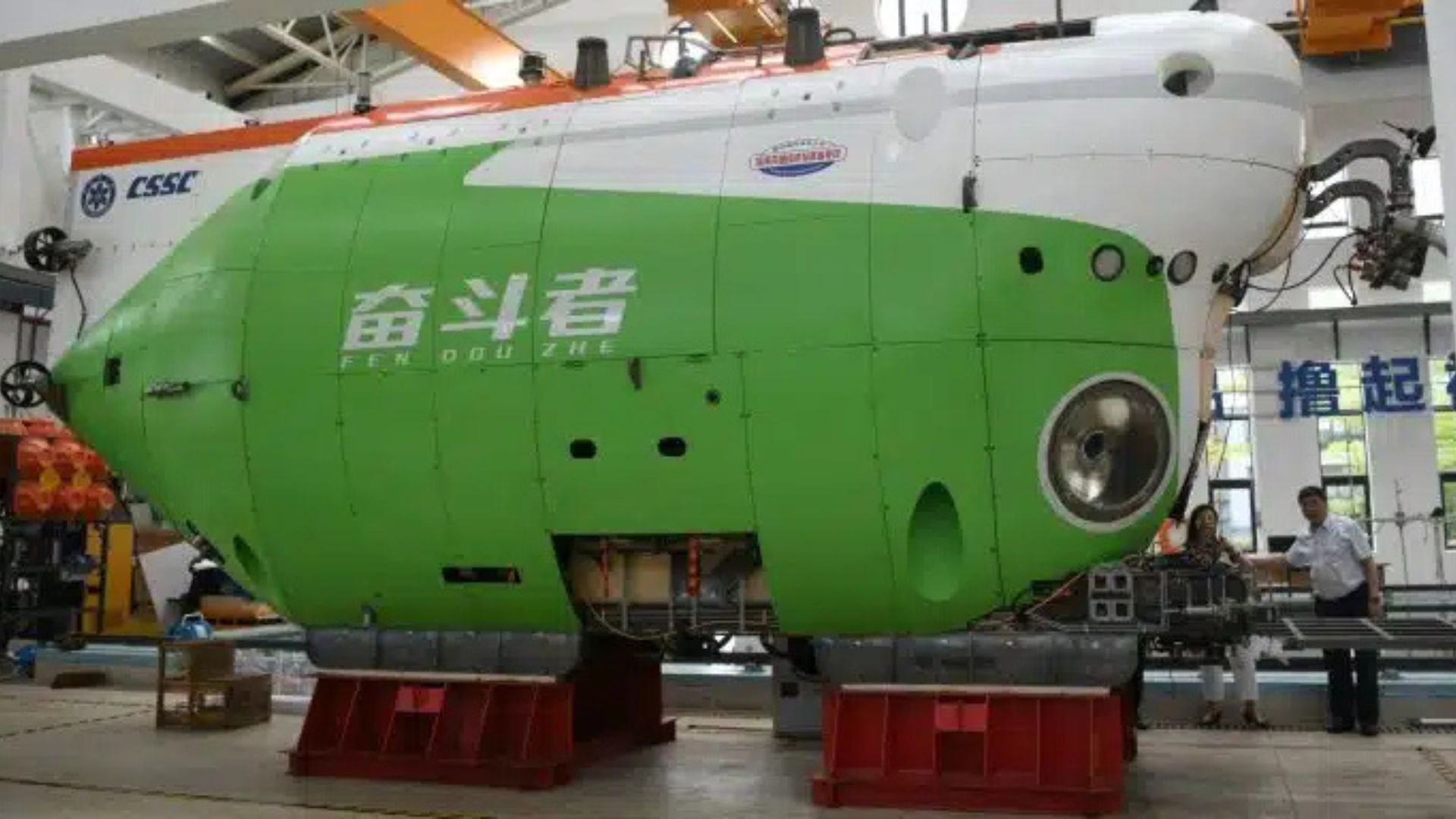
Deep-Sea Exploration Advances with Chinese Submersible Capable of Reaching the Challenger Deep in a Campaign of Dozens of Operations in the Pacific.
The Chinese manned submersible Fendouzhe, known in English as “Striver,” has consolidated China’s presence in the exclusive group of countries capable of taking people to the ocean’s deepest regions.
In tests and expeditions in the Pacific, the vessel reached the Challenger Deep in the Mariana Trench, at about 10,909 meters, and completed dozens of operations at sea, including a campaign that finished with 23 descents and took 27 scientists to areas where the pressure is extreme, according to statements and reports released by Chinese state institutions and media.
Challenger Deep and Hadal Zone: Why the Deep Sea is So Hostile
At approximately six thousand meters begins the so-called hadal zone, an environment marked by permanent darkness, very cold water, and hydrostatic pressure that increases with each meter of depth.
-
With a cost per shot close to zero, the DragonFire laser could change naval warfare in 2027 and provide British ships with nearly unlimited defense against drones.

-
A British startup creates tires that generate electricity in electric vehicles when passing over potholes, speed bumps, and cracks.

-
Scientists have created robots made with living cells that have their own nervous system, swim on their own, explore the environment, and self-organize without any genetic engineering, and now they want to do the same with human cells.

-
Students create a solar-powered ambulance that operates without a plug, without fuel, and still keeps medical equipment running in remote areas.


In this range, minimal sealing failures, inadequate materials, or exposed electrical systems can compromise the entire operation.
As a result, there are few manned submersibles with the real capability to operate at the “total depth” of the ocean.
Recent studies on the biodiversity of these trenches emphasize how the hadal environment imposes severe limits on human presence and scientific instrumentation.
In the case of the Challenger Deep, which is the known deepest point in the oceans, the pressure reaches levels close to one thousand atmospheres.
This requires a hull that can withstand stresses comparable to those used in high-demand industrial applications.
Thus, projects that reach this region often rely on geometries that distribute the load evenly, such as the spherical hull.
23 Descents and the Record of 27 Scientists in the Depths
The records associated with Fendouzhe include the dive that reached the bottom of the Challenger Deep in November 2020.
At that time, the submersible reached 10,909 meters during sea tests.

Meanwhile, the 53-day campaign cited by Chinese media, completed later, reports 23 descents during that period.
Some of these exceeded 10 thousand meters.
In other words, the 23 dives refer to the total descents of the expedition, not necessarily to 23 trips beyond 10,900 meters.
In this same set of operations, statements and reports indicated that Fendouzhe took 27 scientists to the deep sea.
This number is presented as a record for manned missions at depths exceeding 10 thousand meters.
The information appears in texts that attribute the data to the institute linked to the Chinese Academy of Sciences and the team responsible for the tests.
Full-Ocean-Depth: What Changes When a Submersible Reaches 100% of the Ocean
The submersible was delivered to the Institute of Deep-Sea Science and Engineering, an entity affiliated with the Chinese Academy of Sciences, in March 2021.
The institution itself describes Fendouzhe as a full-ocean-depth vehicle.
That is, designed to operate at any known ocean depth, with the capacity to transport a crew and operate scientific equipment on the seabed.
Even with a focus on extreme dives, the operational history of the submersible also includes missions at shallower depths.

In general, these missions are aimed at collecting water, sediments, rocks, and organisms.
This combination is common in research programs.
Deep-sea expeditions are rare, complex, and expensive, while operations at less severe depths increase the volume of samples and allow comparisons of different environments along the water column.
Spherical Hull, Titanium, and Electronics: Engineering to Survive in the Deep Sea
To withstand pressures of the deep sea, Fendouzhe uses a spherical pressure hull made of titanium alloy.
The solution is widely adopted in manned submersibles due to its better load distribution.
Technical papers and institutional materials linked to the Chinese Academy of Sciences describe the use of special titanium alloys for this type of application.
They also relate the design of Fendouzhe to the challenges of operating near 11 thousand meters.
Another sensitive point is the onboard electronics.
At great depths, components need to be isolated and protected to prevent infiltration, corrosion, and pressure damage.
Some of the solutions employ compartments with insulating fluid and pressurized modules for batteries and electrical systems.
This helps maintain the operation of instruments and sensors during stays on the seabed.
Recent reviews on technologies for extreme environments cite how operating at “full ocean depth” requires sealing and high robustness engineering for cameras and optical systems.
Research in the Mariana Trench: What Science Seeks in Hadal Zones
Beyond the technological achievement, the significance of Fendouzhe lies in regular access to an environment that is still poorly sampled.
One of the scientific efforts associated with these expeditions is the Mariana Trench Environment and Ecology Research Project (MEER).
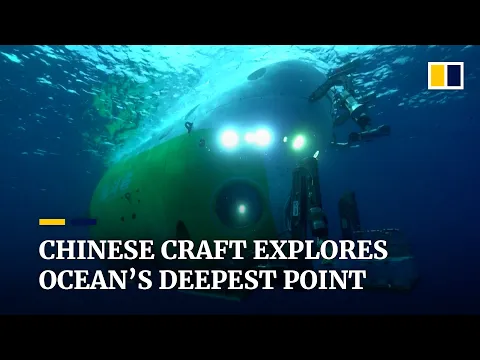

The project brings together Chinese institutions and partner researchers to investigate the ecology and environmental dynamics of the trenches.
Recent work linked to the project describes a more systematic view of the hadal ecosystem.
They also expand the discussion on how life adapts to extreme pressures and low nutrient availability.
In this type of research, each sample of sediment or organism can open new avenues of study.
These range from genetics and physiology to ocean floor geology.
At the same time, the increased human presence in these areas puts pressure on strict protocols for collection and documentation.
The goal is to avoid contamination and allow other groups to compare results in future campaigns.
With more countries trying to reach the “bottom of the bottom,” the race is no longer just for maximum depth.
It now includes mission frequency, sample quality, and the ability to operate safely repeatedly under extreme conditions.
Who will turn this access into discoveries that change what is known about life and geology in the planet’s deepest regions?






-

-

3 pessoas reagiram a isso.