





 Portuguese
  English
  Spanish
  8 min of reading
  4 comments


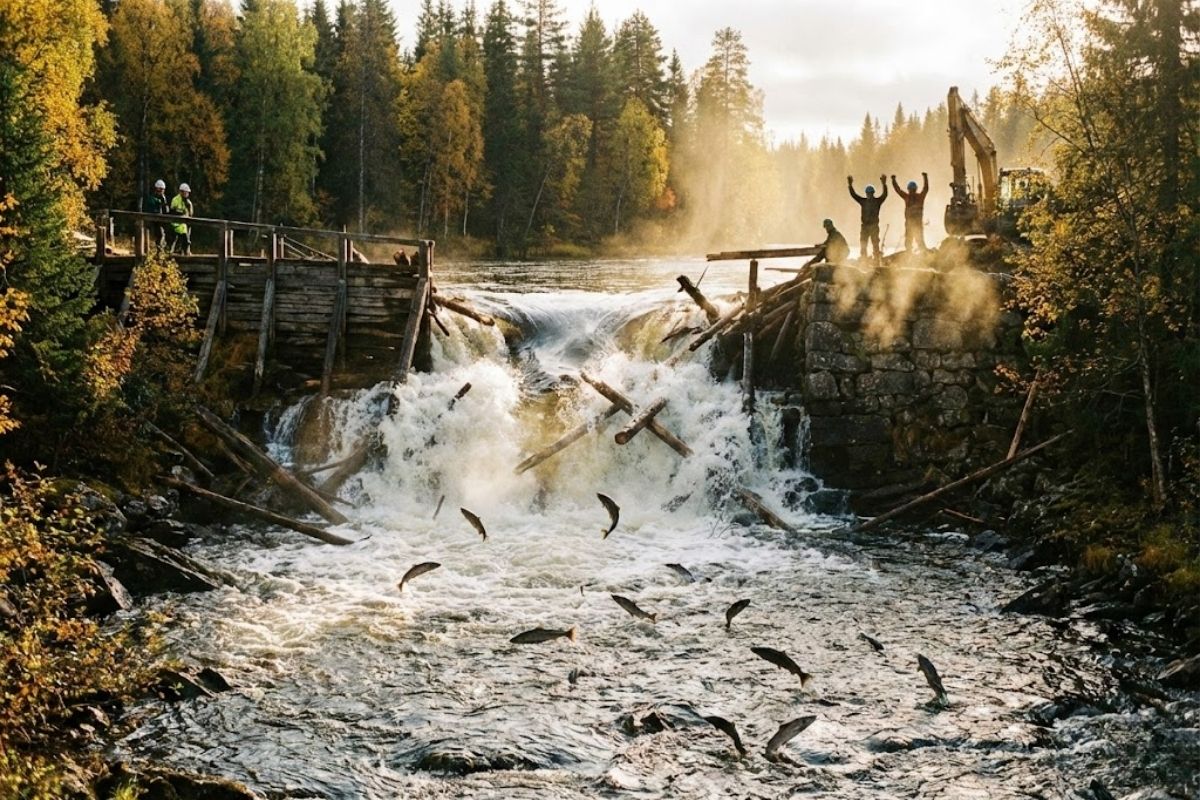


With Funding from the Open Rivers Program, Rewilding Sweden Demolished Four Dams in the Vindelälven-Juhttátahkka Biosphere Reserve, in Västerbotten County, Northwest of Umeå. The Action Restores Free Flow, Improves 84 km of Connectivity, Restores Sediments, and Facilitates Fish Migration and Species in Rivers That Feed Vindel.
In Sweden, within the northern taiga and the Vindelälven-Juhttátahkka Biosphere Reserve, in Västerbotten County, a field operation is removing dams that are small and obsolete to return to the rivers a basic attribute of nature: the continuity of flow, bed, and life.
The work is led by the Rewilding Sweden team with financial support from the Open Rivers program and focuses on results that is rare to see so clearly: when concrete is out of the way, natural processes reappear, connectivity is restored, and aquatic species return to using stretches that have been blocked for decades.
What Was Removed and Where Exactly Did This Happen

The removal occurred within the Vindelälven-Juhttátahkka Biosphere Reserve, an area northwest of the city of Umeå, in Västerbotten County, in northern Sweden.
-
China is building a city in Brazil: a complex with an investment of R$ 5.5 billion comes to light, but allegations involving workers draw attention.
-
While Argentina buys old war equipment, Brazil is keeping an eye open and joins the select group of nations with advanced military technology by investing $5.2 billion, producing 36 Gripen fighters in the country, and reducing operational costs.

-
Brazil on alert? Why invading Brazil is a NIGHTMARE for the USA: 8.5 million km², 213 million inhabitants, Amazon covering 60% of the territory, trillion-dollar war, and resistance that even 13,000 aircraft could not control.

-
How to build a floating island from scratch with reeds, giant blocks, and stakes in the lake in a process that needs to be repeated almost every day.
There, four structures were treated as river barriers to be eliminated to reopen waterways and wildlife pathways.
The four dams removed have names and histories: Strömbäcksdammen, Långträskdammen, Långhjuksnordammen, and Alträskdammen.
Although small, they were positioned in a way that interrupted stretches that feed a larger network.
When a barrier is in the wrong place, it does not just block “one point” of the river; it blocks entire kilometers of ecological function.
The Number That Measures the Turning Point: 84 Kilometers Reconnected

The most objective consequence of removing the four dams is the improvement of connectivity in 84 kilometers of waterways.
These waterways flow into the Vindel River, described as an affluent with 450 kilometers in length, which in turn flows into the Ume River.
In practice, this means that the intervention is not limited to where the concrete was removed. The reconnection propagates downstream and upstream because the river system functions as a corridor.
By reopening passages, the river resumes transporting what it has always transported, and the landscape returns to receiving what it has always received.
Why Small Dams Cause Big Damage to the Ecosystem
Artificial barriers are pointed out as one of the main threats to aquatic and riparian biodiversity on a global scale.
Even when they do not seem “giant,” dams degrade river ecosystems in various ways at the same time.
They cause loss and fragmentation of habitats, alter the distribution of sediments and nutrients, and can concentrate pollutants in blocked stretches.
The result is often less diversity, less resilience, and less capacity of the river to sustain the populations of wildlife that depend on it.
In the northern taiga, this weighs even more because rivers are ecological corridors in a vast landscape.
A blockage does not just interrupt movement, it fragments a pathway that connects environments, seasons, and reproductive cycles.
What Changes When Free Flow Truly Returns
The removal of the dams in the Vindel basin aims to restore natural river processes and, with that, improve the overall health of the river system.
This “return to the natural” is not an abstract idea. It happens in concrete components of the river’s functioning:
Water circulates again with fewer interruptions and patterns closer to the original. Sediments begin to move and redistribute.
Nutrients are no longer trapped in specific points. Seeds and organic matter travel again with the flow, nourishing banks and riparian stretches.
Moreover, in some cases, the wooden flooring installed in the riverbed was also removed. This detail is crucial because it was not just the dam that was problematic.
The wooden covering at the bottom of the river acted as a physical obstacle and as a blockage of bed processes, preventing the natural circulation of water, sediments, and organic matter.
Fish Migration and the Quick Proof: Salmo Trutta in Two Days
One of the most striking signs of ecological response appeared at an unusual speed: there was a return of Salmo trutta 2 days after the restoration.
This type of quick return is an indication that the physical barrier was a central bottleneck to movement.
When the obstacle disappears, nature tends to test the path almost immediately, especially in species that rely on movement along the river.
The logic is simple: free-flowing rivers benefit migratory fish because they need to access different stretches throughout the year for feeding, shelter, and reproduction.
The removal of the dams and associated structures paves the way for these fish to circulate again without the “wall” interrupting the corridor.
The Technical Challenge That Determines Everything: Not Letting Water Levels Drop
Demolishing dams has a difficulty that does not appear in before and after photos: maintaining the water level upstream.
When many of these dams were built, rocks were moved downstream to increase the height difference above and below.
If the dam was removed without replacing these rocks, the water level above could artificially drop, creating a new imbalance, this time caused by the restoration itself.
Therefore, the team needed to build natural and gentle thresholds where the dams were located. These thresholds achieve three things at once.
First, they prevent an abnormal drop in water levels upstream. Second, they enhance the natural aesthetics of the watercourse, so that the restored area does not look like a technical scar. Third, they prevent the flow from becoming so strong that it hinders the movement of fish and other wildlife species.
As part of this process, large rocks were replaced to stabilize the stretch and ensure that the river regains function, not just “a waterway”.
The Greater Strategy: Aquatic Landscape and Green-Blue Corridors
The removal of dams is not treated as an isolated event. It is part of a long-term strategy to restore the river basin of the Vindel, maximizing the results of previous large-scale river restoration efforts and connecting the intervention to other ongoing initiatives.
The approach taken is described as “aquatic landscape,” focusing on enhancing green-blue corridors for nature and wildlife.
This means strengthening the connection between rivers and surrounding landscapes, restoring free flow and allowing dynamic processes to operate again.
When the river regains freedom, the entire landscape gains ecological coherence, because banks, wetlands, and forested stretches begin to interact again with the pulse of water.
What Comes with Dams: Drained Wetlands and Degraded Forests
In the Vindel basin, Rewilding Sweden is also working on other fronts of long-term ecological restoration. In addition to removing dams, the team focuses on restoring drained wetlands and degraded forests.
The restoration of forests has an additional role: to increase biodiversity and support the migration of reindeer through a landscape dominated by commercial forestry.
This point helps to understand why the removal of dams is more than “a river project.” It fits into a territorial plan where water, forest, and fauna need to start functioning as a system again.
Where This Problem Came From: The Legacy of the Swedish Forestry Industry
Three of the four dams that were removed or are in the process of being removed are described as a legacy of the long history of industrial-scale forestry in Sweden, which has strongly impacted the landscape.
Starting in the 1850s, before the era of roads and railways, waterways were channeled and cleared to form a vast network of river transport. Rapids were removed and curves straightened to allow logs to float hundreds of kilometers downstream for processing.
In many places, wooden floors were placed in the riverbeds to facilitate passage. At the same time, an extensive network of drainage ditches connected to the rivers was excavated to create drier soils and promote tree growth.
And then came the dams en masse: thousands of small structures were built to artificially raise water levels in the spring.
When the logs were ready for transport, the dams were opened, and the timber was carried downstream by the resulting current.
What was designed to accelerate timber transportation also left an ecological footprint: hundreds of obsolete dams still exist in the Vindel basin and other regions of Sweden, and those that remain continue to cause negative impacts.
Why “Removing Concrete” Became a Simple and Effective Measure
Among the possible actions to improve the health and functionality of rivers and connected areas, removing dams is described as a simple and effective measure because it eliminates the most direct obstacle to connectivity.
It does not require “reinventing” the river; it requires removing what prevents it from self-managing. When the barrier disappears, the river begins to organize sediments, nutrients, and flow, and wildlife regains complete pathways, not fragments.
Next Step Already Marked: Investigate Five More Dams
The plan continues to expand. A second grant from the Open Rivers program will fund, next year, the investigation of five more dams in the Vindel river basin for potential removal by the project team.
This step is important because it broadens the reach of the reconnection corridor while reinforcing the method: map, assess, and remove, always with care not to create artificial drops in water levels and to maintain functional passages for wildlife.
The Connection with European Goals for Free Rivers by 2030
The efforts to remove dams in the Vindel basin are described as aligned with European policies for watercourse management, which seek to restore biodiversity and ecological connectivity.
The work also contributes to a goal of the European Biodiversity Strategy: to restore free flow in at least 25,000 kilometers of European rivers by 2030.
In addition to Open Rivers, there is mentioned financial support from Rewilding Europe, involved in the European movement for free river circulation and a founding partner of Dam Removal Europe.
The central logic behind this is the same as the Swedish project: with climate change bringing new challenges, there is a need for a new relationship with water, re-accepting it into landscapes and restoring natural habitats wherever possible, with dynamic and natural processes like free flow and floods.
Which of these actions do you think brings the fastest results in rivers blocked by dams: demolishing the structure first or reconstructing the bed with natural thresholds before fully releasing the flow?







A meu ver, reconstruir o leito com limiares naturais, pq a partir do momento em que destroe a barragem, tudo já está preparado para que o rio siga seu curso sem mais nenhuma barreira, sem nada que o impeça de realizar sua função magnífica e natural. Fiquei tão empolgada que li toda a matéria. Em questão de natureza, seja em que parte do mundo for, me interesso muito pq não é apenas uma questão local e sim mundial!
Parabéns, achei excelente!
Derrubar as estruturas, deixando fluir naturalmente e, agir de acordo com as consequências. As condições serão ditadas no decorrer do processo. A força da natureza é insubstituível.
Maria Heloísa Barbosa Borges! Muito grato por tua matéria perfeita! Informações precisas e completas, leitura agradabilíssima e tema essencial!