





 Portuguese
  English
  Spanish
  5 min of reading
  0 comments


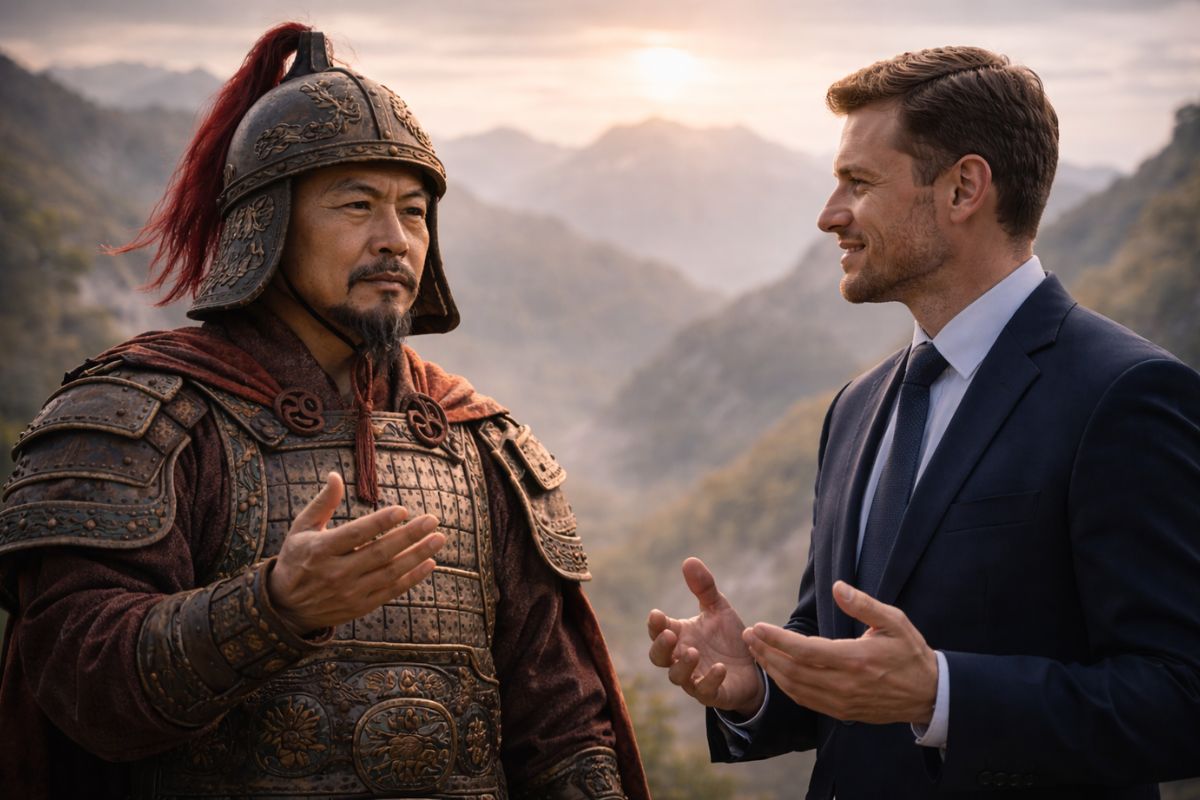
The treatise The Art of War has 13 chapters written during the Spring and Autumn period in ancient China and teaches that true power is not in destroying the adversary but in creating conditions for the battle to become unnecessary
Imagine an executive in a crowded meeting room quoting a Chinese general from 2,500 years ago to decide the course of a million-dollar negotiation. It seems absurd, but it happens every day. Sun Tzu is probably the most quoted author in board meetings, leadership courses, and even couple therapy around the world. And he never wrote a line about business, relationships, or self-help.
He wrote about war. And the phrase that has crossed 25 centuries without losing a drop of relevance is this: “The supreme art of war is to defeat the enemy without fighting.”
It is not a metaphor. It is not poetry. It is the conclusion of a military strategist who commanded real armies in real battles and realized that the most complete victory does not come from confrontation, but from its absence.
-
With 50,000 people crammed into 3 hectares and buildings stacked like a human anthill, this lawless city that lived without police and oversight reached the highest human density ever recorded in any habitable point on Earth before being erased from the map.

-
Constant tingling in the hands that doesn’t go away even when changing position may be the first warning that an essential vitamin for the nerves is lacking in the body, and ignoring this signal for weeks can cause damage that no supplement can reverse later.

-
While Paris suffocates with 100 million tourists a year, there are 7 countries in Europe that almost no one visits and that offer castles with views of the Alps, wines at juice prices, untouched beaches, and streets without a single selfie stick in sight.

-
The Sun emits strange “voice” captured by a telescope and antenna, and radio signals from a solar spot the size of Earth are surprising.

Who was Sun Tzu and why does he still matter?
Sun Tzu was born around 544 BC, during the so-called Spring and Autumn Period, an era of constant wars between rival states in China. He was a general of the State of Wu, in the service of King Ho-Lu, and wrote The Art of War, a treatise divided into 13 chapters that cover everything from planning and espionage to the use of terrain and surprise.
The book is short. Direct. No fluff. And perhaps that is why it has survived empires, revolutions, and the very invention of gunpowder. Ask 100 businesspeople to name the best strategy book they have ever read, and a good portion will say The Art of War.
But what makes Sun Tzu different from any other military strategist of antiquity is an idea that seems contradictory: the best general is not the one who wins the most battles, but the one who makes battles unnecessary.
What does “winning without fighting” mean in practice?
Most people interpret this phrase as pacifism. It is not. It is the opposite of impulsiveness, not the opposite of strength.
Sun Tzu does not say to avoid conflict out of fear. He says to avoid conflict because it is costly, exhausting, and unpredictable. Even those who win a battle come away with losses. The perfect victory, in his logic, is one in which the adversary gives up before fighting because they realize they have no chance.
How does he achieve this? The treatise points to concrete paths: weaken the opponent’s alliances before confrontation, use information as a decisive advantage, choose the right moment to act, and perhaps most importantly, know yourself and the other deeply.
The most famous phrase from The Art of War summarizes this logic: “If you know the enemy and know yourself, you need not fear the result of a hundred battles.”
Why did this philosophy explode in business?
In a world where everything goes viral quickly and any mistake can gain global dimensions, the reading of Sun Tzu has gained new meanings. A direct confrontation, whether legal, commercial, or communicative, can generate losses that last for years. “Not fighting” in the business context can mean seeking smart agreements, strengthening partnerships, and investing in reputation and dialogue.
Steve Jobs, when launching the iPhone, did not confront the cell phones of the time. He did not campaign saying that Nokia was bad. He created a product so superior that the battle became unnecessary. Nokia was not defeated in a confrontation. It was defeated by positioning. Sun Tzu would approve.
In the corporate world, the logic applies to negotiations, crisis management, and even how to deal with competition. The company that studies public behavior, the weaknesses of competitors, and regulatory risks can grow more securely than one that engages in price wars or public disputes.
And in real life, how does this work?
This is the point that made Sun Tzu’s philosophy go viral on Discover Brazil this week. The portal Catraca Livre published an article showing how the principles of The Art of War can be applied in everyday situations: conflicts with neighbors, tensions at work, family discussions.
The logic is simple and powerful. When tempers are high, it is not the time to act. When you do not know the other person’s motivations, it is not the time to react. When the cost of confrontation is greater than the cost of waiting, it is not the time to fight.
This is not passivity. It is what Sun Tzu would call intelligence in choosing battles. Some practical lessons that come directly from the treatise and work at any dinner table or office:
Know the profile of the people you share space with. At work, in the condominium, in the family. Understanding how the other thinks and reacts is half the strategy.
Avoid discussions when tempers are visibly high. Sun Tzu wrote: “A sovereign should never put an army into action motivated by anger.” In other words: do not send that message in the heat of the moment.
Observe before reacting. “Everyone can see the tactics of my victories, but no one can discern the strategy that generated the victories.” Patient observation reveals things that impulsive reaction hides.
Why does a 2,500-year-old book still work?
Because conflicts have changed in format, but not in nature. People still fight for territory, recognition, resources, and pride. The tools are different (instead of swords, we use emails, lawsuits, and stories), but the emotional dynamics are the same.
Sun Tzu understood something that modern psychology only confirmed millennia later: most conflicts escalate not because of the original problem, but because of the reaction to the problem. Controlling the reaction is controlling the conflict. And controlling the conflict without needing to fight is, for Sun Tzu, the highest form of power.
The Art of War is not a book about destruction. It is a book about energy conservation, scenario reading, and self-knowledge. And perhaps that is exactly why a military treatise written 25 centuries ago by a Chinese general is today the bedside book of CEOs, psychologists, sports coaches, and even those who just want to survive the condominium meeting.
The best victory is the one that does not require battle. And the best strategy is the one you apply before the problem exists. Sun Tzu knew this in 544 BC. The rest of the world is still learning.
With information from Catraca Livre, Revista Oeste, Revista Fórum, and G4 Business.





Seja o primeiro a reagir!