





 Portuguese
  English
  Spanish
  4 min of reading
  112 comments


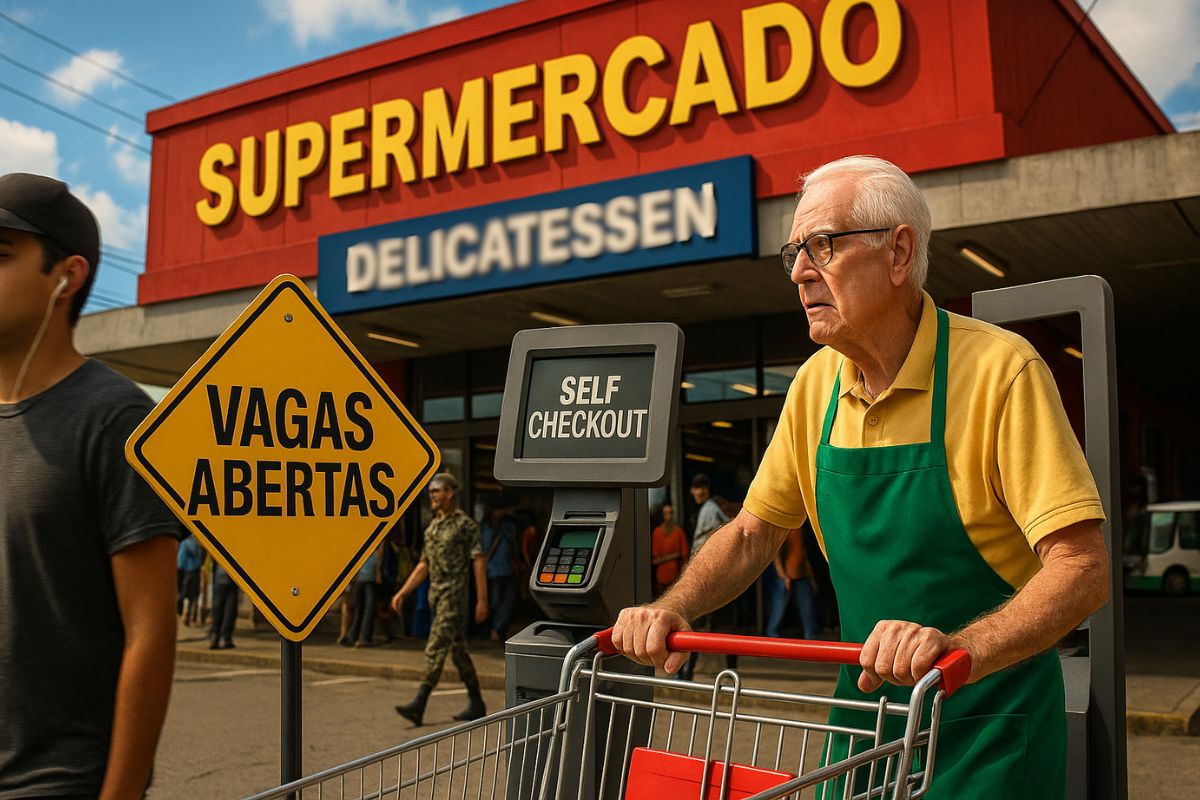


With Job Openings Available and Young People Rejecting Permanent Jobs, Chains Turn to Seniors, Reservists, and Self-Service to Avoid Operational Collapse.
For decades, working in supermarkets was the first step for many Brazilians into the formal job market. Bagging groceries, operating the cash register, or restocking shelves was almost a rite of passage, a chance to earn a first salary. Today, however, this scenario has turned upside down: even with hundreds of thousands of job openings, the sector is experiencing a historic labor shortage.
According to the channel elementar, the problem is not a lack of people. With unemployment at historically low levels, the challenge now is finding someone willing to fill these vacancies. The traditional model of long hours, low wages, and little comfort has lost its appeal, especially among young people who seek flexibility, purpose, and time freedom.
The First Job Has Lost Its Meaning
Until the 2000s, supermarkets were the main gateway to formal employment. Today, the internet and informality compete directly with this model.
-
Attracting around 250,000 people a year, a lighthouse 200 meters from the sea, on a 60-meter high cliff, on the North Sea coast in Denmark, becomes one of the most impressive examples of how nature can threaten historical buildings.

-
The narrowest house in the world is only 63 centimeters wide, but inside it can accommodate a bathroom, kitchen, bedroom, office, and even two staircases.

-
In the middle of the sea, these enormous concrete and steel structures, built by the British Navy to protect strategic maritime routes, look like they came straight out of a Star Wars movie.

-
For years, no one could cross a neighborhood in Tokyo because of the tracks, but an impressive solution changed mobility and completely transformed the local routine.

Young people prefer to sell online, provide freelance services, or do deliveries through apps, even without stability.
According to the sector, there are more than 350 thousand job openings across the country. Still, hiring is stalled.
“The profile of the worker has changed,” admits the vice president of Abras, Márcio Milan. “Young people who saw the supermarket as their first job now prefer informal activities due to the flexibility.”
In a scenario where companies are looking for workers, and not the other way around, the supermarket has lost its allure.
And when someone accepts a position, they find that the badge comes with “etc.”: the cashier also cleans the floor, assists in restocking, and does whatever else comes up without a proportional increase in salary.
When the Salary Doesn’t Cover the Basics


A cashier on average earns R$ 1,600, an amount that barely covers rent, transportation, and food. The basic food basket exceeds R$ 430, and the rent for a simple room exceeds R$ 900 in several capitals.
The result is predictable: the salary does not compensate for the effort.
Even traditional chains are struggling. Hirota, in São Paulo, had to relocate employees from other stores after failing to fill 80 vacancies in a new unit.
Others, like Oxxo, have even postponed openings due to staff shortages. The labor force exists, but no one wants the positions.
The National Confederation of Commerce (CNC) confirms: the eight most common positions, from butcher to stock clerk, are among those most affected by the shortage.
The solution, according to economist Fabio Bentes, would be to raise the starting salary above the market average. But with profit margins of only 2% to 5%, few chains can afford this adjustment.
Seniors, Reservists, and the “New Profile” of Workers
In light of the crisis, chains are seeking alternatives. Seniors, retirees, and army reservists have begun to be recruited in large numbers.
According to Abras, 80% of young people who completed military service find employment shortly after leaving the uniform. The logic is simple: discipline, punctuality, and endurance to routine.
The Carrefour, for example, hired 53 thousand people registered in CadÚnico in 2024 from low-income families, many of whom have been out of the job market for years.
This strategy has been successful: lower turnover and higher commitment. The “ideal” employee profile has changed, and the sector is learning this the hard way.
Fast recruitment platforms have also come into play. Tauste, with the Helppi tool, reduced the average hiring time from 15 to 7 days.
The system matches distance from residence, availability, and professional history, almost like a “Tinder for retail,” but with overtime instead of romance.
Self-Service Grows, but Divides Opinions
Meanwhile, chains are accelerating the use of self-service checkouts. Pão de Açúcar already has 90% of its stores automated, and Hortifruti has expanded the model even to weighable items, such as fruits and vegetables.
According to consulting firm RBR, Brazil already has 8 thousand self-checkout units, a number that keeps rising.
Abroad, however, the trend shows signs of regression. Supermarkets in the UK and the US have started to remove the machines after complaints of slowness, impersonality, and increased theft.
In Brazil, it is still the opposite: companies see automation as a temporary solution to the lack of personnel, even though the impact on customer experience still raises doubts.
The Dilemma of Those Who Stay
Hiring is easy. Retaining is the real challenge. For HR specialist Evelyn Rodrigues, high turnover is a reflection of harsh environments, little recognition, and lack of perspective.
Without a clear career plan and decent conditions, the worker leaves at the first opportunity.
Meanwhile, chains operate on the brink: they need people, but cannot afford to pay much more. And the greater the automation, the less incentive there is to improve the human environment.
The risk is a cycle of permanent devaluation little motivation, low performance, and high turnover, again and again.
The Future of Supermarkets in Question
The hiring crisis in supermarkets is, at its core, a symptom of social transformation. Young people do not reject work itself; they reject the outdated format.
At the same time, the sector is trying to reinvent itself with seniors, technology, and creativity, but still without addressing the root of the problem: valuing human work.
And you? Do you think the problem lies with young people who don’t want to work, or with the conditions that the sector offers? Share your opinion in the comments. The conversation about the future of supermarkets is just beginning.








Nas condições nos salários **** e querem que faça todas as funções que tiver que estava disponível pro horário que eles quiserem.
O baixo salário, o longo período trabalhado 6×1 e as condições oferecidas no ambiente de trabalho como higiene , acomodações para descanso e refeição, são alguns dos problemas que não atraem o trabalhador.
Trabalho em um hipermercado paga o salário base, não temos vale alimentação porque eles dão almoço, a empresa responsável é a sapore a maioria dos funcionários optaram por trazer suas marmitas de casa, já encontramos cabelo, lesma e mosquitos na salada e o sac da empresa simplesmente falou que isso acontece, nosso convênio Hapvida e NotreDame Intermédica não é aceito em muitas clínicas as vezes temos que nos deslocar para outras cidades para realização de exames e atendimento de especialidades e não somos ressarcidos das despesas de locomoção. Farmácia temos o convênio de R$ 300,00, condução aqui na cidade o último ônibus dependendo do bairro sai as 23:40 se a pessoa se atrasar e perder tem que ir a pé ou utilizar aplicativo pagando bem mais caro devido o horário. As mulheres não tem o domingo sim e outro não, falamos com o sindicato eles falaram que nesta rede de hipermercados e supermercados não funciona essa lei e quando sairmos nada impede de colocarmos na justiça e requerer todos os domingos trabalhados, agora temos até que fazer trabalho do RH, lançamentos de atestados, concerto das marcações de ponto, desvio de função se nós temos que fazer para que ter RH? Plano de carreira nem escutamos falar. Agora com o alto atendimento que toda hora trava e os clientes brigam, muitos de nós estamos com crise de ansiedade. Pergunto porque não é feita fiscalização a este respeito? Cadê o sindicato que só é a favor das empresas? E muitas outras coisas…a verdade é que ninguém se importa porque somos um número e substituíveis.