





 Portuguese
  English
  Spanish
  4 min of reading
  29 comments


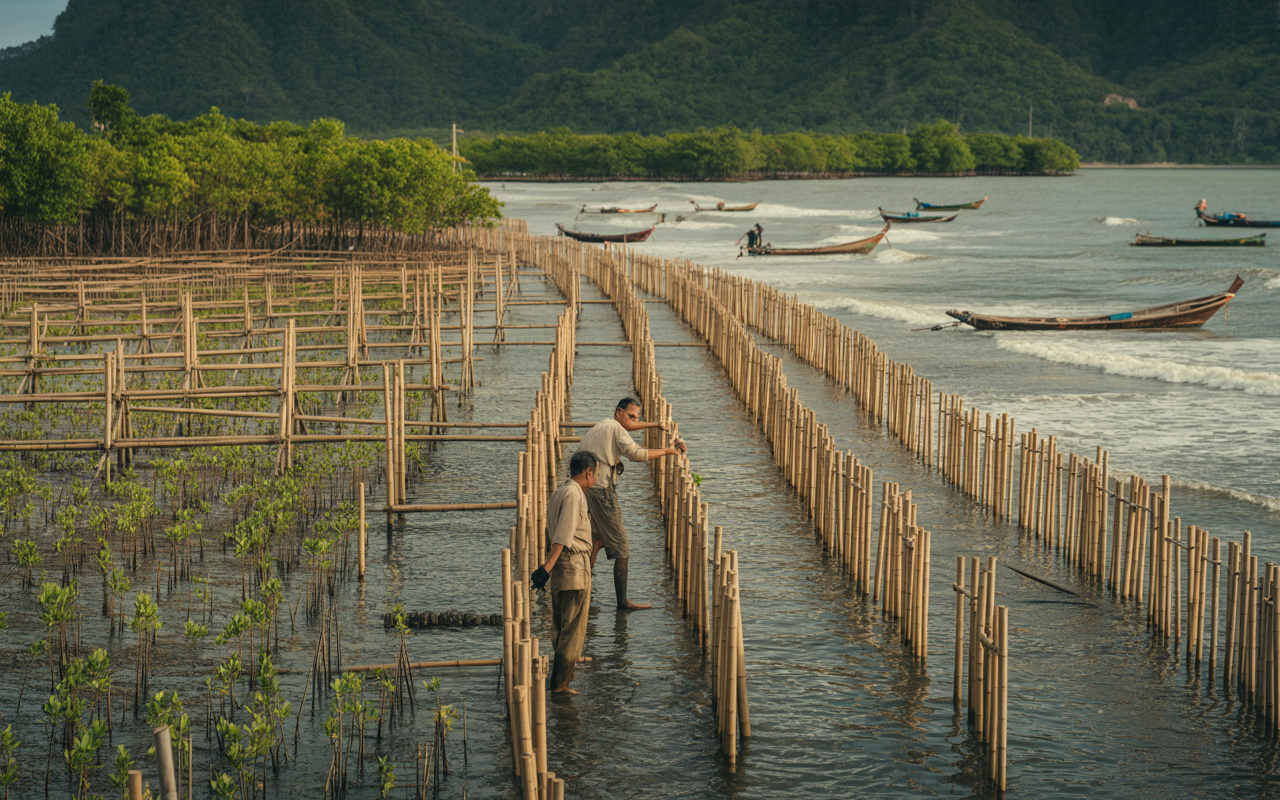


Thailand Uses Bamboo Barriers That Reduce Waves By Up To 70% And Recreate Mangroves, Slowing Coastal Erosion With Simple, Cheap And Ecological Solution.
When it comes to defending coastal cities from erosion and sea encroachment, the imagination tends to lean toward mega infrastructures: concrete walls, levees, breakwaters, gabions. But in Thailand, since mid-2015, a solution as simple as it is silent has been catching the attention of researchers, environmentalists, and coastal engineers: kilometers of rows of bamboo installed in shallow waters, capable of reducing wave energy by up to 70% and creating ideal conditions for mangroves to re-emerge where there was previously only erosion.
The initiative, documented by Thai environmental agencies and analyzed in research centers such as the “Royal Project on Mangrove Restoration,” has a clear goal: to transform a costly and ongoing problem — accelerated coastal erosion — into a permanent natural defense.
The Problem: Accelerated Erosion And Soil Loss
Thailand has lost large areas of mangroves during decades of coastal urbanization, aquaculture expansion, and disorderly occupation. Without the dense roots that act as a living mesh, the seabed and coastal soil have been exposed. The result: entire villages began to lose land to the sea, roads started to collapse, and nearby agricultural areas were abandoned.
-
The water that almost everyone throws away after cooking potatoes carries nutrients released during the preparation and can be reused to help in the development of plants when used correctly at the base of gardens and pots, at no additional cost and without changing the routine.

-
The sea water temperature rose from 28 to 34 degrees in Santa Catarina and killed up to 90% of the oysters: producers who planted over 1 million seeds lost practically everything and say that if it happens again, production is doomed to end.

-
An Indian tree that grows in the Brazilian Northeast produces an oil capable of acting against more than 200 species of pests and interrupting the insect cycle, gaining ground as a natural alternative in soybean, cotton, and vegetable crops.
-
The rise in oil prices in the Middle East is already affecting Brazilian sugar: mills in the Central-South are seeing their margins shrink just as ethanol gains strength.



This scenario worsened with the global rise in sea levels, intensifying storms, and alterations in coastal currents, a set of factors that the scientific community refers to as “multifactorial coastal erosion.”
Over time, it became clear that reconstructing mangroves would be essential, but mangroves do not spontaneously recover in heavily eroded areas. It is necessary to stabilize the soil and soften the impact of the waves before the seedlings can survive.
The Thai Solution: Bamboo As A “Natural Breakwater”
The structure is simple: double or triple rows of bamboo driven vertically into the sandy bottom, spaced strategically to allow water to pass while dissipating much of the wave energy. It is not a solid barrier like a concrete wall; it is a filter, which reduces water speed and captures sediments.
According to measurements released by environmental agencies in the country, the reduction in wave energy reaches 60% to 70%, depending on the wind and tide. This is enough for mud and sand to start accumulating behind the rows of bamboo, creating a new physical cradle for the return of mangroves.
Mangroves As “Ecological Engineers”
Once the sediment stabilizes, the second phase begins: the planting (or natural recolonization) of mangroves.
Mangroves are considered by biologists as ecological engineers for three main reasons:
- They anchor the soil with their roots, preventing it from being carried away by the tide.
- They further reduce wave force, acting as a natural “mattress.”
- They sustain entire ecological chains, serving as nurseries for fish, mollusks, and crustaceans.
Moreover, mangroves are one of the most efficient ecosystems in the world for capturing carbon, accumulating on average four times more carbon per hectare than terrestrial tropical forests.
Results Already Observed: More Soil, Less Erosion And Return Of Fauna
In the areas where the project has been implemented, aerial images, drones, and bathymetric surveys have shown three clear changes:
- Recovery of soil that was previously lost to the sea, forming sediment banks behind the barriers;
- Gradual return of mangroves, both through planting and natural regeneration;
- Reappearance of crabs, fish, and coastal birds, which depend on the mangrove roots for feeding and shelter.
For local communities, this also means protection for homes, roads, temples, and agricultural areas, reducing social and economic costs.

Why Bamboo And Not Concrete?
Engineers interviewed by the “Bangkok Metropolitan Administration” highlight five advantages:
— Low Cost
— Faster Installation
— Integration With Living Ecosystems
— Simple Maintenance
— Possibility Of Modular Expansion
While concrete works can cost tens of millions of dollars, bamboo barriers cost a fraction, can be replaced section by section, and do not prevent the circulation of coastal fauna — something vital for a fishing country.
A Model For Other Coastal Nations?
Similar initiatives are already being studied in Bangladesh, the Philippines, Indonesia, Vietnam, and even the USA, where scientists are seeking low-impact, low-carbon coastal defense alternatives.
The logic is clear: instead of fighting the sea with walls, the ecosystem itself is used as a defense. Bamboo buys time, and the mangrove does the definitive work.
Today, Thailand stands as a silent reference of how light infrastructure + applied ecology + community participation can overcome a problem that would cost billions if addressed solely with concrete.
While many coastal cities around the world await large works, Thailand has discovered that small cylinders of bamboo can make the sea recede and the mangrove advance.







Que lindo e exemplo para o mundo!
Gud God work
Então, recentemente aqui, ficou viral um vídeo de uma senhora pedindo que a área de mangue próximo a sua casa fosse retirada para dar mais espaço aos proprietários do condomínio e aos turistas de uma praia… 🤦🏽♀️ Vários estados vêm nos últimos anos realizando o alargamento de suas praias… Modificando a costa e o bioma marinho. O homem pensa na recompensa financeira do turismo… Esquece que a natureza tem sua própria vontade… Enquanto o homem continuar vendo o planeta através de cifras esse tipo de situação se repetirá constantemente. Parabéns aos tailandeses que conseguiram encontrar uma solução natural para resolver o problema que eles mesmos provocaram. Amo a natureza porque mesmo ela se vingando de nossos deslizes, quando o homem volta a razão, ela perdoa e cura a si mesma e a nós! 🙏🏽🙏🏽🙏🏽