





 Portuguese
  English
  Spanish
  5 min of reading
  1 comment


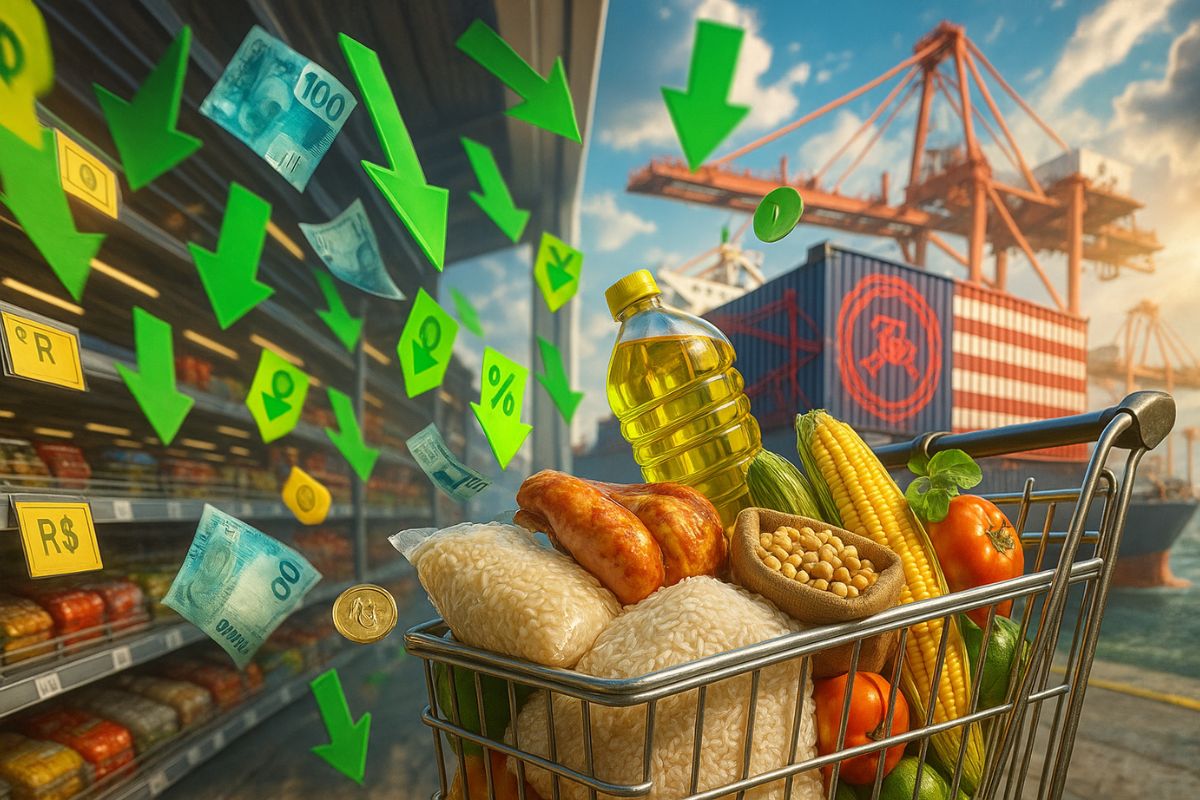


The Latest Reading Indicates That Food Prices in Brazil Have Decreased After the 50% Tariff Imposed by the United States on Relevant Brazilian Exports, With Indirect Effects on Domestic Supply, Exchange Rates, and Reallocation of Sales to Other Markets, Especially in Asia, While Experts Warn of Only Temporary Movements and Possible Pressures Ahead
The price of food in Brazil has entered a relief trajectory in recent months, following a first half of increases. Analysts point out three main vectors for the recent decline: redirecting products previously intended for the U.S., which increases domestic supply, appreciation of the real against the dollar, which lowers the cost of imported items and inputs, and favorable harvests in grains and proteins. In parallel, tariff exceptions and specific flow adjustments have kept some exports active, without the initially predicted negative impact.
The technical assessment, however, is cautious. The calm is likely to be temporary in the face of known risks: off-season and summer weather, which can reduce productivity, trade realignments among major buyers, and the repositioning of international prices in dollars. In summary, the recent disinflation improves the short term, but does not guarantee a sustained trend throughout 2026.
What Explains the Recent Decline
The first explanation is mechanical. With high tariffs, part of the production that would have gone to the North American market has been absorbed by domestic purchases or redirected to other destinations, easing local pressures.
-
Oil surged to $115 a barrel due to the war in the Middle East, and diesel in Brazil has already risen to R$ 7.45 per liter, while the United States…

-
Brazilian city bets on the business environment to generate jobs and attract investments in the energy sector — secretary reveals strategy at Macaé Energy 2026.

-
50 viaducts, 4 tunnels, 28 bridges, and 40 kilometers of bike paths: BR-262 in Espírito Santo will receive 8.6 billion reais for the largest engineering project in the state’s history, inspired by the Immigrant Highway in São Paulo.

-
Brazil produces too much clean energy and doesn’t know what to do with it: over 20% of solar and wind capacity was wasted in 2025 while investors flee and 509 renewable generation projects were abandoned in the last year.


This movement reduces the competition for supply in retail and contains adjustments in sensitive items of the basket.
The second explanation is exchange rate-related. The appreciation of the real during the period decreases the cost of inputs and moderates the formation of prices for food with partially dollarized supply chains.
In parallel, better harvests in rice, beans, and proteins have contributed to a greater availability and cooling of wholesale prices. This relief also reflects more favorable exchange rates.
How the Tariff Has Spread Through Prices
The tariff creates two channels. Externally, producers seek new buyers, sometimes with lower prices in dollars to gain market, which anchors international quotations.
Internally, part of the remaining supply softens price adjustments at selling points, reducing immediate pressure on consumers.
Even so, the effect is not uniform across sectors. Items with more rigid contracts and logistics timelines take longer to reflect the new dynamics.
Goods with close substitutes respond more quickly, as consumers switch from one product to another when the relative price changes.
Signs of Temporariness and Risks on the Horizon
Economists point to a set of reversal factors.
The off-season in proteins and fruits can tighten supply at the turn of summer, while typical climatic events of the period affect productivity and logistics.
If production decreases, the price relief is likely to diminish.
The commercial repositioning among major economies also matters.
If bilateral agreements alter buying flows, especially in soy and meats, competition for markets can reduce domestic availability and rekindle pressures in retail.
In such scenarios, the recent decline can lose strength quickly. The summer harvest may reverse some of the relief.
Sectoral Effects: Coffee and Meats in Focus
In coffee, previous shocks and the dynamics of future contracts have kept prices high for an extended period.
The recent improvement in domestic supply has led to some temporary declines, but experts remind us that the level is still high and sensitivity to weather and exchange rates remains significant.
In meats, the assessment is different. Even with recent relief in some cuts, off-season and firm exports can tighten domestic supply.
Consumers tend to substitute more expensive cuts for cheaper options, which redistributes pressure among proteins and can raise relative prices of chicken and eggs when demand shifts.
Foreign Trade and Realignment of Destinations
With the high tariff in the U.S., sales have been redirected to Asian markets, particularly China and India, as well as smaller destinations that have increased purchases in the short term.
In some cases, even with the surcharge, products like coffee and meats have maintained resilient performance in spot shipments, reflecting competitiveness in price and quality.
This redirection is not unlimited. As other suppliers compete for the same customers, prices in dollars adjust and the margin for maneuver decreases.
If foreign trade decreases or changes origin, domestic supply may vary more intensely and reintroduce volatility in the price of food in Brazil.
The Role of the Exchange Rate and Inputs
The exchange rate remains a key variable. The appreciation of the real improves the cost of inputs, feeds, packaging, and imports, which depresses pressures in the short term.
The reverse is also true: a weaker real accelerates costs and can contaminate retail with a few months of lag.
In addition to the exchange rate, logistical and energy costs contribute to the price base. Freights, storage, and cheaper energy facilitate the decompression in wholesale.
Shocks in these components, in turn, tighten margins and anticipate transfers to consumers.
Indicators to Monitor in the Coming Months
To understand the trend of the price of food in Brazil, three areas deserve attention. First, the summer harvest and weather conditions that determine supply and costs.
Second, the exchange rate and interest rate dynamics, which have a direct impact on inputs and inventory planning.
Third, trade flows in soy, meats, and coffee, which adjust internal availability and relative prices.
Additionally, it is useful to observe data on food and beverages in price indices, which capture the effect from wholesale to retail with a lag.
Fluctuations in contracts and auctions of government purchases, when they occur, can also recalibrate the short term.
The tariff has generated a tactical relief in the price of food in Brazil, enhanced by more favorable exchange rates and positive harvests, but the situation is not guaranteed for 2026.
The combination of off-season, weather, trade realignments, and exchange rates can reverse part of the decline and reintroduce volatility to sensitive items in the shopping cart.
The combination of tariff, exchange rate, summer harvest, and foreign trade will continue to define the price of food in Brazil.
In your view, which variable weighs most in the next three months on the price of food in Brazil: exchange rate, summer harvest, or redirection of foreign trade?









De fato, o Brasil precisa cobrar imposto de exportação para aumentar a disponibilidade interna e, de quebra, arrecadar um pouco.