





 Português
  Inglês
  Espanhol
  3 min de leitura


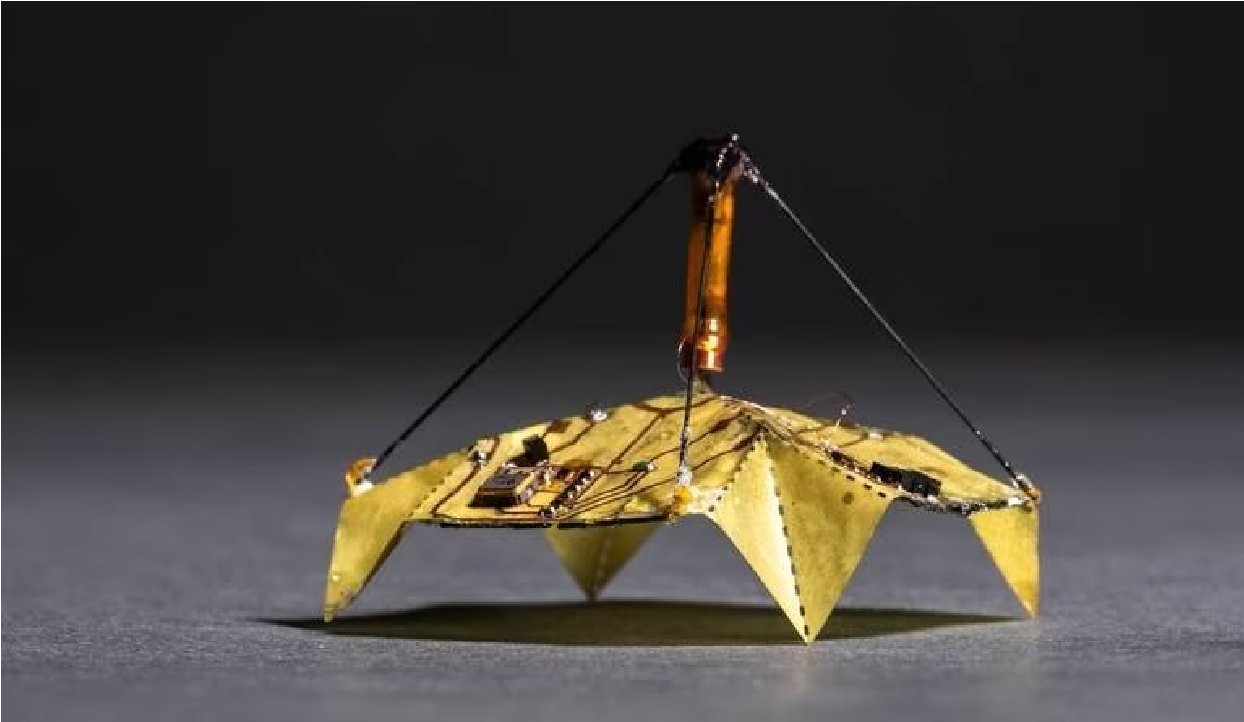
The New Technology Ensures Robots Have a Microcontroller with Bluetooth, Radio, Sense, No Battery, and Is Only 12cm Long
Researchers from the renowned University of Washington present an impressive technological innovation: flying robots that do not require batteries and use an origami-inspired technique to change their shape during flight. These small devices, approximately 12 cm long and weighing a few grams, are compact yet packed with cutting-edge technology, according to R7.
They are equipped with a programmable microcontroller, Bluetooth radio communication, a solar energy harvesting circuit, a pressure sensor to estimate altitude, and a temperature sensor – all contained in an incredibly small structure. However, these robots cannot initiate flight on their own, relying on drones or other high-altitude objects to be launched and on the wind to move.
Inspired by Nature: Flying Robot Technology with Origami Design
When it comes time to begin the descent, each microdevice receives a signal via Bluetooth containing timing and altitude information. At this moment, they resort to a folding technique known as Miura-ori, which is a specific geometric pattern. This allows the robots to reduce their size, helping them dive quickly towards the ground.
-
A bright yellow mushroom imported from Asia escaped from a cultivation farm in the United States in 2010 and is now aggressively spreading across 25 states, destroying entire communities of native fungi in American forests.

-
Buried under China, a colossal machine weighing 20,000 tons began operating as the largest neutrino detector on the planet and, in just 59 days, surpassed results that science took half a century to achieve.

-
Iran enters the center of a climate alert after the war emitted 5.6 million tons of CO2 in two weeks, surpassing the annual pollution of entire countries.

-
Lunar exploration may change after a Chinese probe finds a “cavity” of radiation that reduces the impact on astronauts by up to 20% at certain times on the Moon.


Scientists found inspiration for this design from the way leaves fall from trees. “We combined the Miura-ori fold, inspired by geometric patterns found in leaves, with energy harvesting and small actuators to allow our flyers to mimic the flight of different types of leaves in the air,” explained Vikram Iyer, assistant professor at the Paul G. Allen School of Computer Science and Engineering at the University of Washington.
Surprisingly, these tiny devices have the capability to travel over 100 meters in a straight line and withstand drops from heights of approximately 40 meters without suffering damage. But their abilities do not stop there.
Versatile Applications for Battery-Free Flying Robots
The micro flyers are not only a marvel of technology, but they also have practical applications. They can be used to collect crucial environmental data, such as temperature, humidity, and other conditions. This data collection capability makes these robots particularly useful in various fields, such as environmental monitoring and scientific research.
However, scientists also recognize the need to consider the ethical implications of this technology that does not require an emerging battery. They express concern that in the future, these flying robots could be used for less noble purposes, such as espionage or harmful activities.
The Future of Battery-Free Flying Robots: Challenges and Opportunities
While the technology behind these battery-free flying robots is impressive, it also raises ethical and security challenges. Responsible development and proper regulation are essential to ensure that these innovations are used beneficially for society.
As research advances and new applications are discovered, the potential of these origami-inspired battery-free flying robots is vast. They could revolutionize the way we collect data in challenging and inaccessible environments, opening doors to new discoveries and scientific advances.
However, the responsibility lies with society and researchers to ensure that these battery-free technologies are used for the common good, balancing innovation and ethics for a better future.






Seja o primeiro a reagir!