






 Portuguese
  Spanish


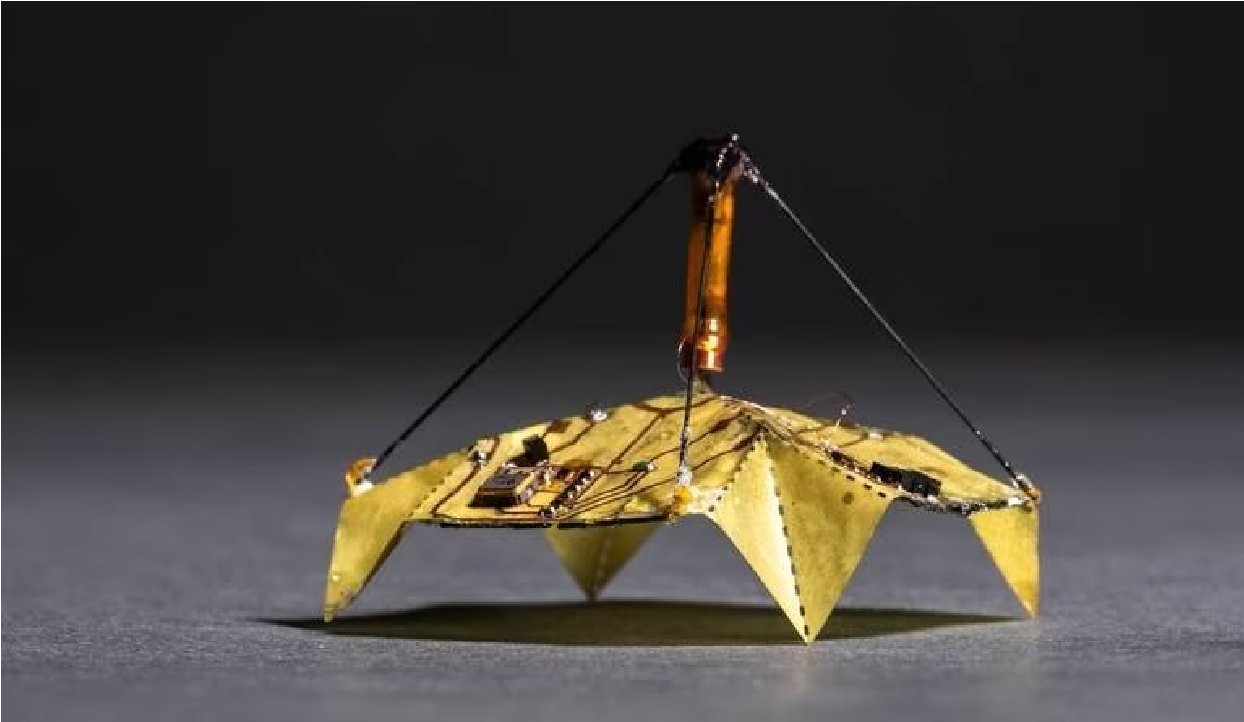

The New Technology Ensures Robots Have a Microcontroller with Bluetooth, Radio, Sense, No Battery, and Is Only 12cm Long
Researchers from the renowned University of Washington present an impressive technological innovation: flying robots that do not require batteries and use an origami-inspired technique to change their shape during flight. These small devices, approximately 12 cm long and weighing a few grams, are compact yet packed with cutting-edge technology, according to R7.
They are equipped with a programmable microcontroller, Bluetooth radio communication, a solar energy harvesting circuit, a pressure sensor to estimate altitude, and a temperature sensor – all contained in an incredibly small structure. However, these robots cannot initiate flight on their own, relying on drones or other high-altitude objects to be launched and on the wind to move.
Inspired by Nature: Flying Robot Technology with Origami Design
When it comes time to begin the descent, each microdevice receives a signal via Bluetooth containing timing and altitude information. At this moment, they resort to a folding technique known as Miura-ori, which is a specific geometric pattern. This allows the robots to reduce their size, helping them dive quickly towards the ground.
-
China Launches First Oceanic Medical Rescue Ship with Advanced Facilities to Serve Remote Regions

-
Midea Unveils Portable PortaSplit Air Conditioner: 12,000 BTUs, Quiet Mode, Heating, Dehumidification, App Control, and AI Efficiency Without Professional Installation
-
Singapore Turns Incinerated Waste Ash into Construction “Sand” in Ambitious Project to Revolutionize Megacity Waste Management
-
High School Teen Develops AI to Detect Autism and ADHD Signs from Retinal Patterns with 89% Accuracy


Scientists found inspiration for this design from the way leaves fall from trees. “We combined the Miura-ori fold, inspired by geometric patterns found in leaves, with energy harvesting and small actuators to allow our flyers to mimic the flight of different types of leaves in the air,” explained Vikram Iyer, assistant professor at the Paul G. Allen School of Computer Science and Engineering at the University of Washington.
Surprisingly, these tiny devices have the capability to travel over 100 meters in a straight line and withstand drops from heights of approximately 40 meters without suffering damage. But their abilities do not stop there.
Versatile Applications for Battery-Free Flying Robots
The micro flyers are not only a marvel of technology, but they also have practical applications. They can be used to collect crucial environmental data, such as temperature, humidity, and other conditions. This data collection capability makes these robots particularly useful in various fields, such as environmental monitoring and scientific research.
However, scientists also recognize the need to consider the ethical implications of this technology that does not require an emerging battery. They express concern that in the future, these flying robots could be used for less noble purposes, such as espionage or harmful activities.
The Future of Battery-Free Flying Robots: Challenges and Opportunities
While the technology behind these battery-free flying robots is impressive, it also raises ethical and security challenges. Responsible development and proper regulation are essential to ensure that these innovations are used beneficially for society.
As research advances and new applications are discovered, the potential of these origami-inspired battery-free flying robots is vast. They could revolutionize the way we collect data in challenging and inaccessible environments, opening doors to new discoveries and scientific advances.
However, the responsibility lies with society and researchers to ensure that these battery-free technologies are used for the common good, balancing innovation and ethics for a better future.


