





 Portuguese
  English
  Spanish
  4 min of reading
  2 comments


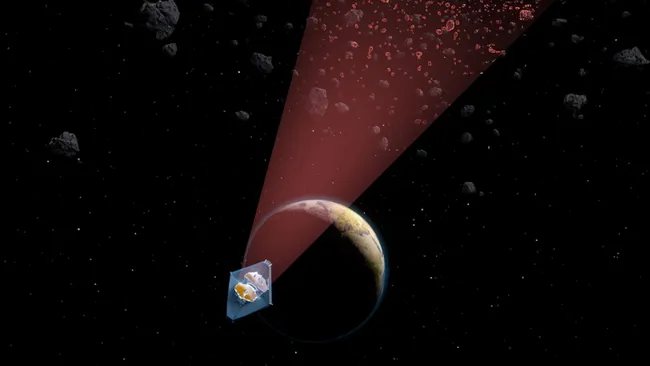


The James Webb Telescope Identified Over 100 New Asteroids in the Region Between Jupiter and Mars. Some of Them Are on a Collision Course with Earth
Astronomers analyzing archived images from the James Webb Space Telescope (JWST) were surprised by the discovery of a vast population of extremely small asteroids in the asteroid belt between Mars and Jupiter.
These asteroids, smaller than any seen before, are of great importance as they may approach Earth, posing new challenges for planetary security.
They range in size from a bus to several football fields, in contrast to the enormous space rocks that caused the extinction of the dinosaurs. Although small, their impact can be significant.
-
With a cost per shot close to zero, the DragonFire laser could change naval warfare in 2027 and provide British ships with nearly unlimited defense against drones.

-
A British startup creates tires that generate electricity in electric vehicles when passing over potholes, speed bumps, and cracks.

-
Scientists have created robots made with living cells that have their own nervous system, swim on their own, explore the environment, and self-organize without any genetic engineering, and now they want to do the same with human cells.

-
Students create a solar-powered ambulance that operates without a plug, without fuel, and still keeps medical equipment running in remote areas.

An example of this occurred just a decade ago when a metro-sized asteroid exploded over Chelyabinsk, Russia, releasing 30 times more energy than the atomic bomb in Hiroshima.
The decameter-sized asteroids, as they are known, collide with Earth 10,000 times more frequently than their larger counterparts, but the difficulty of detecting them due to their tiny size represents a significant challenge for scientists.
New Discoveries from the James Webb Telescope
This discovery brings new hope that these small celestial bodies can be monitored more accurately.
A team of astronomers, led by Julien de Wit, associate professor at MIT, has been using a computationally intensive method to identify asteroids in telescope images that capture distant stars.
The application of this method to images from the James Webb Space Telescope (JWST) revealed a large number of tiny asteroids, with 138 new ones found in the asteroid belt.
Moreover, six of these asteroids showed signs of being pushed by nearby planets into trajectories that could put them on a collision course with Earth.
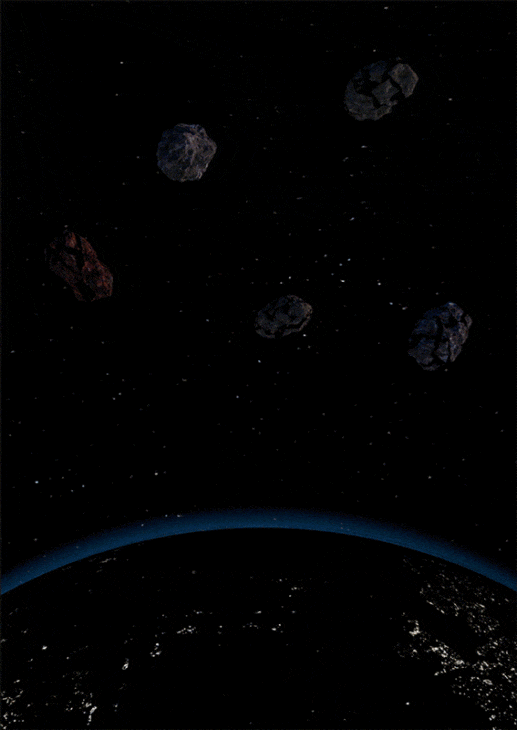
“We expected to find only a few new objects, but the number was much greater than we imagined — especially the small ones,” de Wit said, highlighting the significance of the discovery. “We are investigating a new population regime,” he added.
New Technologies Opening Unexplored Paths
To conduct this research, de Wit’s team compiled about 93 hours of images from the TRAPPIST-1 system, located 40 light-years from Earth. The goal was to highlight fast-moving objects like asteroids and overcome image noise.
The innovative technique used powerful graphics processing units (GPUs) to analyze large volumes of data, allowing for an efficient “blind” search to locate asteroids in all possibilities.
“We are entering unexplored territory, thanks to modern technologies,” said Artem Burdanov, research scientist at MIT and lead author of the study.
“This is an example of how looking at the data differently can bring great rewards,” he stated, emphasizing the significance of the innovative approach.
The key to this discovery was the use of the infrared capabilities of the James Webb Space Telescope (JWST). This telescope, with its ability to detect the thermal emissions of asteroids, proved ideal for the task.
These emissions are much more visible than the reflection of sunlight off the surfaces of asteroids, which is the type of light used in traditional observations.
The Future of Discoveries
With the success of this initial analysis, the James Webb Space Telescope (JWST) plans to conduct more observations, focusing on 15 to 20 distant stars for over 500 hours.
This could pave the way for the discovery of thousands of decameter-sized asteroids in our solar system, improving monitoring and prediction of objects that may represent risks to Earth.
Additionally, the Vera C. Rubin Observatory in Chile will become operational next year, housing the largest digital camera in the world. This observatory will image the southern sky every night, covering an area equivalent to 40 full moons.
It is expected that within just six months, the Vera C. Rubin could identify up to 2.4 million asteroids, nearly double the current known number.
With these new observation and analysis tools, scientists believe it is possible to track these asteroids with greater effectiveness and thereby conduct effective monitoring for planetary defense.
The future of astronomical discoveries looks increasingly promising, with a keen eye on what might be awaiting in the vastness of space.







Só pode estar associado às aparições de objetos não identificados que surgiu nos EUA agora semana passada.Vieram para nos ajudar!!
Tá na cara que é fake