





 Portuguese
  English
  Spanish
  4 min of reading
  0 comments


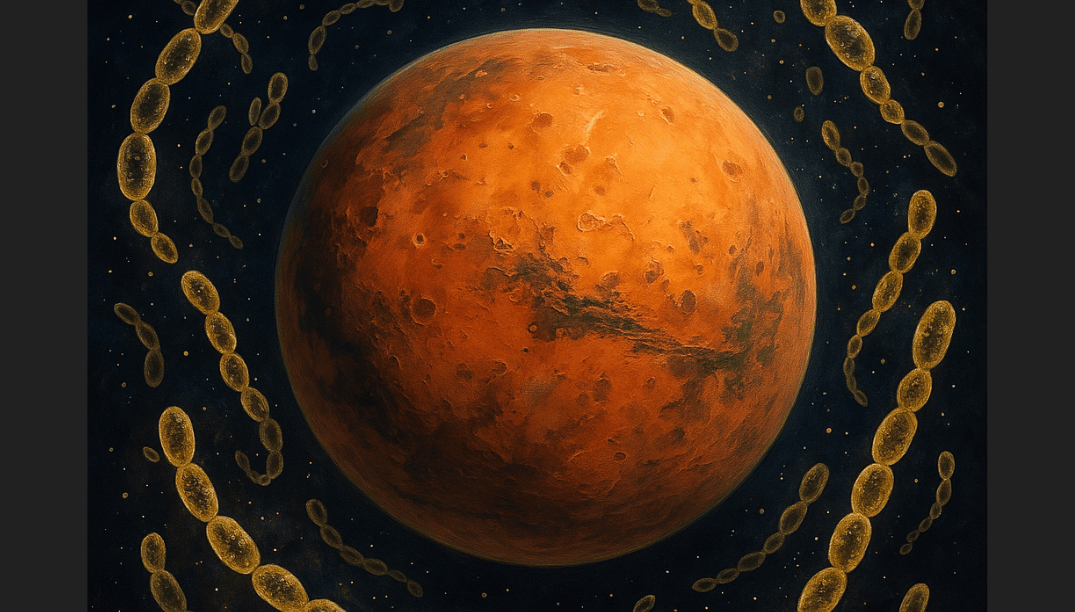
A theory that has been gaining attention in the scientific community proposes that humans may have already found life on Mars — and accidentally destroyed it. According to the hypothesis, experiments conducted by NASA probes in past decades may have eliminated Martian micro-organisms before they were correctly identified.
The search for extraterrestrial life remains one of the biggest obsessions of modern science. From space probes to listening stations, efforts are made daily to find any signs of alien existence. But a controversial theory has reignited an old debate: what if life on Mars had already been found — and accidentally destroyed?
The Theory of Accidental Error
The central point of the discussion comes from an opinion article published in 2023 on the website Big Think. The author, Dirk Schulze-Makuch, a PhD in sciences and professor at the Technical University of Berlin, claims that NASA’s Viking probes, launched in the 1970s, may have detected signals of Martian life.
However, the very experiments conducted by the scientists would have eliminated any chance of confirmation.
-
In a flooded well, archaeologists found a 1,700-year-old Roman egg that still contains clear and yolk intact inside the very thin shell.

-
Something is happening around the Earth: Inside the huge explosion of fireballs in 2026

-
A hot air bubble coming from Argentina expands over Brazil, causing thermometers to exceed 38 degrees with a thermal sensation of 40 degrees in late March, affecting 6 states at once.

-
The radish leaf that almost everyone throws away has more polyphenols, flavonoids, and fiber than the consumed root, and a 2025 study showed that the leaf contains compounds that protect the intestine, combat inflammation, and may inhibit the growth of cancer cells.


At the time, the Viking modules found chlorinated organic compounds in the Martian soil.
These substances are formed by carbon molecules linked to chlorine atoms.
The NASA team concluded that it was contamination coming from Earth. For this reason, they did not pursue the finding further.
Decades later, with new probes exploring Mars, it was discovered that the chlorinated compounds were indeed present on the planet and were not a result of external contamination.
Too Much Water for a Dry Environment
According to Schulze-Makuch, life on Mars may have evolved to survive in extremely dry environments.
This would include adaptation to salt rocks, capable of absorbing moisture from the atmosphere.
The sudden influx of terrestrial water used in the tests conducted by the Viking probes would have killed any possible microbes present in the soil samples.
This hypothesis is based on studies of extremophilic microorganisms — beings that live in very harsh conditions, such as extreme heat, cold, salinity, or acidity.
Schulze-Makuch believes that microbes of this type could have lived on Mars, tolerating aggressive compounds like chlorides and perchlorates, which are common there.
NASA’s Response to the Theory of Life on Mars
The thesis has caused controversy and gained attention in the scientific community. But not everyone agrees. Chris McKay, an astrobiophysicist and senior scientist at NASA, counters the idea.
According to him, there is no evidence in the results of the Viking mission that proves the presence of life.
“The claim that the Viking may have ‘found and eliminated’ life is incorrect,” McKay stated. For him, the team at the time was prepared to deal with the kind of reaction that might occur from adding water to Martian soil.
The procedures were conducted based on the knowledge available about saline and cold environments, similar to those on Mars.
In other words, even if the tests caused any type of reaction, it was already anticipated. The absence of direct signs of life makes Schulze-Makuch’s thesis invalid in McKay’s view.
New Discoveries Reinforce the Hypothesis
Despite the criticism, Schulze-Makuch remains firm in his theory. He points out that the recent discovery of alkanes — organic compounds made up solely of carbon and hydrogen — by the Perseverance rover strengthens the idea that Mars may have had or still has some form of life.
These compounds were detected in Martian soils and reinforce, according to the professor, the thesis that microorganisms may have survived in isolated niches, even under the harsh conditions of the planet.
In September of the previous year, Schulze-Makuch published an updated article in the journal Nature Astronomy, where he revisits the arguments presented in the Big Think piece. The new publication includes support from evidence collected by more recent missions to Mars.
A Debate That Still Divides
With the approach of the 50th anniversary of the first launch of the Viking mission, the topic has regained momentum.
The question remains: has humanity been so close to confirming alien life — and lost the chance due to a protocol error?
The professor recommends reading all of his articles for those who want to understand his line of reasoning in depth. For him, the case is still not closed.
Even without consensus, the debate continues to inspire new searches and fuel the imagination of those who believe we are not alone in the universe.







Seja o primeiro a reagir!