





 Portuguese
  English
  Spanish
  7 min of reading
  0 comments


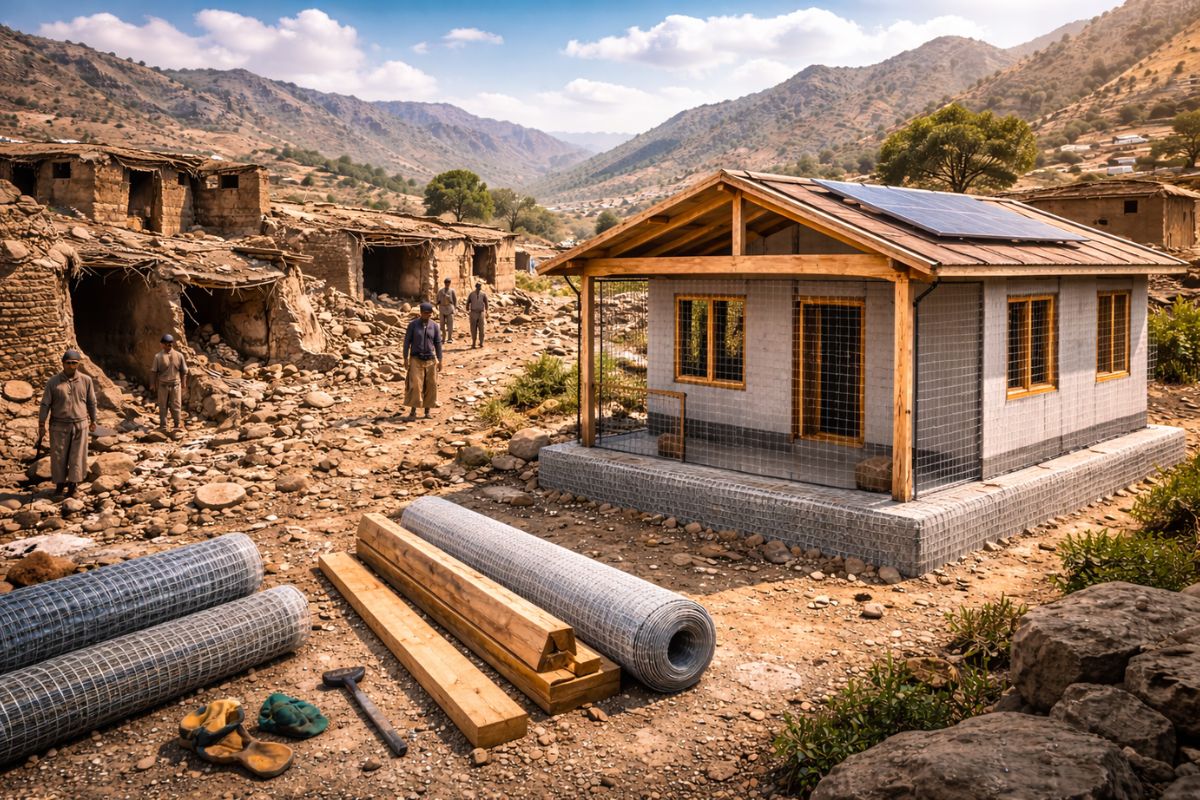
A Model Of Earth House Created By Researchers Combines Mud, Wood, Steel Mesh, And Even Plastic Fencing To Multiply Seismic Resistance In Rural Villages Of Afghanistan And Reduce The Risk Of Total Collapse In Future Earthquakes.
It was supposed to be just another series of tremors in a region used to seeing the ground shake. Instead, entire villages of mud houses turned to dust in a few seconds, repeating a pattern of destruction that has followed Afghanistan for decades. Thick earthen walls, flat roofs, and unreinforced constructions collapse with moderate seismic movements, crushing the interior of homes. It is in this scenario that a new model of earthquake-resistant earth house, designed specifically for the rural typologies of the country, gains strength.
Based on decades of laboratory experiments, shake table tests, and comparisons with seismic codes from countries like Peru, Nepal, India, and New Zealand, this model of house does not aim to transform villages into concrete cities. The proposal is different: to make typical mud houses stop collapsing in a fragile and sudden manner, endure larger deformations without collapsing, and, most importantly, give people time to escape with their lives when the ground shakes.
Earthquakes That Turn Mud Villages Into Rubble
The seismic history of Afghanistan is long and heavy. In just 25 years, between 1998 and 2023, the country recorded more than 15 significant earthquakes, with magnitudes ranging from 5.3 to 7.5. The death toll is brutal: over 12,500 dead, around 30,000 injured, approximately 60,000 houses destroyed, and nearly 190,000 people displaced.
-
The lack of welders, electricians, and operators becomes a structural threat in 2025, with the construction industry and manufacturing already suffering from delays, cost pressures, and labor shortages in Brazil.
-
Brazil and Paraguay are just 46 meters away from a historic union on the bioceanic bridge that promises to revolutionize trade between the Atlantic and the Pacific.

-
With 55 km over the sea, a cost of US$ 20 billion, and enough steel to build 60 Eiffel Towers, China’s largest project has connected Hong Kong, Zhuhai, and Macau in a colossal bridge that defies the logic of engineering.

-
A trick with joint compound transforms a Styrofoam ceiling into a plaster-like ceiling: leveled panels, wires and mesh at the joints, sand, paint, and change the environment while spending little today.
Behind these numbers, there is a common thread. Almost all victims lived in unreinforced earthen houses, built with adobe, layered molded clay (pakhsa), or stone masonry without any seismic concern.
More than 85% of the population lives in walled mud houses, many of them within large family compounds, the Qala, with high walls, several rooms, and heavy flat roofs. When a moderate earthquake hits these structures, structural behavior is fragile, abrupt, and lacks safety margins.
Why Do Mud Houses Collapse So Quickly?
Raw earth itself is not the villain. It is one of the oldest building materials in the world, low-cost, abundant, and with very low carbon footprint compared to concrete and steel. The problem lies in how the structural system is organized.
In the most common typologies, earthen walls have low tensile strength, meaning they crack easily when subjected to lateral forces. The flat roof is heavy and supported by few wooden beams, creating concentrated loads at specific points on the wall.
There are no tie beams connecting walls and the roof in a kind of “structural box.” Corners and intersections, naturally critical areas, almost never receive dedicated reinforcement.
In practice, this means that many earthen walls begin to fail under displacements of just 0.5% of their height, something very low for a structure subjected to seismic actions. Instead of deforming in a controlled manner, the house behaves like a rigid block that cracks, loses stiffness quickly, and collapses.
The Model Of Earth House Designed For Afghanistan

Given this structural vulnerability, researchers proposed a model of earthquake-resistant earth house, which serves as a technical reference.
It is not a unique and closed project but a set of specifications for geometry, wall thicknesses, foundation details, and structural reinforcements that can guide future national standards and reconstruction programs.
The central logic is simple: to maintain the essence of the Afghan mud house while “stitching” the system with discreet, low-cost, and easy-to-execute reinforcements.
Instead of entirely replacing the mud with reinforced concrete, the model works with what already exists and introduces elements of containment and tying that change the seismic behavior of the structure.
In this context, the house model offers a middle ground. It respects vernacular architecture, does not require sophisticated machinery, and has been designed to be understood and executed by rural masons experienced in earth but without formal engineering training.
Three Ways To Reinforce The Same Earth House
The great differentiator of the proposal lies in three reinforcement alternatives, all compatible with the same house model and with varying degrees of cost, technical level, and material availability.
In the first alternative, the house receives a reinforcement with wood. Wooden posts with diameters between 10 and 15 centimeters are positioned at the corners, intersections of walls, free ends, and beside doors and windows.
These posts are embedded in stone masonry or simple concrete foundations, protected by metal or plastic sleeves to prevent rotting and then connected to horizontal beams and the roof.
In this way, the mud house comes to have a hidden wooden skeleton, which helps hold the wall in case of cracks and provides an alternative support pathway for the roof if part of the masonry fails.
In the second alternative, reinforcement is done with flexible steel mesh or geogrid, applied to the surfaces of the walls.
Instead of covering everything blindly, the strips are positioned in strategic areas, such as corners, intersections, mid-sections of long walls, and edges of openings. These meshes are attached to the base of the wall and connected to the tie beam or roof structure. They can then be covered with mortar.
When the earthquake comes, this “reinforced skin” holds the mud even after cracks form, preventing the wall from detaching in large blocks and toppling out of plane.
In the third alternative, the solution uses high-quality flexible plastic fencing. Instead of point strips, the plastic mesh completely envelops the walls on both faces and is tied through the wall’s thickness with steel or nylon ropes every few decimeters. The surface is covered with plaster, preferably based on lime and sand.
The result resembles a continuous “sack”: the wall may crack internally, but the fragments remain contained by the wrapper, which reduces the risk of sudden collapse. This alternative is especially interesting where metal mesh is expensive or difficult to transport.
What Laboratory Tests Reveal About The House Model
The formulation of this earthquake-resistant house model did not come out of nowhere. It relies on tests with adobe and compacted earth walls on both reduced and full scales, subjected to cyclic loads and shake table tests.
These tests show that, in unreinforced earth walls, lateral resistance is low, stiffness degrades quickly, and the failure is brittle, both in-plane and out-of-plane.
In reinforced walls with wood, metal meshes, geogrids, synthetic ropes, plastic fences, and textile mortar systems, the behavior changes radically.
Results indicate increases of 30% to 200% in lateral resistance, elevations in ductility from three to seven times, and more than double the out-of-plane capacity when there is good anchorage in the foundations and at the top of the walls.
Practically, this means that the proposed house model can sustain significant damage, show visible cracks, and experience substantial deformations, yet still remain standing long enough to prevent total collapse and allow occupants to escape.
Instead of a scenario where the ceiling comes down in seconds, the possibility arises of a structure that absorbs energy, sways, cracks, but remains intact enough to save lives.
Why Not Replace Mud With Concrete Everywhere
A central point of the proposal is that it does not try to replace earthen construction with mass reinforced concrete, something that would require financial resources, supply chains, and technical labor that many villages simply do not have.
Raw earth, when used with criteria, has important environmental advantages and thermal comfort.
The CO₂ emissions associated with producing mud walls are much lower than those of concrete and steel, and the thermal performance helps stabilize internal temperature and humidity, which is valuable in regions with extreme climates.
By strengthening the traditional house model with wood, steel meshes, or plastic fences, the study offers an alternative that dialogues with the local construction culture, reduces costs, avoids total dependency on industrialized materials, and at the same time meets the need for greater seismic safety. Instead of a “break” with the past, there is a technical update of what already exists.
The Path Between The Model And The Afghan Reality
Even being technically sound, the earthquake-resistant earth house model still needs to overcome barriers to become standard practice.
There are institutional challenges, such as the need to update building codes, create training programs for local masons and technicians, and ensure some degree of minimum oversight.
There are also technical gaps, such as the lack of full-scale testing with very thick walls and traditional roofs with concentrated loads, a very common situation in Afghanistan.
Additionally, economic reality weighs heavily. In many regions, families struggle to rebuild a simple house after an earthquake, making it difficult to require additional reinforcements without financial support.
Therefore, the study suggests that the house model be seen as a foundation for public policies, reconstruction guidelines, and pilot projects in more vulnerable communities.
Even with these limitations, the contribution is clear. For the first time, the country has a model of earth house specifically designed for its seismic, climatic, social, and economic context, aligned with the latest in international research but adapted to the actual construction practices that take place in rural villages.
After learning about this proposal, a direct question for you remains: If you had the option, would you accept living in a model of mud house reinforced with wood, steel meshes, or plastic fencing, provided it is proven to be safer than the traditional constructions in your area?









-

-

-

-

8 pessoas reagiram a isso.