





 Portuguese
  English
  Spanish
  3 min of reading
  0 comments


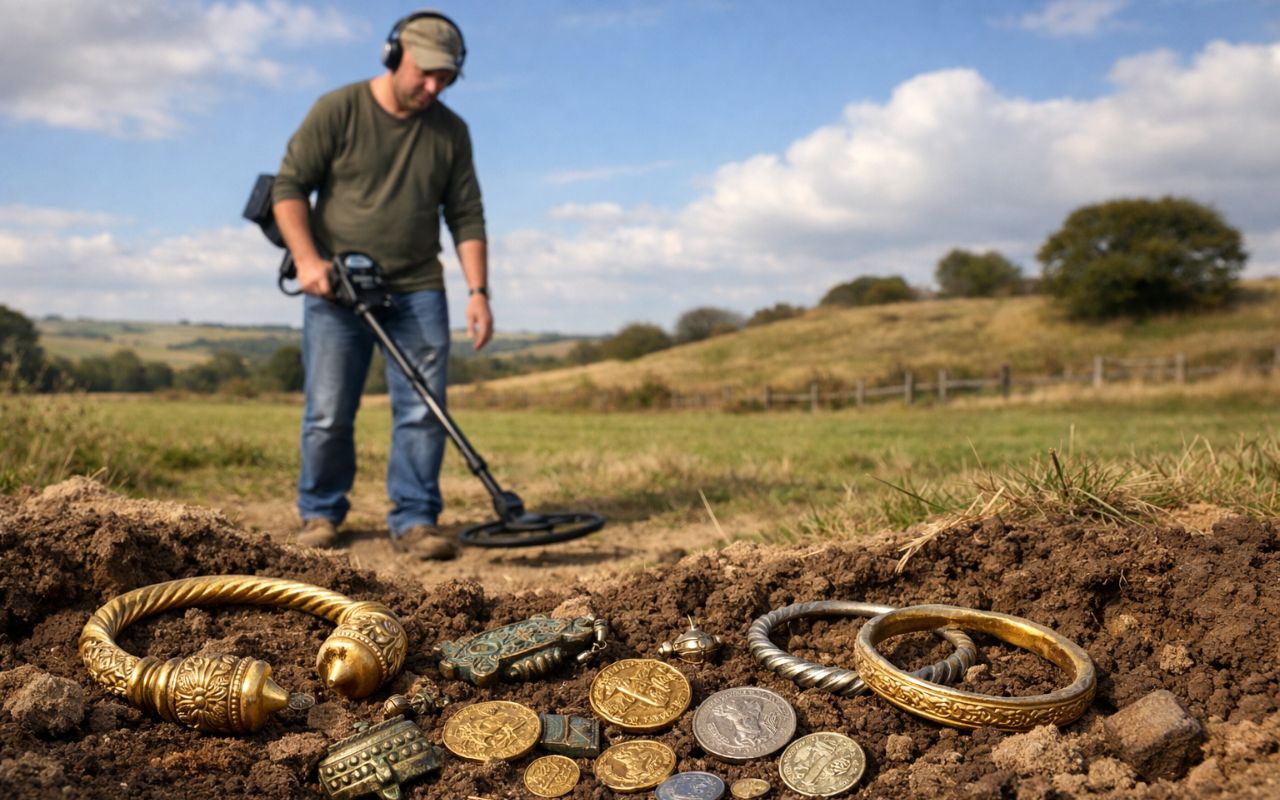
A Metal Detector Led to the Discovery of a Vast Iron Age Treasure in Northern England, with Rare Pieces, Ancient Chariots, and Objects That Rewrite History.
Using a metal detector, a treasure with over 800 artifacts buried for about 2,000 years came to light in northern England, forming one of the largest collections ever recorded from the Iron Age in the region.
The discovery was officially announced in March 2025 and considered a turning point for British archaeology.
The objects include parts of chariots, iron wheels, ornate harnesses, and decorative pieces with colored glass and Mediterranean coral.
-
He started running at 66 years old, broke records at 82, and is now a subject of study for having a metabolic age comparable to that of a 20-year-old, in a case that is intriguing scientists and inspiring the world.

-
Oldest tree on the planet reappears after 130 years of searches: Wattieza, 385 million years old, was 10 meters tall and had no leaves or seeds; Gilboa fossils in New York solved the mystery in 2007.

-
A 48-square-meter house assembled in hours with 4,000 bricks made of recycled plastic that does not absorb moisture, has natural thermal insulation, and costs less than 90,000 reais in a complete kit.

-
Luciano Hang revealed that Havan’s air fleet has already accumulated more than 20,000 landings, 10,000 flight hours, and 6 million kilometers traveled, and he says that without the planes, the company would never have grown so quickly.


The wealth and variety of the material indicate a level of social sophistication much higher than previously thought for that historical period.
Where Was the Treasure Found?
The find occurred in a farmland near the village of Melsonby, in northern England.
The area has historically been associated with the Brigantes, a people who dominated much of the region before the arrival of the Romans.
The artifacts were dated to the 1st century AD, a period marked by Roman expansion under Emperor Claudius.

This historical context makes the Iron Age treasure even more relevant, as it may reveal details about how these local groups reacted to the political and military transformations of the time.
How Did the Metal Detector Lead to the Discovery?
Interestingly, it all started years before the official announcement. In 2021, Peter Heads, an enthusiast, was using a metal detector in the area when he detected unusual signals underground.
Realizing it could be something significant, he alerted the relevant authorities, allowing professional archaeologists to conduct a controlled excavation.
This action was essential to preserve the historical context of the treasure, which is fundamental for accurate scientific analyses.
Indications of Rituals and Cultural Practices of the Iron Age
One of the aspects that intrigues researchers the most is the condition of several objects. Many appear to have been deliberately broken or burned before being buried.
This pattern suggests that the deposit was not accidental. Experts raise hypotheses about possible rituals, ceremonies, or demonstrations of power conducted during the Iron Age, which expands the debate on the cultural practices of these peoples.
Commercial Connections and Mobility Surprise Experts
The presence of Mediterranean coral and colored glass among the items indicates that there were trade networks much wider than previously assumed.
This demonstrates that communities in northern England maintained contacts with distant regions of Europe.

Additionally, the number of chariot components, including 28 iron wheels, reveals sophisticated technical mastery in vehicle construction.
This suggests mobility and a more structured social organization than previous records indicated.
Iron Age Treasure May Be Exhibited to the Public
After the excavation, the Yorkshire Museum began efforts to officially acquire the collection and ensure its preservation.
Some pieces have already been exhibited temporarily, drawing great interest from the public and the academic community.
The case also reignites the debate about the responsible use of the metal detector.
When used within the law and with proper communication to authorities, the equipment can significantly contribute to science.
In this episode, the collaboration between an amateur and professional archaeologists was crucial in transforming a simple metal signal into a discovery that could rewrite part of the history of the Iron Age in Great Britain.








-

-

-

10 pessoas reagiram a isso.