





 Portuguese
  English
  Spanish
  4 min of reading
  1 comment


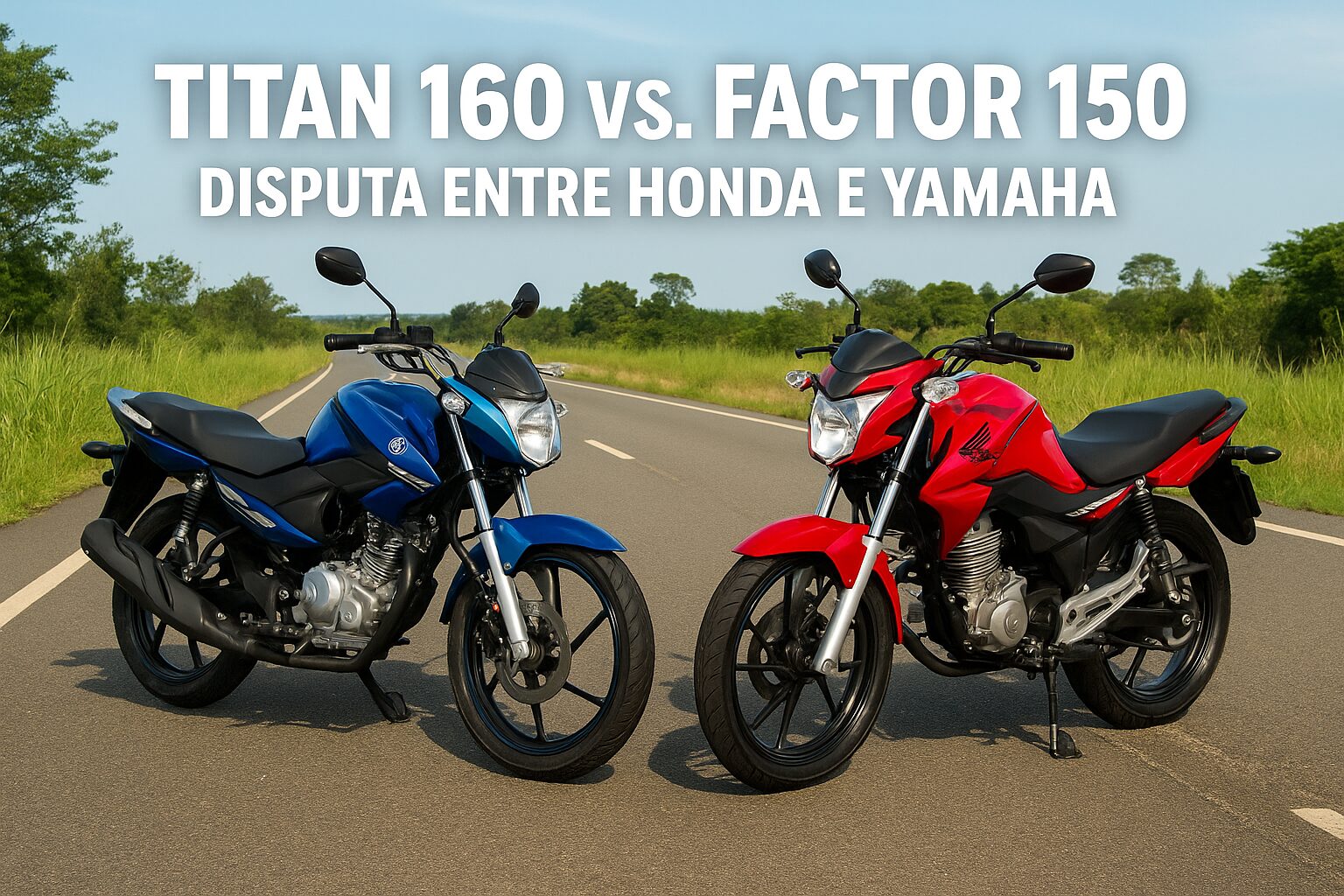


In A Test With Only One Liter Of Gasoline, The Yamaha Factor 150 Outperformed The Honda Titan 160 In Fuel Efficiency, Reigniting The Dispute Between The Two Brands In The Brazilian Market.
The rivalry between Honda and Yamaha in Brazil is enormous. This time, check out a direct comparison between two of the most popular models in the low-displacement category: the Honda Titan 160 2023 and the Yamaha Factor 150 2023.
An informal test, but conducted with careful methodology by content creator Cars With Tiago, placed the two bikes side by side to measure which offers greater fuel efficiency with only one liter of gasoline.
The bikes were completely emptied of their tanks.
-
The car stored for 38 years: when opening the barn door, what appears is breathtaking and looks like a scene from a movie!

-
Fiat works miracles in the Brazilian market, lowers the price of its 0 km hatch to R$ 69,990, reestablishes the model as the cheapest car in the country, and reignites the battle against Kwid and C3.
-
Chevette with cooking gas: How the gas cylinder ends up being used in cars clandestinely and why this makeshift solution can result in leaks, explosions, damaged engines, and seized vehicles.

-
Fiat launches the new 2027 Toro hybrid with 48V, 176 hp, an electric motor of 15.5 hp, a 0.85 kWh battery, up to 7% fuel savings, 8% fewer emissions, and possible exemption from IPVA.

From there, both models received exactly one liter of fuel, each.
The fuel consumption test was conducted simultaneously, on the same road, with the same direction and a constant average speed of 80 km/h.
Two motorcyclists rode together, under equal conditions.
The intention was simple: to see which bike could travel farther before stopping due to lack of fuel.
The Test Yamaha Factor 150 Vs Honda Titan 160
The competition was close, but the results showed slight differences that could be decisive for those prioritizing fuel economy.
The Honda CG Titan 160 was the first to stop due to lack of fuel, after traveling 44 kilometers. The Yamaha Factor 150 went farther.
Even with difficulties at the end of the route — with engine malfunctions and sporadic stalls — the Yamaha bike managed to cover 47 kilometers, winning the fuel consumption test by three kilometers.
Despite the issues that arose at the end of the journey, the Factor demonstrated greater fuel efficiency, which can make a difference for consumers, especially in times of high fuel prices.
Two Giants In Dispute
Honda and Yamaha have been starring in one of the fiercest rivalries in the two-wheel sector in Brazil for decades.
Honda leads the national market by a wide margin, but Yamaha has gained ground and recognition for the efficiency of its models and the durability of its engines.
The Titan is a long-time favorite of Brazilians and a reference in reliability.
The Factor is viewed as a robust and economical alternative, winning fans precisely for its good cost-benefit ratio.
The low-displacement motorcycle segment, especially between 150 and 160 cubic centimeters, is one of the most important in the country.
This type of motorcycle is highly sought after by those who use the vehicle daily, both for personal transport and for work with deliveries and urban commuting.
In this context, every cent counts — and fuel efficiency per liter can be decisive.


Price Comparison
In the current market, both models are priced relatively close, although they may vary depending on the region of the country. The Honda CG 160 Titan 2023 has an average price of R$ 15,000 to R$ 16,000 at dealerships.
The Yamaha Factor 150 2023, on the other hand, appears slightly more affordable, with prices ranging between R$ 13,500 and R$ 14,500, depending on the version and options.
In addition to the consumption difference, the initial cost can also weigh in the buyer’s decision. However, it’s important to remember that maintenance, parts, and resale value are also part of the equation.
Performance, Comfort, And Maintenance
The Titan 160 features a 162.7 cc engine, with electronic fuel injection, a maximum power of 15.1 horsepower, and a five-speed transmission. It is known for its smooth gear shifts, good urban performance, and comfortable riding position. Its dashboard is fully digital, and the model comes with a combined brake system (CBS), ensuring greater safety.
The Factor 150, on the other hand, has a 149.3 cc engine, with a power of 12.4 horsepower and also electronic fuel injection. Its main advantage lies in its lightness and fuel efficiency.
Even with inferior performance in numbers, the bike is appreciated for its low fuel consumption, ergonomic riding position, and simple maintenance.
The dashboard is analog with a small digital display, and the model is highly praised for its durability in daily use.
Economy In Practice
The test conducted, even though it was informal, reinforces an important point: for those seeking fuel economy, the Factor may have a slight advantage.
Traveling 3 km more on the same liter of gasoline may seem insignificant, but in daily use, this represents savings over the months.
If a motorcyclist travels 1,000 km per month, for instance, this difference adds up to 68 extra kilometers every 22 liters — equivalent to almost an additional tank per year.
On the other hand, many still prefer the Titan for its overall setup, which includes superior performance, greater power, and better resale value.
The Consumer Choice
In the end, the decision between the two motorcycles will depend on the profile of each consumer. Those prioritizing fuel economy may lean towards the Yamaha Factor.
Meanwhile, those who value performance and tradition may prefer the Titan.
The fuel consumption test reignites the debate between the two brands and shows that, even in small differences, the Brazilian consumer is attentive to every detail.
The rivalry between Honda and Yamaha remains alive on the streets — and at fuel stations.









Essa **** ta cheio de propaganda que fica abrindo na tela e não da pra fechar.