





 Portuguese
  English
  Spanish
  3 min of reading
  0 comments


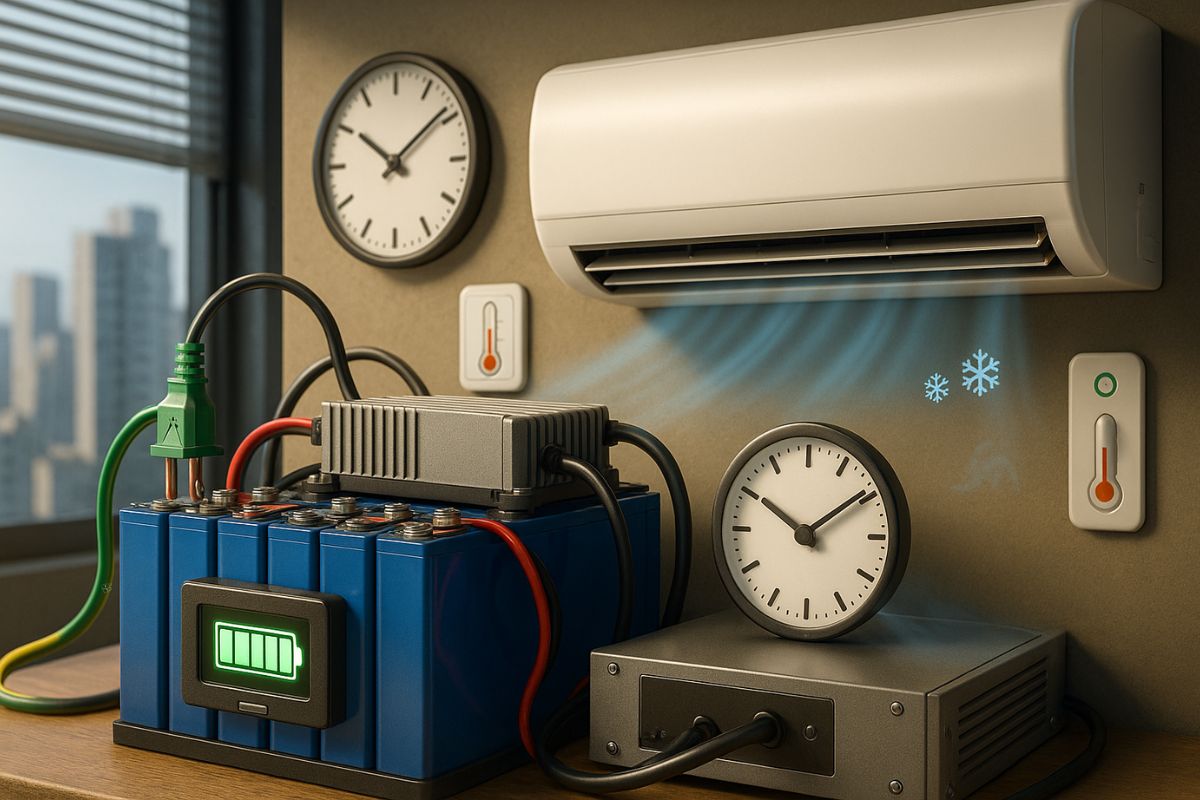
A Single LiFePO₄ Battery 25.6 V/100 Ah Kept An Inverter Air Conditioner 9,000 BTU For 8h38 At 24 °C; Using 80% Of The Charge, Yielded 7h30.
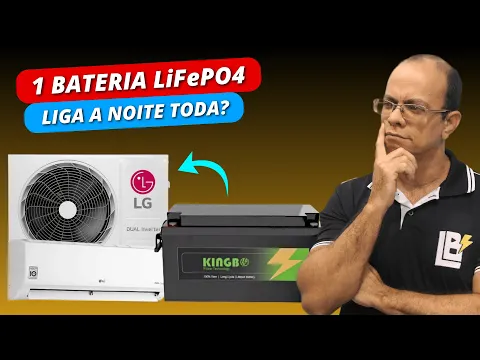
One of the most discussed points in off-grid solar energy projects is the real autonomy of high-consumption equipment, such as air conditioners. In a practical test conducted by Luciano Batista, a LiFePO₄ battery of 25.6 V and 100 Ah kept an inverter air conditioner of 9,000 BTU running for 8 hours and 38 minutes, in a closed environment set to 24 °C.
Considering only 80% of the charge, the recorded autonomy was 7 hours and 30 minutes.
According to Batista, the aim of the trial was to demonstrate how the use of lithium iron phosphate (LiFePO₄) batteries, in conjunction with compatible inverters, can offer reliability and cost savings in the continuous use of air conditioners, even without support from solar generation.
-
Brazil raises alarm to avoid blackout: the country may need 3 Itaipus and is already wasting up to 5,135 MW of energy on days of excess solar.

-
Renewable energy advances over protected areas in Brazil, and a survey by the Energy Transition Observatory reveals silent impacts that challenge environmental conservation and pressure sensitive traditional territories.

-
Rio Grande do Sul accelerates energy transition: State invests in renewable technologies and consolidates decarbonization strategies and pathways to attract billions in new industrial investments.

-
With 160,000 m² of collectors, an area larger than 20 football fields, Silkeborg, in Denmark, hosts a solar thermal plant that heats 19,500 homes and could become the largest solar heating plant in the world.


How The Test Was Conducted
The experiment utilized a Kingball LiFePO₄ battery (25.6 V/100 Ah, ≈ 2,560 Wh), equipped with A-grade EVE cells and a BMS JK with active balancing.
The system was charged to 29.2 V before operation.
The conversion to alternating current was handled by a Usina inverter of 2,500 W (5,000 W peak), outputting at 220 V/60 Hz.
The tested equipment was an LG Dual Inverter of 9,000 BTU, set to 24 °C. The consumption was measured by a wattmeter installed at the AC output of the inverter, with supplementary readings on the DC side to identify conversion losses.
In the first minutes, the compressor reached peaks of 800 to 900 W, stabilizing around 260 to 300 W after the initial cooling.
With the environment balanced, the average consumption remained at 211 to 240 W, confirming the more efficient profile of inverter models.
Results Obtained
After 1 hour of operation, the battery registered about 81% charge, with consumption varying between 207 and 318 W.
In 3 hours, 880 Wh had been drained, maintaining a stable temperature in the environment. By 5 hours, the total reached 1.3 kWh.
The point of 80% discharge was reached in 7h30 of continuous use, when the battery indicated approximately 20% remaining charge.
The test continued until 8h38, reaching about 10% residual charge, with a cumulative consumption of 2.0 kWh measured on the AC side.
Batista highlighted that the reading does not exactly include all system losses, as the measurement was made at the AC output.
In practical terms, the autonomy was within the expected range for the nominal capacity of the battery.
Factors That Affect Autonomy

The specialist noted that the time of use depends on external variables such as:
Room size and thermal insulation;
Exposure of walls to sunlight;
Number of people in the environment;
Air conditioner setting temperature (17 °C requires much more energy than 24–25 °C).
Therefore, practical tests are fundamental to validate sizing and avoid unrealistic expectations in off-grid solar energy projects.
Recommendations for Off-Grid Systems
Luciano Batista emphasized that inverter or dual inverter air conditioners are better suited for battery systems, as they eliminate successive startup peaks and operate with modulated power, reducing consumption.
In addition, he explained that autonomy is proportional to the number of batteries installed.
Using two identical units in parallel, for instance, can double the operation time, provided the inverter, cabling, and protections are properly sized.
The test confirms that a LiFePO₄ battery of 100 Ah can keep a 9,000 BTU inverter air conditioner running for up to 8h38 under controlled conditions, with 7h30 of safe autonomy within the 80% discharge limit.
And you, do you believe this result proves that off-grid systems with LiFePO₄ batteries are viable for residential use in Brazil? Have you considered sizing your own project? Share your opinion in the comments — we want to hear real experiences from those who have already used or plan to invest in this technology.








Seja o primeiro a reagir!