





 Portuguese
  English
  Spanish
  6 min of reading
  0 comments


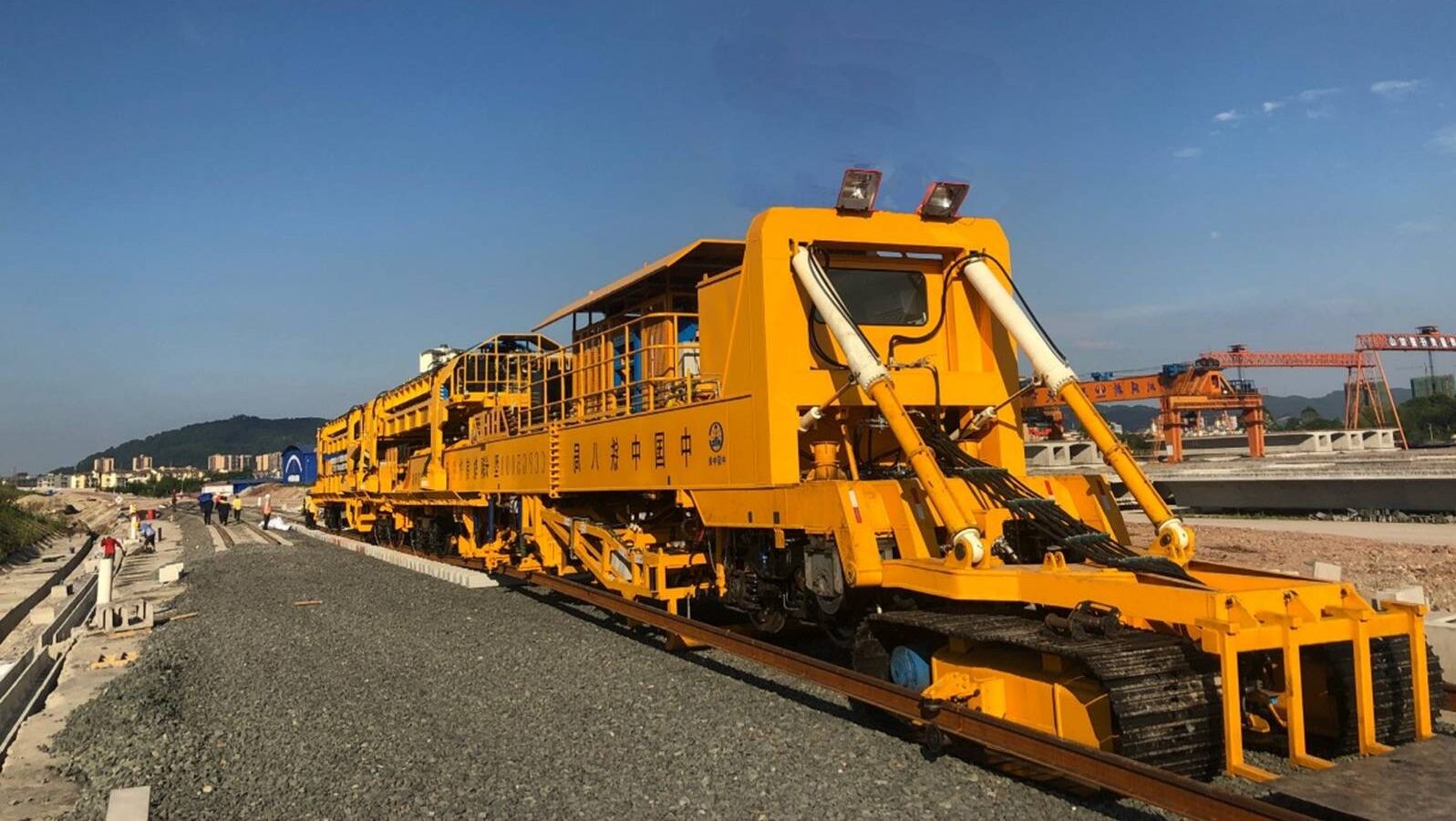
Developed by CRCC, the CCPG500A is a colossal machine that places up to two kilometers of tracks per day, automating the railway construction process and making China a world leader in high-speed trains.
In less than two decades, China has built the largest high-speed train network on the planet — more than 48 thousand kilometers of active lines and a target of 60 thousand by 2030.
At the heart of this revolution is a monumental piece of equipment: the CCPG500A Track-Laying Machine Set, a kind of mobile railway assembly line that lays long tracks with millimeter precision.
Manufactured by the CRRC/CRCC group, the machine has become a symbol of China’s industrial power and is now exported for megaprojects in Asia, Europe, and Africa.
-
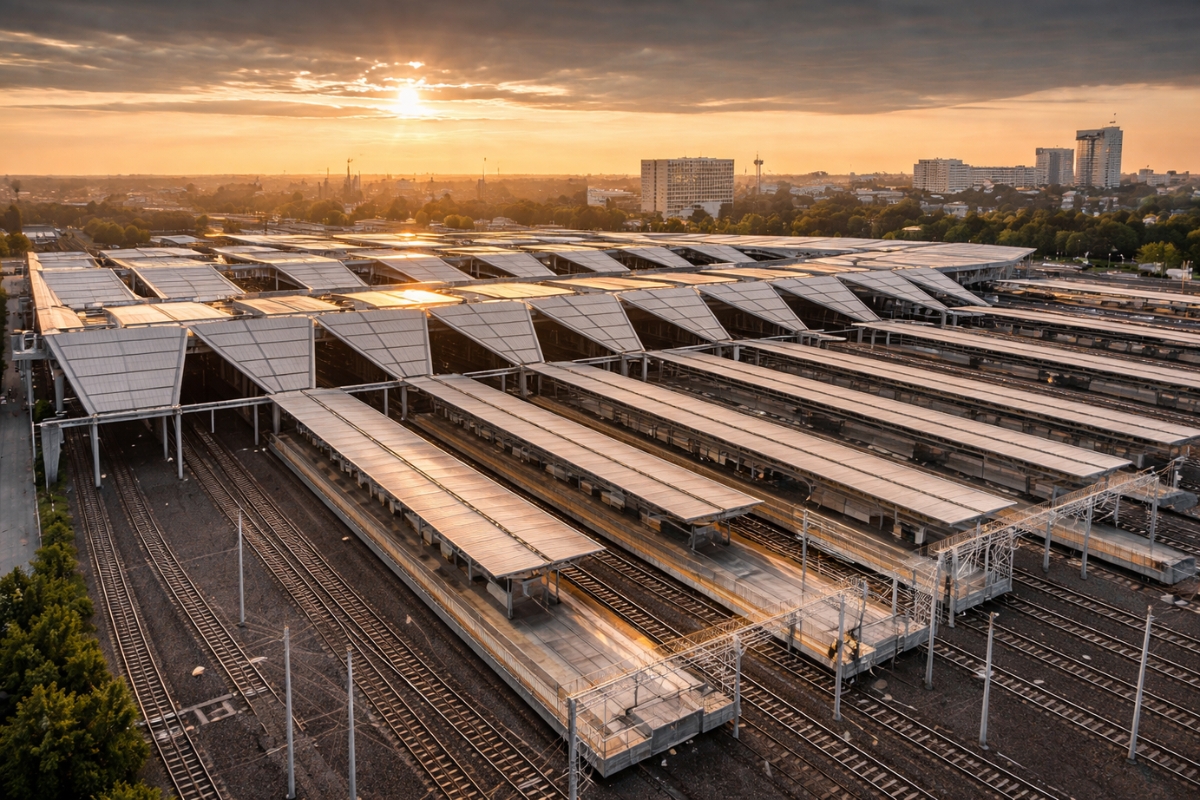
In A European City, The Country’s Largest Railway Junction Was Modernized Without Closing Its Doors, Kept Trains Running During Years Of Construction, Now Serves Up To 60,000 Passengers Per Day, And Installed Solar Panels That Generate About 30% Of Its Energy
-
Famous Brazilian Railway May Become a Parking Lot

-
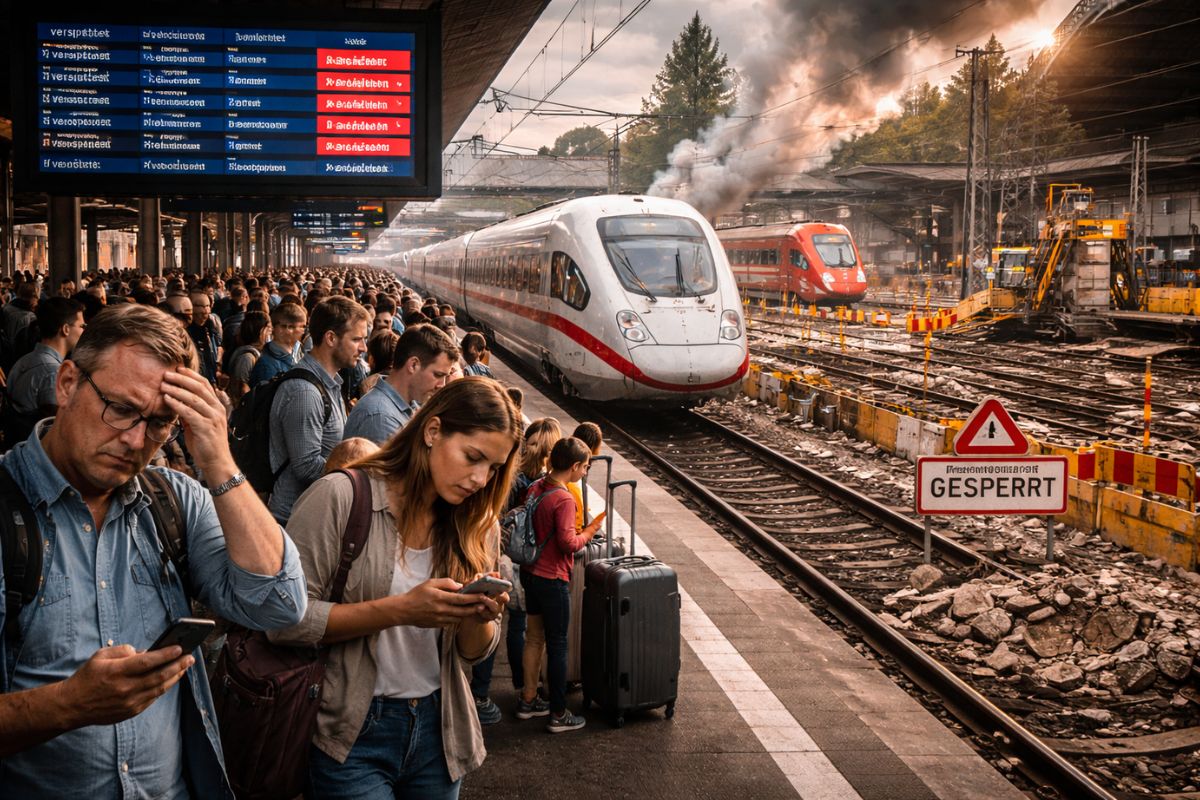
The Country of “Punctual As a Train” Admits It Has Lost Control: High-Speed Trains Delay, Stop, Disappear from the Map and Turn 6-Hour Trips into 10, While Deutsche Bahn Promises Restructuring in 2026 But Faces 19th Century Infrastructure, Staff Shortages and Sections Closed for Months
-
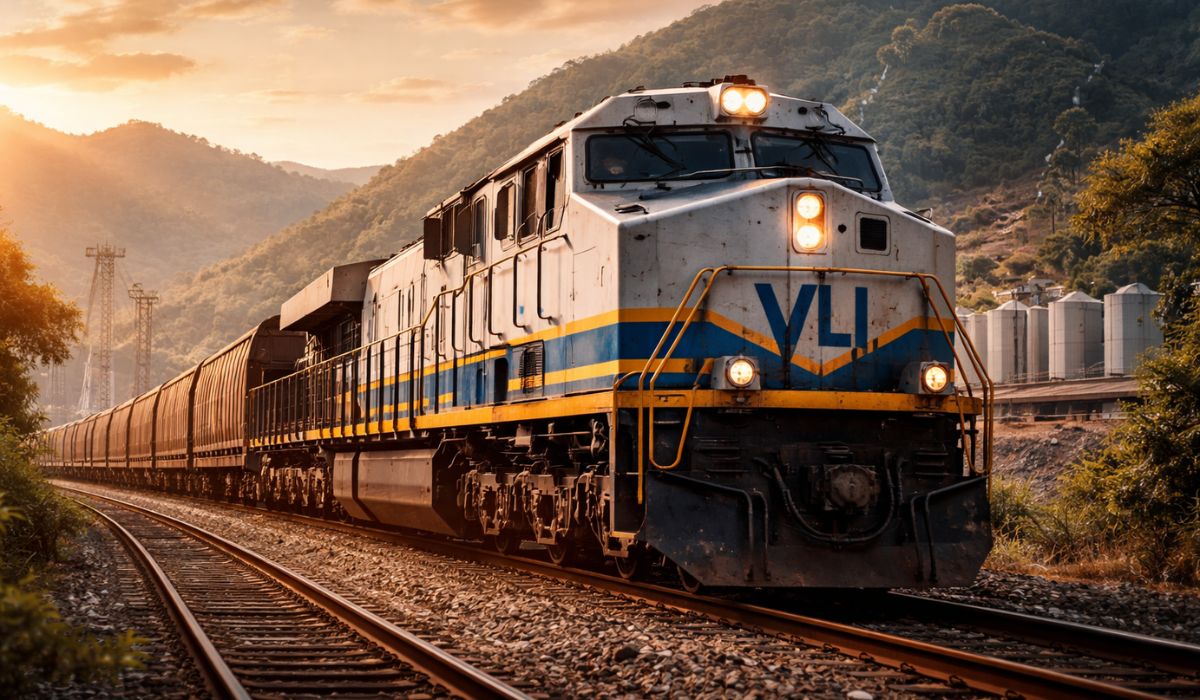
With an Investment of R$ 700 Million in One of the Country’s Main Rail Networks, VLI Reinforces Infrastructure, Receives 8 New Locomotives, and Expands the Corridor Connecting 7 States, Boosting Jobs and the Transportation of Grains, Ore, and Oil Products to the Port of Santos

Origin and Development
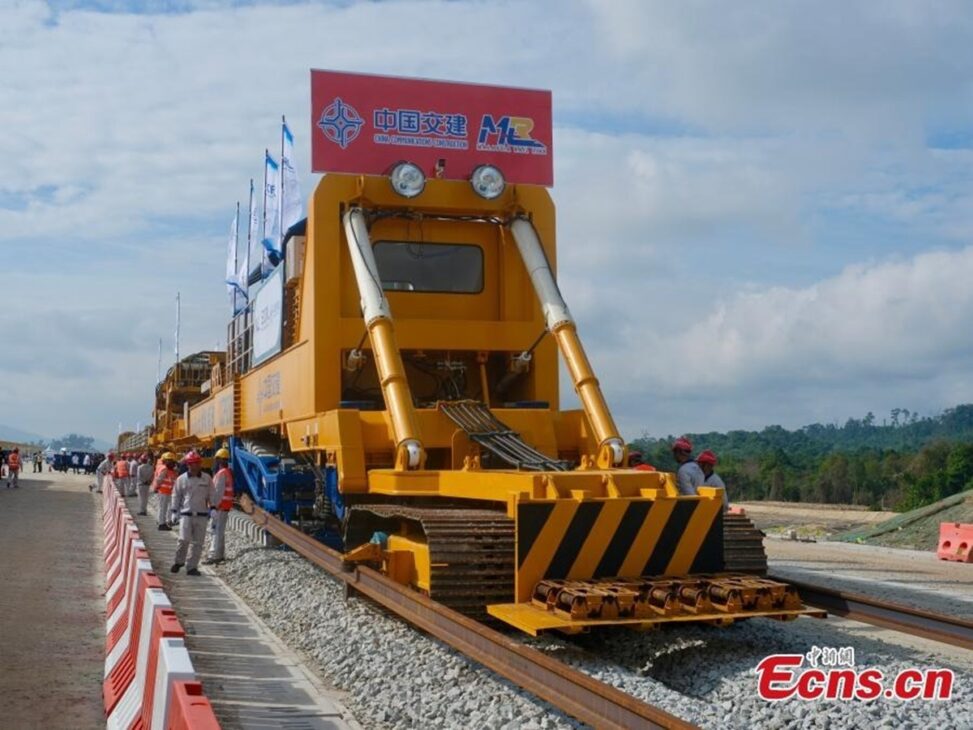
The family of CPG500 machines officially emerged in 2013, developed by CRRC Zhuzhou Locomotive Co., Ltd., to meet the growing demand for high-speed line deployment.
Its principle was simple yet revolutionary: integrate transport, positioning, and fastening of sleepers and long tracks into a single automotive set.
In 2016, CRRC published a technical sheet detailing the parameters of the base model. Shortly thereafter, China Railway Signal & Industrial Co. (CRSIC) unveiled a new version, named CCPG500A, incorporating more precise control systems and a continuous laying method.
The equipment was specifically created for welded long rails (LWR/CWR), eliminating frequent joints and accelerating the construction of high-speed railways.
Constructive Method: “Single-Sleeper Continuous”
The CCPG500A employs the “single-sleeper continuous” method — a continuous process that lays sleeper by sleeper on a previously stabilized ballast.
Shortly thereafter, the long 500-meter tracks are positioned, aligned, and secured automatically.
The system combines laser leveling sensors, synchronized electronic control, and high-precision hydraulic drive, ensuring ideal geometric alignment right from the first pass.
This method replaces old manual operations, where teams placed sleepers and tracks in a segmented manner.
The result is faster, more precise, and uniform work, reducing component wear and the time for subsequent adjustments.
Architecture and Main Components
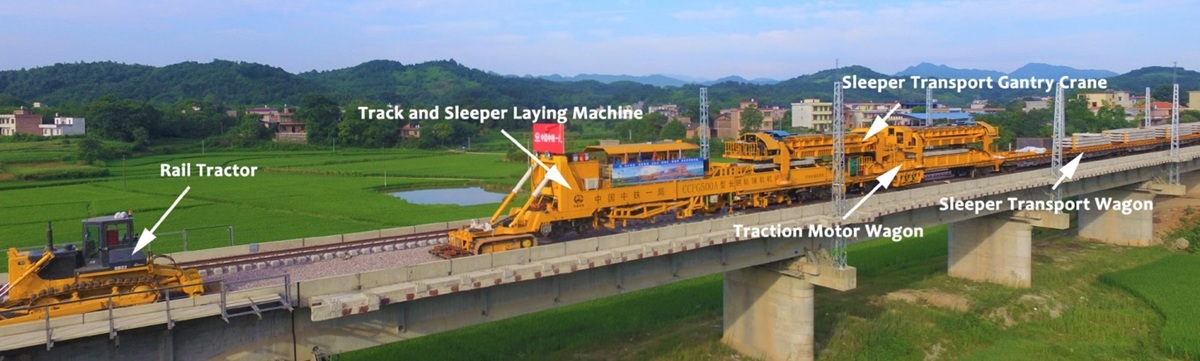
The CCPG500A set consists of several interconnected modules that function as a production line on tracks:
- Crawler Rail Tractor – hydraulic traction locomotive that moves the set;
- Main Operation Car – command center with power and control systems;
- Auxiliary Power Car – electrical and hydraulic support unit;
- Transport Train – supply wagons carrying sleepers and long 500m tracks to the work front;
- Lifting Gantries – rail cranes that transfer sleepers and steel bars to the laying point.
The modular layout allows continuous operation, with no pauses for equipment change or manual replenishment.
Each component performs a specific function within the productive flow — like an advanced factory moving along the railway bed.
Technical Performance and Operational Parameters
The official sheet from CRRC (2016) lists data that helps to quantify the power of the equipment:
- Total Power: 383 kW
- Operational Weight: 1,060 tons
- Pulling Capacity: 2,500 tons (on a 12‰ slope)
- Working Speed: 0 to 0.6 km/h
- Productivity: 12 to 16 sleepers per minute
- Minimum Operational Radius: 250 m
- Minimum Negotiable Curve Radius: 145 m
These values explain how the CCPG500A can install 1.5 to 2.0 kilometers of track per day, a pace confirmed in recent works in Malaysia and Indonesia.
However, performance depends on supply logistics and terrain conditions — the machine operates with maximum efficiency on long, straight sections with leveled ballast.
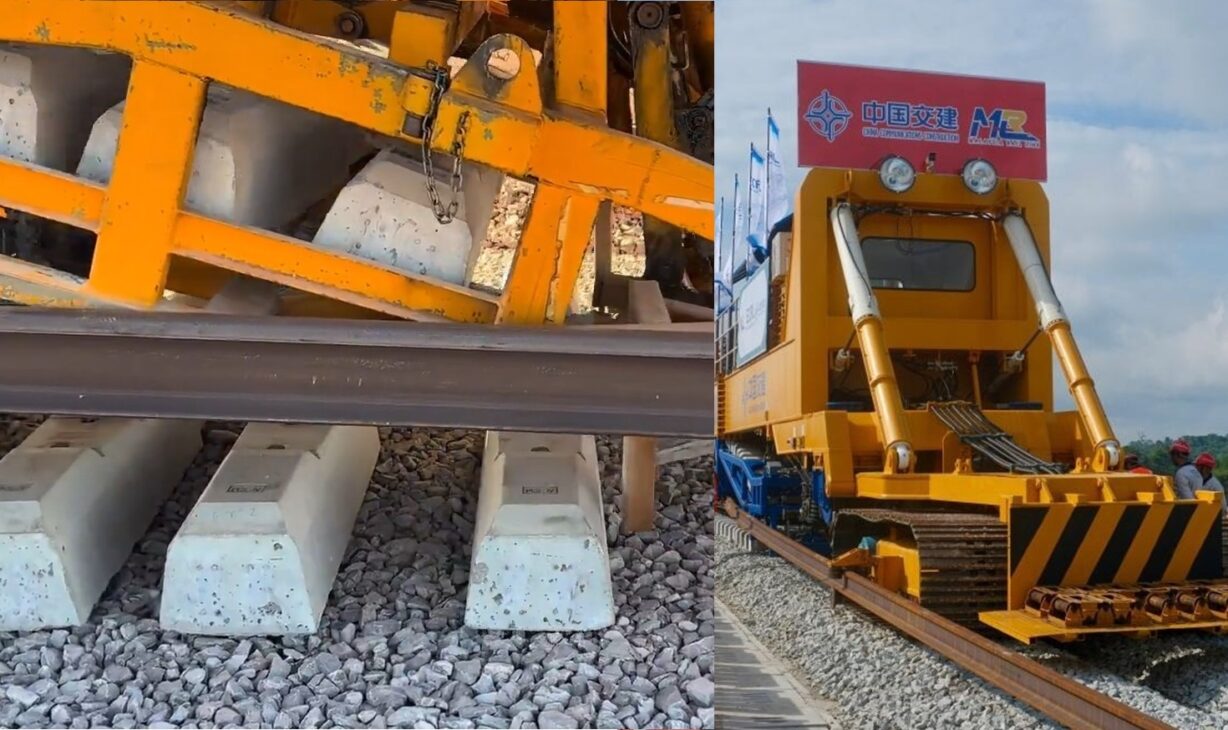
Pre-requisites and Application in Long Rails
Designed for continuous welded rails (CWR), the CCPG500A has been optimized for 500-meter bars, compared to 25 to 300 meters of conventional methods.
This configuration reduces joints, minimizes the risk of thermal misalignment, and increases track durability.
The equipment is also compatible with 60 kg/m rails, standard for high-speed lines, and can operate on both granular ballast and slab track, as long as the bed is prepared and stabilized.
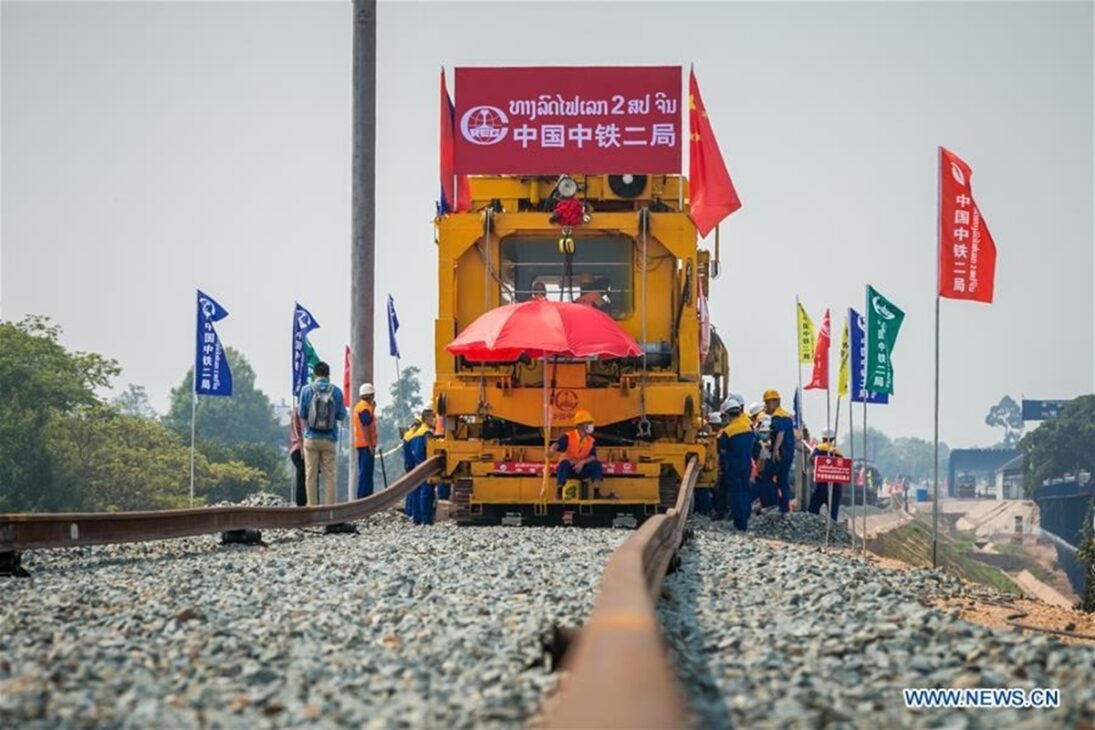
Where It Is in Operation
The CCPG500A is used in large projects inside and outside China, consolidating the export of railway technology as a tool of the Belt and Road Initiative.
Malaysia — East Coast Rail Link (ECRL)
In December 2023, Malaysia began laying tracks for the ECRL using a CCPG500A manufactured by CRSIC.
The equipment was assembled in the Kuantan region, in the east of the country, and is responsible for installing 1.5 to 2.0 km of tracks per day, according to the operator Malaysia Rail Link and the state agency Xinhua.
In March 2024, the first section of 92 km was completed one month ahead of schedule — which the concessionaire itself attributed to the use of the Chinese system.
Indonesia — Jakarta–Bandung High-Speed Railway
In Indonesia, the CPG500 was employed on the Jakarta–Bandung railway, the first high-speed train in Southeast Asia.
The model laid 500 m long tracks and 360 kg sleepers, operating at an average of 1.5 km per day with millimeter precision.
The project, inaugurated in 2023, was constructed by a Sino-Indonesian consortium led by CRRC.
China–Laos Railway
On the China–Laos Railway, inaugurated in 2021, the machine was used on the Yuxi–Mohan/Vientiane section, ensuring the schedule of one of the most complex works of the pan-Asian railway corridor.
The continuous laying system reduced the total time for track installation by about 30%, according to reports from Xinhua and China Railway Engineering.
Hungary–Serbia Railway
In Europe, the CCPG500 is in use on the Hungary–Serbia Railway project, responsible for modernizing the main railway corridor in the Balkans.
The machine operates on the Novi Sad–Belgrade section, laying long tracks and sleepers simultaneously, in a process similar to that used on the Zhengzhou–Wanzhou and Fuzhou–Xiamen lines within China.
Additional Cases and Tests
In addition to commercial operations, the technical document from CRSIC mentions test sections of 500 meters with the CCPG500A in a project identified as Maeast Railway, designed to assess accuracy and laying pace before the main phase.
These sections are standard practices in megaprojects: they serve to calibrate sensors, train operators, and adjust long rail supply logistics.
Strategic Importance and Global Impact
The CCPG500A represents the pinnacle of Chinese railway engineering: a fusion of industrial automation, heavy mechanics, and electronic precision.
By exporting this equipment, China is not just selling a machine, but a complete railway construction system, which includes know-how, control software, maintenance, and training.
This capability has transformed the country into the leading supplier of railway infrastructure on the planet — responsible for projects in more than 100 countries, according to the Chinese Ministry of Transport.
CRCC and its subsidiaries (such as CRRC, CREC, and CRSIC) use the CCPG500A as a showcase of their technical efficiency and the promise expressed in their banners:
“Connecting the World is CRCC’s Value Contribution.”
Operational Limits and Precautions
Despite its impressive capacity, the CCPG500A requires rigorous logistical planning.
Its maximum performance depends on the availability of sleepers and long tracks near the work front, as well as stable weather and terrain conditions.
Mountainous stretches or very tight curves (below 250 m radius) reduce the pace of installation.
Even so, even in complex scenarios, the machine maintains productivity levels superior to any conventional method.
The Future of Railway Laying Machines
With the anticipated expansion of the Chinese high-speed network to 60 thousand km by 2030, the CCPG500A and its successors — such as the CCPG600 and CPG700, currently in development — are expected to play a central role in the upcoming phases of modernization.
Outside of China, the machine is associated with new strategic partnerships in Africa and the Middle East, including projects in Egypt and Nigeria, reinforcing CRCC’s role as a global infrastructure leader.
The CCPG500A is not just a works machine: it is a symbol of the second-generation Chinese industrial era, where engineering, automation, and economic diplomacy converge.
With each kilometer of track laid by it — be it in Tibet, Kuantan, or the Balkans — China takes another step toward its declared goal: connecting the world by railway.










-

-

-

-

-

12 pessoas reagiram a isso.