





 Portuguese
  English
  Spanish
  4 min of reading
  0 comments


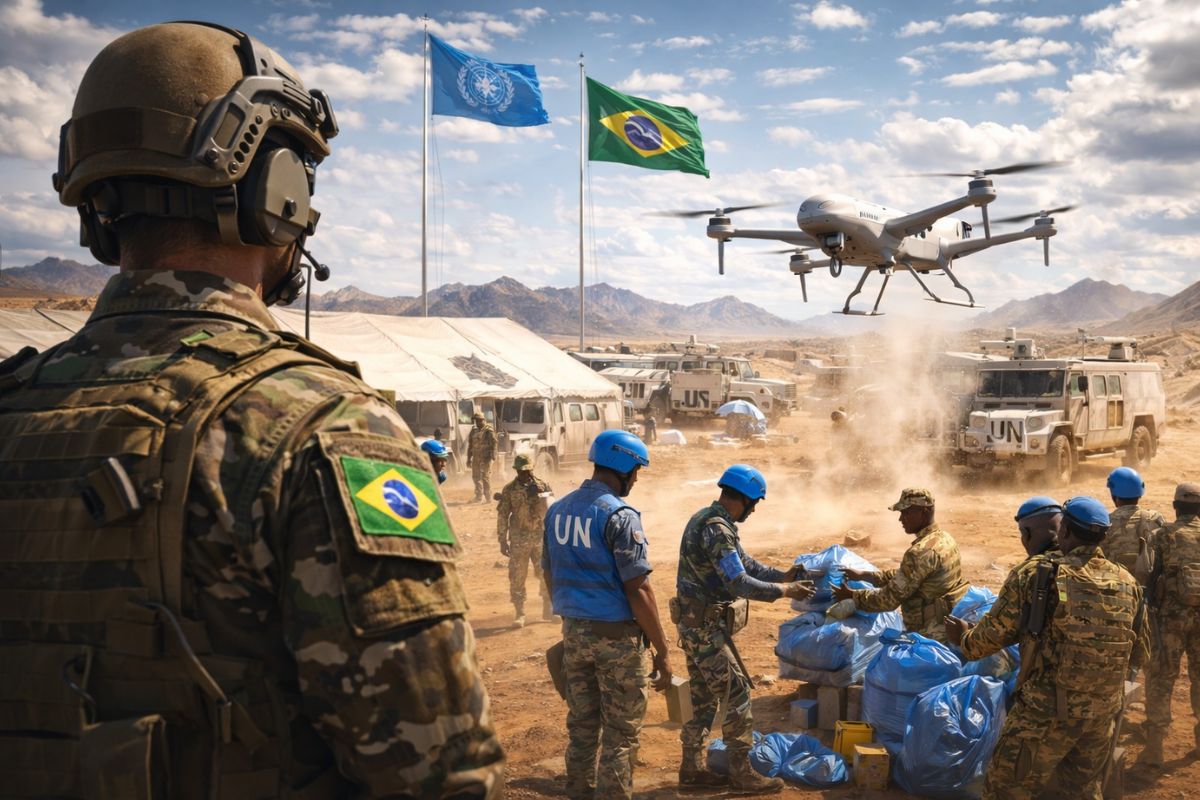
The Brazilian Air Force operated in the UNISFA mission in Sudan with a specialist captain who coordinated the first drone workshop of the mission, trained contingents from Pakistan, Ghana, Bangladesh, Vietnam, India, Nigeria, and China, and also distributed food, water, and medicines in communities affected by the conflict.
The Brazilian Air Force maintained an active presence for a full year in the United Nations Interim Security Force for Abyei (UNISFA) in Sudan, one of the most unstable regions on the African continent. Captain Eduardo Araújo da Silva, a Specialist in Air Traffic Control, represented the FAB from March 2025 to March 2026, conducting initiatives ranging from drone operations to the distribution of humanitarian aid in communities affected by the conflict. At the end of the mission, he was awarded the United Nations Peace Medal.
What makes this operation of the Brazilian Air Force particularly relevant is the breadth of the work. The captain not only coordinated operational activities in remote areas but also organized the first workshop on unmanned aircraft systems for the mission, trained military personnel from seven countries, and directly participated in humanitarian actions that included the distribution of food, water, medicines, and mosquito nets. It is the type of mission that requires both technical competence and the ability to operate in scenarios of extreme political and logistical sensitivity.
What the Brazilian Air Force did in Sudan during one year
The Brazilian Air Force’s operation in Sudan was divided into three complementary fronts. On the humanitarian front, Captain Eduardo Silva worked directly to support local communities north of the UNISFA Base, participating in the distribution of essential supplies and supporting local community protection structures.
-
In Japan, there is a very common piece of furniture made with foam, fibers, cotton, and ancient artisanal techniques that transform the item into a variety of options for modern and small homes.

-
It’s not São Paulo or Rio de Janeiro, but a state in the South completely dominated the happiness ranking of Brazil with three cities in the top positions and excellent scores above 8.9.

-
Brazil on the radar of the space race in Latin America: what NASA’s new phase with the Artemis Program reveals about Alcântara, the best address in the world for rocket launches.
-
How a 100 m² rudder controls ships carrying 21 thousand containers and reveals the part that keeps the giants of the sea on course.

The military also conducted visits to detention centers to verify conditions, provided pre-hospital care during patrols, and contributed to the protection of civilians—activities that placed the representative of the Brazilian Air Force on the front lines of humanitarian aid.
On the operational front, he coordinated activities in remote areas, ensuring security, logistics, and constant communication with the mission command.
In aviation, his area of expertise, the Brazilian Air Force operated in the inspection of airfields and helipads, risk management, incident prevention, and the safe use of drones, training teams and strengthening the safety of air operations in scenarios where any failure can have serious consequences.
The drone workshop led by the Brazilian Air Force in Sudan
The first Workshop on Unmanned Aircraft Systems of UNISFA was the most significant milestone of the Brazilian Air Force’s presence in the mission.
The meeting brought together military personnel from Pakistan, Ghana, Bangladesh, Vietnam, India, Nigeria, and China—seven countries with active contingents in the region—to standardize procedures and strengthen the doctrine of drone use in complex scenarios like Sudan.
Captain Eduardo Silva participated in the coordination of the event and provided instructions on drone inspection, operational safety, airspace coordination, flight authorization processes, risk mitigation, and integration between contingents.
“In an environment marked by logistical challenges, political sensitivity, and shared airspace, technical alignment among the contingents ensures efficiency and compliance with United Nations principles,” emphasized the Brazilian Air Force military. The workshop was the first forum dedicated exclusively to the operational governance of drones in this UN mission.
Why the mission in Sudan requires such a high level of complexity
The Abyei region in Sudan has been disputed between Sudan and South Sudan since the separation of the two countries in 2011. UNISFA exists precisely to maintain a security presence that prevents the escalation of violence in an area where armed groups, territorial disputes, and humanitarian crises coexist.
For the Brazilian Air Force, operating in this environment means dealing with extreme logistical challenges—poor infrastructure, limited communications, severe temperatures, and the need to coordinate actions with military personnel from dozens of nationalities.
The use of drones in this context is not just a technical issue—it is political. The airspace over a conflict zone is shared among UN helicopters, military aircraft from different contingents, and surveillance drones, and any unauthorized or poorly coordinated flight can lead to serious incidents.
By leading the standardization of drone procedures, the Brazilian Air Force helped reduce this risk for the entire mission.
What the mission in Sudan reveals about the role of the Brazilian Air Force in the world
Colonel José Paulino Sobrinho Junior, Chief of the Sub-Department of Peacekeeping Mission Coordination, summarized the significance of the Brazilian presence.
“The presence of FAB military personnel in UN missions reflects the high level of professionalism of our personnel in international operations. The first drone workshop highlights Brazil’s contribution to strengthening operational security and harmonizing protocols,” he stated.
Captain Eduardo Silva was the first Air Traffic Control Specialist to serve simultaneously as a Military Observer and Flight Safety Officer in such a complex operational environment.
The award of the United Nations Peace Medal is not just individual recognition; it is validation that the Brazilian Air Force has the capacity to operate in any scenario on the planet, from multinational exercises in Campo Grande to conflict zones in Sudan. For a country seeking a permanent seat on the UN Security Council, this type of operational presence is more than a military mission—it is foreign policy in action.
Did you know that the Brazilian Air Force operates in peace missions in Sudan? Do you think Brazil should expand its presence in UN operations?







Seja o primeiro a reagir!