





 Portuguese
  English
  Spanish
  6 min of reading
  0 comments


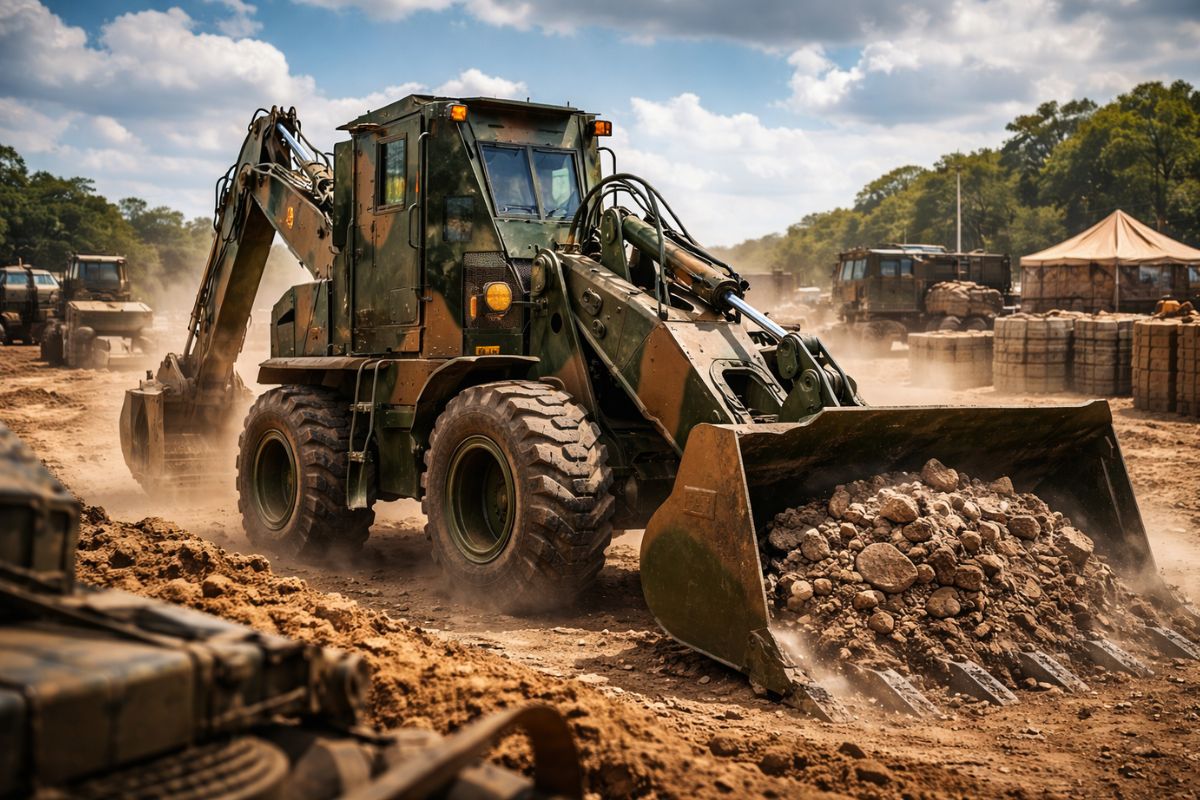
The Brazilian Army received from the War Arsenal of Rio a Caterpillar 416F2 backhoe equipped with ballistic armoring developed entirely in Brazil, and the project already foresees the protection of other military engineering equipment for use in risk scenarios without harming the operation of the machines.
The Brazilian Army has just incorporated into its arsenal a capability that until recently depended on foreign technology: engineering machines with ballistic protection designed and manufactured entirely on national territory. On March 27, the War Arsenal of Rio (AGR) delivered to the 1st Combat Engineering Battalion School a Caterpillar backhoe, model 416F2, equipped with a custom armor kit that protects the operator without compromising the functionality of the equipment. This is the second engineering vehicle to receive this type of protection developed by the AGR, consolidating a program that began in 2022 with the armoring of a Caterpillar 924H loader.
The project represents more than just a one-time equipment delivery. It signals that the Brazilian Army is institutionally building a national production line for armor for military engineering machines, a segment in which few countries have their own capability. The next step is already defined: at the request of the Engineering Material Directorate, the AGR will develop armor for the multi-purpose skid steer loader, expanding the portfolio of protected equipment available to the Ground Force.
What the Brazilian Army received and why it matters

According to the portal Forte.jor, the backhoe delivered to the Brazilian Army is not an ordinary machine with bolted steel plates. The ballistic protection kit was fully customized, requiring detailed dimensional surveys of the original structure of the Caterpillar 416F2 and specific engineering solutions for each attachment point.
-
Starlink’s satellite internet is now bundled with mobile service: US Mobile aims to revolutionize the American connectivity market with an integrated plan starting at $50, but still leaves many questions unanswered about how it will work.

-
NASA advances in oxygen production on the Moon using concentrated solar energy, eliminating logistical barriers and bringing the scenario of permanent human bases closer with less dependence on Earth shipments.

-
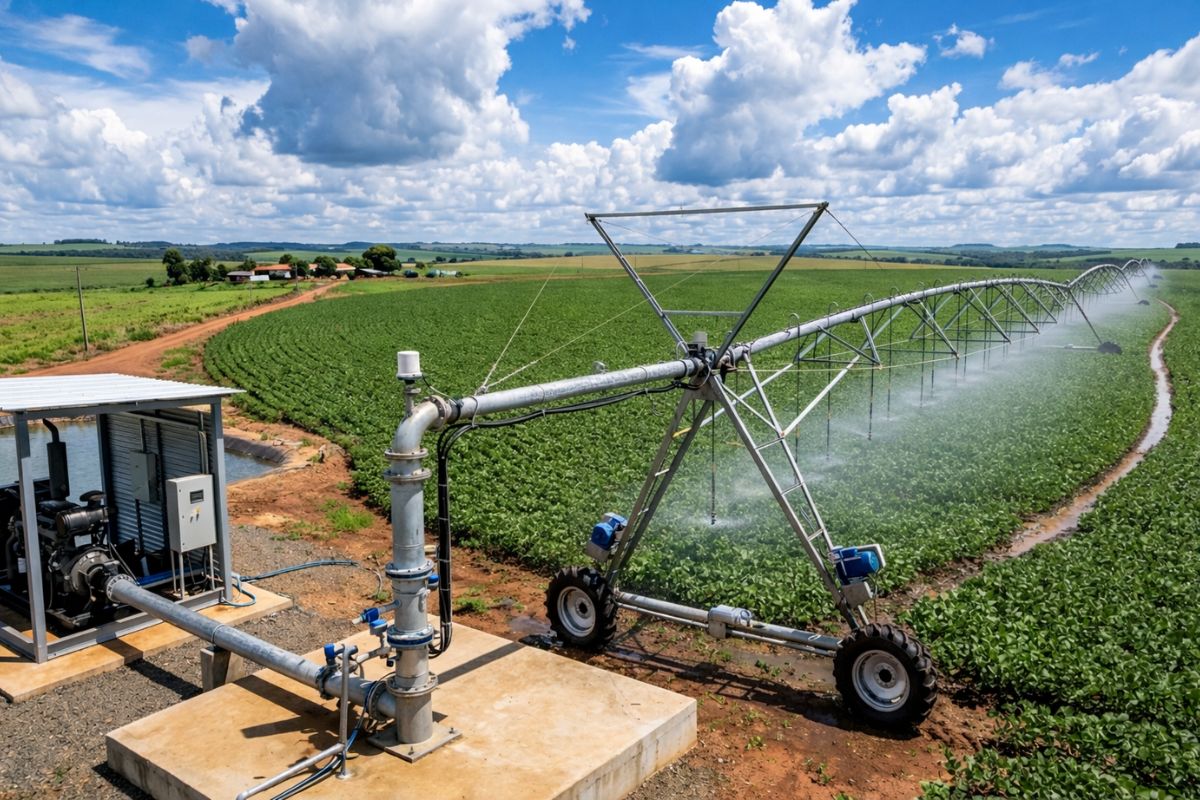
How a central pivot works inside: from the pump house to the 500 m rotation, 150 hp motor, 75 hectares irrigated in 16 to 24 hours, sensors, nozzles, and maintenance.
-
Why is the ship’s command bridge located at the back: engine and rudder at the stern, more space for cargo, safer maneuvers, more stable crew, and laws that sometimes require it to be in the center or bow?

The work was conducted by the Engineering Projects Section of the AGR, which used modeling in state-of-the-art software and specific metal alloys to ensure that the armor met simultaneously three critical requirements: effective protection, full visibility for the operator, and mechanical feasibility of installation.
These three requirements are what make the armoring of engineering equipment a challenge different from what is done with traditional combat vehicles. A backhoe needs to operate with an articulated arm, bucket, and rotating cabin; any limitation of movement or visibility caused by the armor would render the machine useless in the field.
The fact that the Brazilian Army has managed to solve this dilemma with its own technology is significant. In real operations, these armored machines enhance the capability to remove barricades, clear paths, and perform engineering work in hostile environments, providing concrete protection to the crew operating the equipment.
The War Arsenal of Rio and its 250 years producing military capacity

The War Arsenal of Rio is not just any factory. With over 250 years of history, it is one of the oldest manufacturing military organizations in the Brazilian Army and one of the main fields of action for military engineers in their various specialties.
The AGR manufactures armaments including mortars, revitalizes defense materials, conducts applied research, and, when necessary, supports civil defense operations. Its bicentennial trajectory positions it as a fundamental piece for maintaining the operational capacity and war production of the Ground Force.
It is in this institutional context that the engineering equipment armoring project gains strategic dimension. The AGR is not just delivering armored machines to the Brazilian Army; it is developing accumulated technical knowledge that allows the country to produce tailored solutions, without relying on imports or generic adaptations from foreign manufacturers.
Each armor kit is a new project, designed specifically for the model of equipment that will receive the protection. This capacity for customized engineering is what differentiates the Brazilian program from ready-made solutions available in the international market.
How the project evolved from loader to backhoe
The path to the delivery of the armored backhoe to the Brazilian Army began in 2022, when the AGR presented the first machine of the program: a Caterpillar 924H loader equipped with a ballistic protection kit.
That first equipment served as a proof of concept, demonstrating that it was technically feasible to armor a heavy engineering machine without compromising its operationality. The experience accumulated in this initial project was fundamental for the development of the backhoe’s armor, a piece of equipment with significantly different geometry and operational requirements.
The progression of the project follows a deliberate logic. The Engineering Material Directorate requested the AGR to advance from the loader to the backhoe and then to the multi-purpose skid steer loader. Each new armored equipment expands the spectrum of missions that the Brazilian Army can execute in risk scenarios with protection for its operators.
The loader and the backhoe, for example, have complementary uses: while one is more suitable for moving large volumes of material, the other offers versatility for excavation, loading, and work in tighter spaces. Together, they cover a good part of the engineering needs in urban and combat operations.
What are armored engineering machines used for in real operations
The reader may wonder why the Brazilian Army needs backhoes and loaders with ballistic armor. The answer lies in the scenarios in which these machines are employed.
In urban operations, law and order guarantees, or in peace missions abroad, operators of engineering equipment often work under direct threat of gunfire. Removing barricades on blocked roads, opening passages in conflict areas, or performing clearance work in risk zones are tasks that expose the crew to dangers that a conventional cabin cannot mitigate.
The armor developed by the AGR transforms these engineering machines into assets that can operate where it was previously unfeasible without heavy escort or unacceptable risk to the operator. The stated goal of the project is to provide greater safety to the crew during employment in adverse scenarios, without the protection compromising the operational capacity of the equipment.
In practice, this means that the Brazilian Army gains tactical flexibility: it can employ its engineering machines in situations that previously required dedicated armored vehicles or simply would not be executed due to lack of adequate protection.
What is next in the Brazilian Army armor program
The armor program for engineering equipment does not end with the backhoe. The next equipment in line is the multi-purpose skid steer loader, a compact and versatile machine that has applications in both military operations and support for civil defense situations.
The expansion of the armored machine portfolio indicates that the Brazilian Army treats the project not as a one-time initiative, but as a permanent line of industrial capacity building within the AGR.
The model adopted—internal development, customization by equipment, use of metal alloys, and cutting-edge software—positions the War Arsenal of Rio as a reference in the armoring of engineering equipment within the Brazilian Armed Forces. For the Brazilian Army, the gain is twofold: technological autonomy and operational protection.
The country ceases to depend on foreign solutions to protect its operators and, at the same time, accumulates technical competence that can be expanded to other types of vehicles and equipment in the future. The AGR, with its more than 250 years, proves that tradition and innovation can walk together as long as there is institutional demand and engineering capable of meeting the challenge.
The Brazilian Army armoring its own engineering machines with national technology is a significant advance, or should the country invest more in ready-made purchases from abroad? Do you think this type of military industrial capacity deserves more visibility? Leave your opinion in the comments.






Seja o primeiro a reagir!