





 Portuguese
  English
  Spanish
  4 min of reading
  1 comment


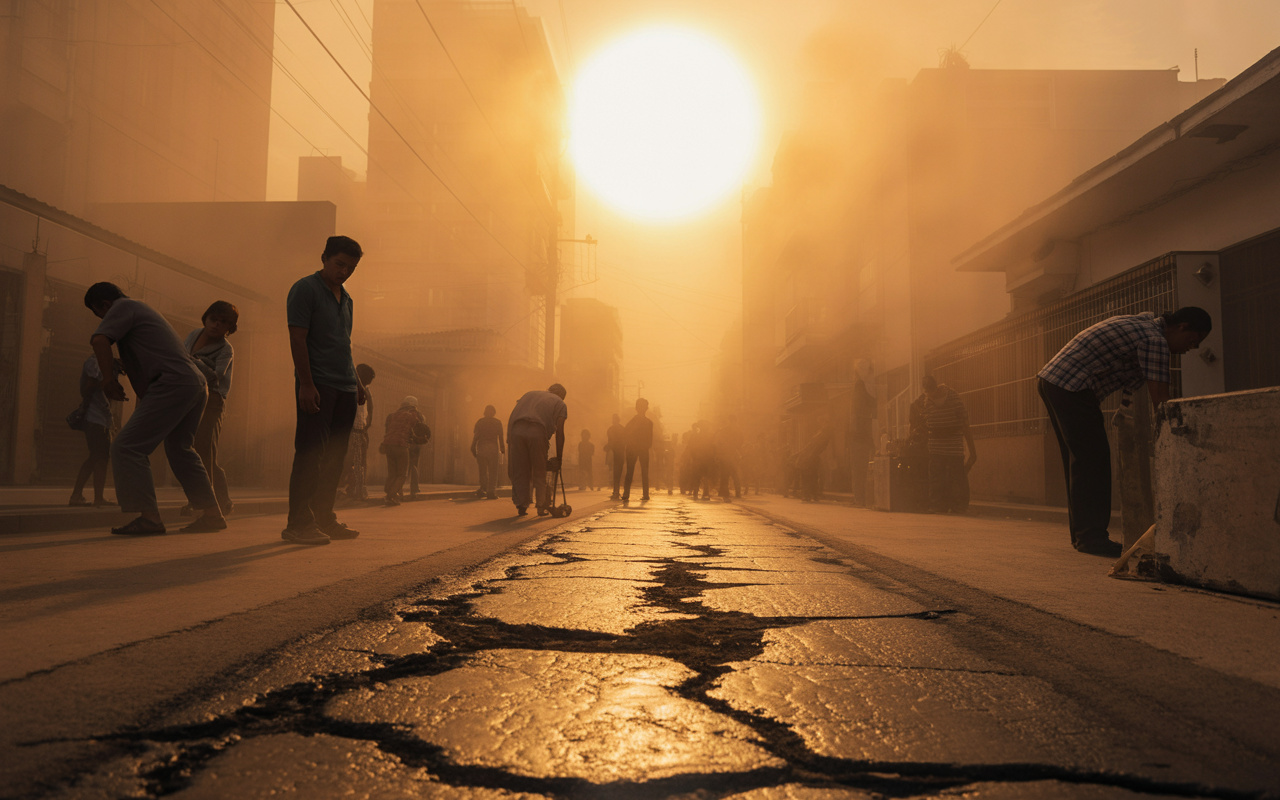


The Feels-Like Temperature of 72 °C Puts Residents at Their Physiological Limit. Understand Why This City Faces Extreme Heat, Health Risks, and a Global Climate Alert.
There is a point when heat stops being just uncomfortable and starts to represent a direct threat to human survival. In this city, located in one of the hottest regions on the planet, the combination of extremely high temperatures and suffocating humidity has already made the feels-like temperature exceed 72 °C, a rare threshold in the world and extremely close to the physiological limit of the human body. Under these conditions, common activities become dangerous, outdoor work turns into a life-threatening endeavor, and climate adaptation ceases to be an option and becomes an absolute necessity.
The science of climate and human health views this place as a warning sign: what seems extreme and localized today may become more frequent in other parts of the world in the coming decades.
Where the City Is Located and Why It Draws Global Attention
The most well-known and widely documented case occurs in Bandar Mahshahr, in southwestern Iran, a port city situated on the shores of the Persian Gulf.
-
Worlds covered by water, atmospheres filled with hydrogen, and the possibility of life beyond Earth: ocean planets are rewriting the map of cosmic search and forcing scientists to rethink where to look.

-
Argentina achieves the unimaginable after more than 110 years and reintroduces the largest native herbivore of South America to the Chaco to restore a lost link in nature.

-
Returning to the Moon now costs a billion-dollar bill and reignites the competition between the USA and China for science, technology, and rare minerals on lunar soil.
-
While the world looks at oil, the war with Iran is already disrupting helium supply from Qatar, affecting car and iPhone chips, threatening AI expansion, and putting pressure on aluminum packaging at the highest value in four years.


The region combines all the ingredients for extreme heat events: very hot air coming from the desert interior, extremely high humidity evaporated from the gulf, and little air circulation.
In episodes recorded by international meteorological services, the combination of these factors has raised the feels-like temperature to estimated values above 72 °C, with even higher peaks when considering the heat index and the concept of wet-bulb temperature.


Similar cases have also been observed in coastal areas of the Persian Gulf, including urban and industrial regions near Jeddah, in Saudi Arabia, reinforcing that this is not an isolated event but a pattern of extreme regional climate.
What It Means to Have a Feels-Like Temperature above 72 °C
The feels-like temperature does not measure just the air temperature. It takes into account humidity, wind, and solar radiation, reflecting the real impact of the climate on the human body. In very humid environments, sweat does not evaporate effectively, preventing the body’s natural cooling.
When the feels-like temperature exceeds 72 °C, the body enters a critical zone. Heat loss virtually stops functioning, body temperature begins to rise rapidly, and the risk of hyperthermia, heatstroke, and heat collapse increases exponentially.
Experts point out that above certain thresholds of wet-bulb temperature — close to 35 °C — a healthy human body cannot cool down, even at rest and in the shade. Some recorded events in this city have dangerously approached this limit.
Who Suffers Most from Extreme Heat
Although everyone is affected, the impacts are not distributed evenly. Outdoor workers, such as dockers, laborers, drivers, and construction professionals, are among the most vulnerable. On many days, work must be interrupted or carried out only at night.

Seniors, children, and people with cardiovascular or respiratory diseases face even greater risks. Extreme heat increases the incidence of dehydration, acute kidney failure, arrhythmias, and exacerbation of chronic diseases.
During severe heat waves, health authorities issue alerts for remaining in air-conditioned environments, constant water consumption, and drastic reductions in outdoor activities — recommendations that are not always feasible for low-income populations.
The City as an Unintentional Climate Laboratory
Bandar Mahshahr and other cities in the Persian Gulf are being observed by climatologists as forecasts of the global climate future. What is happening there today may become common in other tropical coastal regions as global warming advances.
The increase in average ocean temperatures raises air humidity, creating ideal conditions for extreme heat events. This means that feels-like temperatures above 50 °C, once very rare, are likely to become more frequent and enduring.
For this reason, these cities are frequently cited in studies on climate habitability, that is, to what extent certain regions will remain suitable for continuous human life.
Urban Adaptations and Engineering Limits
To cope with extreme heat, the city is investing in adaptation measures such as increasing air conditioning usage, changing work hours, urban shading, and improving access to drinking water. However, these solutions have clear limits.
Energy consumption skyrockets on extreme days, straining electrical grids and increasing the risk of blackouts — a critical scenario in places where climate control is not a luxury but an issue of survival.
Moreover, not all residents have constant access to cooled environments, creating a social thermal divide, where the ability to protect oneself from heat directly depends on income.
The Risk of Becoming Uninhabitable
Although the city remains inhabited, scientists warn that the frequent repetition of extreme events may make similar regions progressively less habitable. This is not about immediate abandonment but a gradual process in which living there requires increasingly more resources, infrastructure, and energy.
In more pessimistic scenarios of global warming, hot and humid coastal areas may regularly exceed human tolerance limits, forcing internal and international climate migrations.
A Warning That Goes Beyond One City
The city where the feels-like temperature has already broken the 72 °C mark is not just a climate curiosity. It represents a forewarning of what can happen when global warming meets densely populated urban environments, lacking green spaces and highly humid.
What today places workers, seniors, and children at continuous risk of thermal collapse in one specific spot on the planet may, in the future, affect millions of people across different continents.
More than just enduring the heat, this city shows that the central question of the 21st century may not be where it is possible to live comfortably, but where it will still be possible to live.







Pelo jeito muita gente não se importa c isto.Estao mais preocupados c futebol,natal,ano novo,carnaval e festas.Qdo acontecer aí vira choradeira universal e cirrê corre.