





 Portuguese
  English
  Spanish
  4 min of reading
  3 comments


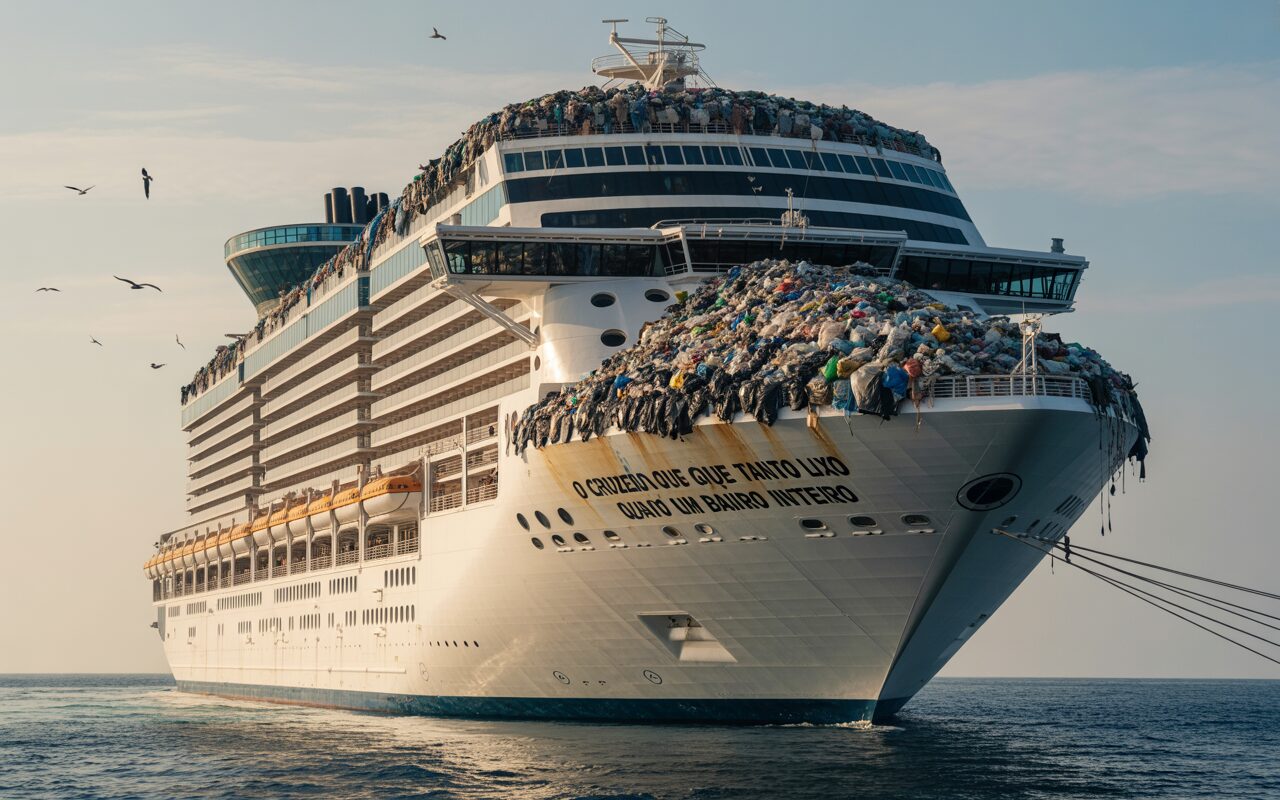

Large Cruise Ships Can Generate Up to A Ton of Waste Per Day — Equivalent to The Waste Production of An Entire Neighborhood. But, Far From Polluting The Oceans, These Modern Vessels Process, Separate, and Even Reuse Most of What They Produce, Using Cutting-Edge Technologies to Ensure Sustainability At Sea.
The Cruise That Generates As Much Waste As A Neighborhood — Imagine a floating city with more than 5,000 people among crew and passengers. This is the daily scenario on cruises like those from the Oasis class of Royal Caribbean or the mega-ships from MSC. On average, each vessel of this size generates about 1 ton of solid waste per day. The amount includes food scraps, plastic packaging, cardboard, glass, cans, toilet paper, and even toxic waste such as oil and batteries.
If this seems like a lot, it’s because it is. The waste management on cruise ships is one of the most complex operations in the maritime sector. And it’s all done on board — without depending on external collection during navigation days.
How Waste Is Separated and Treated On Board The Ship — Cruise That Generates As Much Waste As A Neighborhood
Behind the scenes on ships, environmental teams operate like true urban sanitation departments. The process starts with selective collection by trained crew members, who separate waste into categories: plastics, metals, glass, paper, organics, and hazardous materials.
-
With just joint compound, white glue, and pigment, you can make a homemade paint that yields double the conventional amount, saves up to 70%, and leaves the wall with a finish that no one would believe wasn’t store-bought paint.

-
Home environment can influence the brain, mood, and well-being: studies indicate an increase of up to 15% in productivity, a reduction of 12% in stress with plants, and a direct impact of the circadian rhythm on the 24 hours of the day.

-
A Brazilian millionaire couple restores a farm over 150 years old in the interior of São Paulo and transforms the historic property with Portuguese tiles, antique furniture, and new spaces into a refuge that blends tradition, comfort, and sophistication.

-
Submerged city in a lake in Minas reveals intact streets, preserved vehicles, and houses after more than 60 years, impressing divers.

After that, the material goes to the waste processing center, located in the technical areas of the vessel. There:
- Plastics and metals are compacted and stored for disposal on land;
- Glass is crushed to take up less space and avoid accidents;
- Paper is compacted into recyclable bales;
- Oils and greases are filtered and stored in special tanks;
- Organic waste goes through composting or is incinerated in special chambers.
Ships like the MSC Euribia and the Norwegian Prima already have treatment plants with technology equivalent to that of medium-sized cities, allowing for almost 100% of the generated waste to be treated or stored sustainably.
Water and Waste Reuse: Circular Economy At Sea
In addition to the recycling of solid waste, modern ships also adopt water reuse practices. Desalination equipment transforms seawater into drinking water, reducing the need for resupply in ports.
The water used in showers, washbasins, and laundries goes through filtration and reuse systems, known as gray water, which can be reused for cleaning common areas or irrigating plants on board.
Another highlight is the use of organic waste for thermal energy generation. On some ships, food scraps are dehydrated, turned into pellets, and burned to power secondary systems, such as heaters.
Sustainability At Sea: Reports from The Environmental Team
“Working in the environmental sector of a cruise is like being the manager of a floating neighborhood,” jokes Carlos Mendez, head of environmental operations at Royal Caribbean. According to him, sustainability at sea requires discipline and constant monitoring. “We conduct daily internal audits, and the entire crew receives mandatory training on waste management,” he explains.
Meanwhile, Larissa Coutinho, an environmental engineer working with the MSC fleet, emphasizes the importance of passenger awareness. “Many people think waste simply disappears, but there is a robust system behind it. Guests are encouraged to assist with separation and reduce disposable usage,” she says.
Logistical and Environmental Challenges In A Sea of Plastic
Even with advancements, the challenges of sustainability on cruise ships are still numerous. One of them is the operational cost of separation and recycling. “The systems are expensive, consume energy, and require constant maintenance,” says Larissa.
Additionally, there is pressure from international organizations and environmentalists regarding the impact of ships on global warming. Emissions of gases, water contamination from sewage, and illegal dumping of waste are still practices reported by NGOs in some cases, especially on older ships or less committed operators.
To combat this, leading companies like MSC, Royal Caribbean, and Norwegian have made commitments to the International Maritime Organization (IMO) and developed decarbonization policies by 2050.
Innovations in Modern Ships: Clean Energy and Cutting-Edge Recycling
The new ships of the next generation are coming out of shipyards with a total focus on sustainability. Among the innovations:
- Engines powered by LNG (liquefied natural gas), which reduce emissions by up to 25%;
- Internal recycling plants with robotic waste separation;
- Digesters to process organic waste without the need for incineration;
- Solar panels and lithium batteries to reduce the use of fossil fuels;
- Shore power connection with ports, allowing engines to be turned off when docked.
Companies like MSC and Carnival Corporation are also investing in big data and AI to optimize onboard resource consumption, anticipating peaks in energy and water use.
The cruise that generates as much waste as an entire neighborhood — and recycles everything on board is now a symbol of a new paradigm in maritime tourism. Far from being villains of the environment, modern ships are becoming sustainability laboratories, with technologies that could — and should — be replicated in real cities.
The journey towards a cleaner ocean is still ongoing, but the first steps are already being taken at sea — and with much more awareness than one might imagine.








Ótima solução, pois os mares já estão poluídos de mais!
Todo lixo orgânico, como restos de comidas engorduradas, papel, panos entres outros poluentes são jogados diretamente ao mar , é conhecido paiol grande, pergunta ao Cmt que sabe do que estamos falando aqui , isso é puro comercial a favor desses maiores poluentes da face da terra , Navios!
Esgoto jogado no mar sería ecológico?