





 Portuguese
  English
  Spanish
  4 min of reading
  0 comments


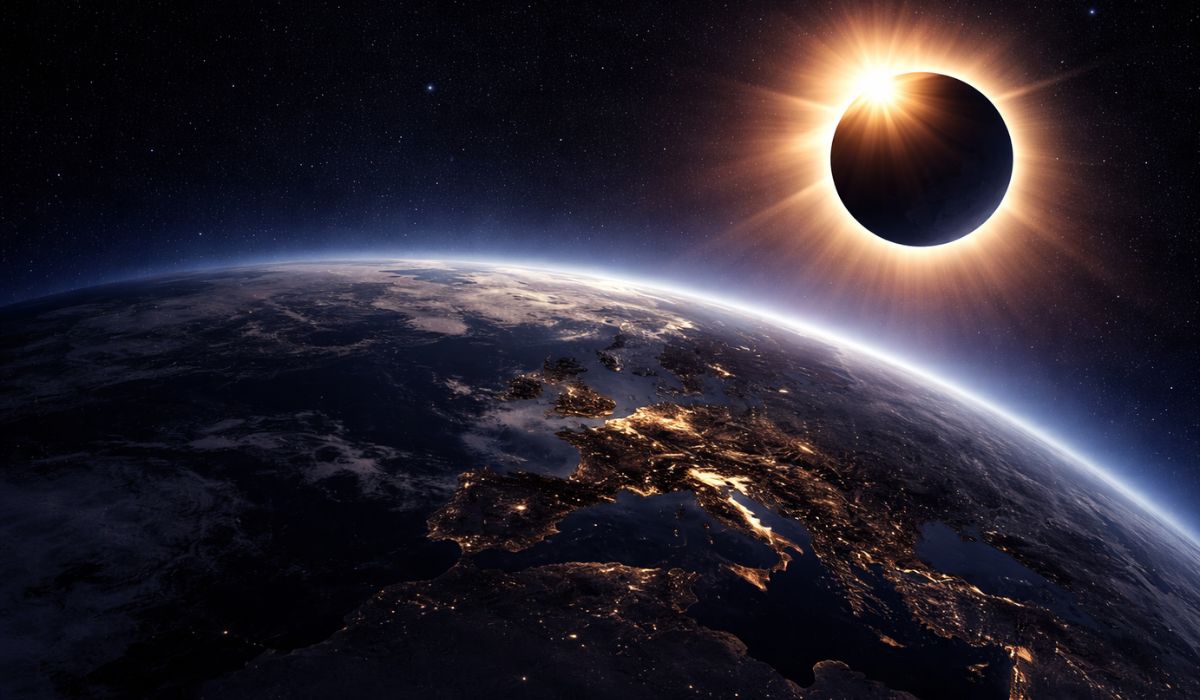
Total solar eclipse expected in August 2026 mobilizes observers and generates searches for explanations about duration, visibility locations, and precautions to safely observe the phenomenon, after publications on social media associated the event with a supposed global blackout.
Messages circulating on social media about a supposed “world blackout” in August 2026 are based on a real event but present the phenomenon inaccurately.
What is expected on August 12 is a total solar eclipse, when the Moon passes between the Earth and the Sun and completely covers the solar disk only in a specific band of the planet.
The effect will be a temporary darkening of the sky in restricted areas, unrelated to electrical failures, technological breakdowns, or widespread risk to the population.
-
How the terraforming of Mars can transform the planet: artificial aerosols can increase the temperature by up to 35°C in 15 years, creating conditions for liquid water.

-
Scientists drilled nearly 8,000 meters into the ocean floor above the fault that caused the 2011 tsunami in Japan and discovered that a layer of clay 130 million years old was responsible for making the wave much worse than any model had predicted.

-
Thousands of years after causing the largest eruption of the Holocene, one of the world’s largest supervolcanoes is rebuilding itself beneath the sea south of Japan, receiving new magma and alarming scientists with its transformation.
-
China has activated a magnet 700,000 times more powerful than the Earth’s magnetic field that operates for over 200 consecutive hours while consuming little energy, and now the world wants to know what Beijing plans to do with this technology in 2026.


On the expected date, the shadow of the Moon is set to cross part of the Arctic, Greenland, Iceland, the North Atlantic, northern Spain, and a small portion of northeastern Portugal.
In these regions, those within the so-called path of totality will be able to observe the Sun completely covered for a few seconds or a few minutes.
Outside this corridor, the eclipse will be partial and will not produce the same darkness.
The total solar eclipse does not affect the entire planet at the same time, nor does it turn day into night on a global scale.
It is a rapid and localized change in brightness, calculated in advance by astronomical institutions.
During the total phase, the sky may take on an appearance similar to twilight.
There may also be a slight drop in temperature and changes in animal behavior, which react to the sudden reduction in sunlight.
These effects have been recorded in other eclipses and are considered compatible with this type of phenomenon.
Total solar eclipse on August 12, 2026
The eclipse on August 12, 2026, will be one of the main astronomical events expected for that year.
The totality phase, at its longest point, is expected to last about 2 minutes and 18 seconds, according to astronomical projections.
In cities and inhabited regions located within the central band, this time will be shorter and varies according to the observer’s position.
In Iceland, for example, totality is expected to exceed one minute in some areas.

In northern Spain, the total eclipse will also be brief and, at certain points, will occur close to sunset.
In regions that will only experience a partial eclipse, part of the solar disk will remain visible throughout the phenomenon.
The duration, therefore, directly depends on the observation location.
The eclipse does not cause uniform or continuous darkness, but a temporary darkening whose intensity changes according to geographic position.
Where the solar eclipse will be most visible
The path of totality expected for August 2026 places Greenland, Iceland, and part of northern Spain among the main observation points.
In addition to these areas, a small portion of northeastern Portugal is also expected to register the total phase.
In much of Europe, northern Africa, and areas of the Atlantic, visibility will be partial.
In these locations, the public will see only part of the Sun being covered by the Moon.
Although the visual effect may be noticeable, it will not be equivalent to that of totality.
In Brazil, the trend is for partial visibility without totality.
This rules out the possibility of widespread darkening as described in publications treating the phenomenon as a “general blackout.”
Precautions for safely observing the eclipse
According to scientific institutions and astronomy experts, solar eclipses are natural phenomena, predictable and studied for centuries.
The event in August 2026 has no known relation to threats to electrical networks, communication systems, the internet, or infrastructure.
The main precaution is in observing the Sun.
Looking directly at the eclipse without proper protection can cause serious and permanent retinal injuries.
The recommendation from scientific bodies is to use eclipse glasses or certified solar filters, compatible with the international standard ISO 12312-2.
Regular sunglasses do not provide sufficient protection.
The same applies to the use of binoculars, cameras, and telescopes without appropriate filters, as these devices amplify light and can increase the risk of eye damage.
Experts also explain that there is an exception only during the brief moments of totality, when the Sun is completely covered for those who are exactly within the path of totality.
Outside this interval, visual protection remains essential.

Why the phenomenon attracts the attention of scientists and observers
The total solar eclipse on August 12, 2026, is expected to mobilize observers, scientists, and tourists in different countries.
In continental Europe, for example, the event has additional relevance because it will be the first total solar eclipse visible in part of the continent since 1999.
In addition to public interest, the phenomenon has scientific importance.
During totality, researchers can observe the solar corona, the outermost layer of the Sun’s atmosphere, visible only when the solar disk is completely covered.
Eclipses also allow studies on atmospheric brightness, environmental conditions, and animal behavior in response to the sudden reduction of light.
On social media, however, the event’s impact has been marked by terms that amplify or distort its reach.









Seja o primeiro a reagir!