





 English
  Francês
  Alemão
  Italiano
  Japonês
  Norueguês
  Portuguese
  Spanish
  5 min of reading
  0 comments


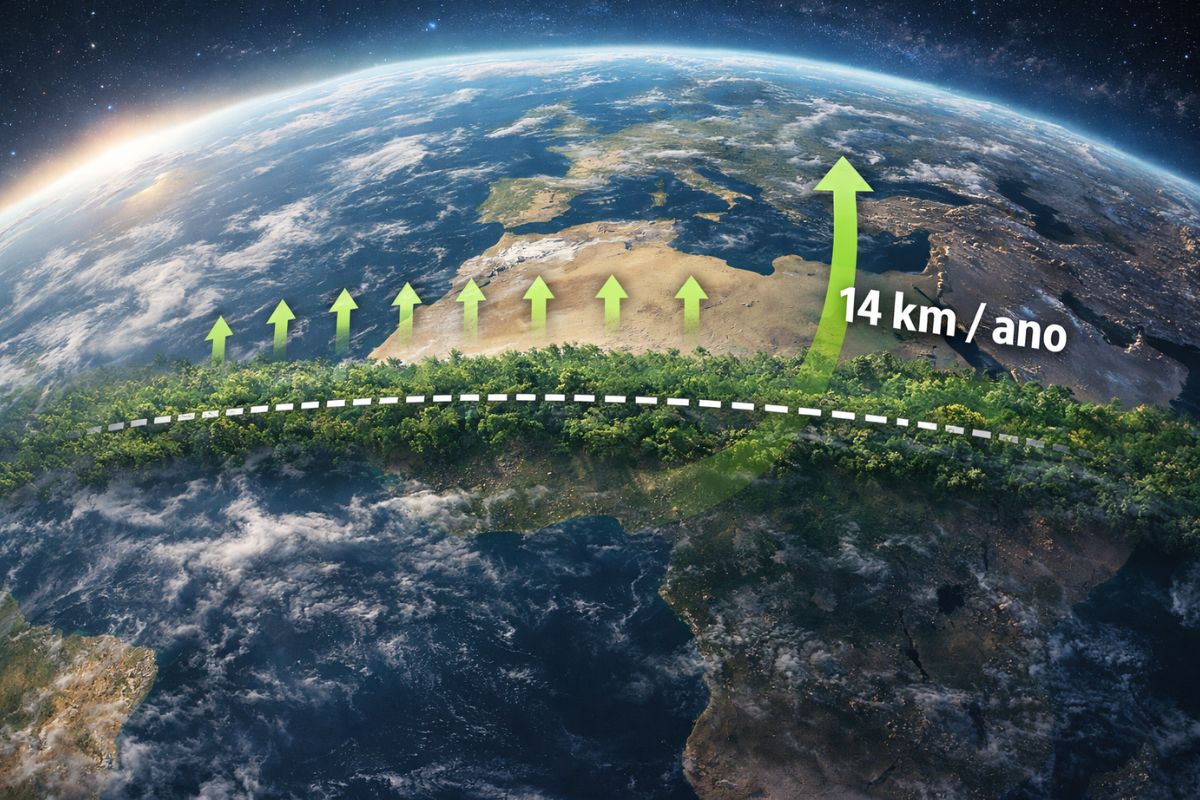
Researchers from Leipzig and Valencia universities discovered that the Earth’s green belt is moving northwest at an accelerated rate of 14 kilometers per year, with the southern hemisphere losing vegetation while Asia and Europe pull the planet’s green gravity center north and east
The Earth’s green belt, the strip of vegetation that extends across the planet’s surface following the seasons, has remained stable for centuries. Now, a team of researchers from the University of Leipzig, the German Centre for Integrative Biodiversity Research, and the University of Valencia has discovered that this green wave is shifting northwest at a rate of 14 kilometers per year, a significant acceleration recorded between 2010 and 2020.
According to the University of Valencia, what makes this discovery especially concerning is that the displacement of the Earth’s green belt is happening in both hemispheres at the same time, but in the same direction. In the northern hemisphere, vegetation is advancing north, as climate models predicted. In the southern hemisphere, vegetation is also moving north, the opposite of what was expected. This simultaneous behavior means that the planet is becoming increasingly asymmetric in terms of vegetation cover, with direct consequences for carbon cycles, species migrations, and the balance of global ecosystems.
What is the Earth’s green belt and why does it follow the seasons

If we look at the Earth from space over the course of a year, it is possible to perceive a wave of vegetation moving across the planet’s surface following the seasons. In the summer of the northern hemisphere, the peak of greenness moves north.
-
The United States showcases a microwave weapon in an autonomous vehicle that can take down multiple drones at once and aims to reduce the costs of a war that currently burns millions on missiles.

-
China reveals autonomous vehicle capable of launching 96 kamikaze drones in just 3 seconds on the battlefield with an artificial intelligence system that finds and attacks targets en masse without human intervention.

-
At the bottom of the North Sea, scientists found surprising remnants of Doggerland, a vanished land that once connected Great Britain to Europe and hid a much greener past.

-
China brings railway technology that Brazil does not master and sets up in Araraquara to manufacture 44 subway trains and 22 compositions for the Campinas-São Paulo train in a billion-dollar partnership that will generate jobs and transfer knowledge.


In the summer of the southern hemisphere, it moves south. This seasonal pattern creates what scientists call the Earth’s green belt: a strip of biological activity that oscillates from north to south with predictable regularity.
This cycle has functioned stably for centuries. Researchers calculated what they call the centroid of global vegetation, that is, the point that would represent the center of mass of all the planet’s vegetation cover in 3D coordinates, weighted by greenness indices.
They named the moment of maximum greenness in each hemisphere viridistice, in reference to the solstice. The trajectory of this centroid over the decades summarizes in a single curve the dynamics of all biological cycles on the planet.
How scientists measured the displacement of 14 kilometers per year

To arrive at these results, researchers analyzed satellite data collected between 1982 and 2020, nearly four decades of continuous observation of global vegetation.
The results were validated with six models of the Earth system from the CMIP6 project, which coordinates the world’s most advanced climate simulations.
This combination of observational data and modeling ensured that the discovery regarding the displacement of the Earth’s green belt was not just a statistical artifact, but a real and measurable trend.
The displacement accelerated significantly in the last decade. Between 2010 and 2020, the southern hemisphere recorded the most significant change, with the center of gravity of vegetation moving 14 kilometers per year northwest.
This is the first global metric of biological cycles expressed in kilometers, a unit as clear and intuitive as sea level or global average temperature. It acts as a compass showing where the planet’s vegetation is migrating.
Why is the southern hemisphere losing vegetation instead of gaining
In traditional climate models, it was expected that global warming would cause vegetation to advance toward the poles in both hemispheres. In the northern hemisphere, this is happening: shorter winters give plants more time to grow, and the extra CO2 acts as fertilizer.
But in the southern hemisphere, vegetation is retreating due to deforestation, prolonged droughts, and changes in land use, especially in South America.
This dual movement causes the Earth’s green belt to compress and shift north simultaneously. East Asia, India, and Europe are pulling the center of gravity of global greenness north and east, while South America does the opposite.
China and India have intensified their agricultural activities and reforestation programs in recent decades, becoming the main drivers of increased vegetation in the northern hemisphere. The result is a planet increasingly asymmetric from a biological perspective.
What does the displacement of the Earth’s green belt mean for climate and ecosystems
The change in the position of the Earth’s green belt is not just a scientific curiosity. It implies a profound reconfiguration of where and when the planet’s biosphere operates, directly affecting carbon cycles, species migratory routes, and the stability of entire ecosystems.
If vegetation changes location, the animals that depend on it also need to move, and not all species can keep up.
Researchers warn that in a high-emission scenario, the eastward shift will eventually dominate the northward shift by the end of the century.
This means that Asia will gain even greater weight as the planet’s center of gravity for vegetation, while regions like South America and Africa may continue to lose green cover.
The amplitude of the green wave between north and south is decreasing, suggesting that seasonal vegetation cycles are becoming less pronounced, a change that could affect global CO2 absorption.
The role of global warming and CO2 in accelerating the displacement
Global warming is the main driver behind the displacement of the Earth’s green belt. Shorter winters in the northern hemisphere allow plants to grow longer each year, expanding vegetation cover in previously inhospitable latitudes.
Additional carbon dioxide in the atmosphere acts as fertilizer for plants, accelerating greening, the widespread increase in greenness documented since the 1980s.
But this greening is not uniform, and this is precisely where the problem lies. The increase in vegetation is concentrated in Asia, Europe, and parts of North America, while South America and Sub-Saharan Africa face losses.
The Earth’s green belt is not simply growing; it is redistributing unevenly. And this inequality has real consequences: regions that lose vegetation also lose the capacity to absorb carbon, which feeds back into the very warming that is causing the displacement.
A planet that is changing faster than expected
The displacement of the Earth’s green belt at 14 kilometers per year toward the northern hemisphere is yet another sign that climate change is reconfiguring the planet in real time.
The green wave that was stable for centuries is now moving, compressing, and redistributing in ways that science did not anticipate.
And while some countries gain vegetation, others lose, creating a biological imbalance that could exacerbate the very climate problems that caused it.
Did you know that the planet’s vegetation strip is moving? Do you think deforestation in South America is the main culprit, or is the problem global? Leave your thoughts in the comments and share this article with those who follow science and the environment.






Seja o primeiro a reagir!