





 Portuguese
  English
  Spanish
  6 min of reading
  0 comments


The PHC pile and precast tube factory shows an industrial process in which steel bars, wire, high-strength concrete, and molds work in sequence almost without pause.
In the factory, the process begins with steel bars and wire, goes through the assembly of the metal cage, and continues until the concrete enters the mold, is compacted, and then comes out ready for use. In the case of PHC piles, the piece also undergoes centrifugation and steam curing. For precast tubes, vibration, smoothing, and rapid curing accelerate the release of the final product.
The process is impressive because it combines mechanical strength, precision, and repetition. The steel becomes a kind of internal skeleton, the concrete enters the mold in a controlled amount, and the compaction eliminates voids to increase the piece’s strength. Instead of relying on time and site conditions, production happens within the line, with a more predictable rhythm and finish.
Throughout the video, the manufacturing of PHC piles appears as the most impactful segment, but the line of precast tubes also draws attention for its degree of organization. The same logic is repeated in different products: preparing the reinforcement, protecting the mold with a release agent, feeding the concrete, compacting well, and releasing the piece after curing.
-
Governments in Latin America are advancing with a sustainability and energy transition agreement in aviation, creating an environment for the scaling of SAF, operational gains, and a direct response to global climate demands.

-
Brazil surprises the world by cloning a pig with human genes in an attempt to save humans with transplants, a technique with only 1% to 5% success rate, editing 3 genes, inserting 7 human genes, and impacting 48,000 patients on the waiting list.
-
With a height of 8.7 meters, the giant termite mound found in Somalia has entered history as the largest ever recorded and reveals how insects just a few millimeters tall build three-story structures.

-
Measuring about 50 cm in wingspan, the merlin, the smallest bird of prey in the world, is at risk of extinction and could disappear by 2050, according to research published in Nature.
Factory starts with cut, wired, and welded steel in cage form

The starting point of production lies in the metallic raw materials. The base shows that the plant works with steel bars and wire, which first go through cutting and wiring before entering the structural assembly stage. After that, this set goes to the welding machine, where the steel cage that will serve as reinforcement for the concrete piece is born.
This part is central because it defines the internal reinforcement of both the pile and the tubes. The welded cage acts as the structure that supports the concrete, helping the final piece to withstand use better.
In the segment about precast tubes, the base even compares this reinforcement to a bone inside the body, precisely to highlight its function of reinforcement and durability.
Release agent prepares the mold before the concrete enters
After the reinforcement is ready, the production advances to the preparation of the mold. The video shows the application of release oil, used to prevent the concrete from sticking to the mold and to facilitate the removal of the piece after curing. This step appears in both the manufacturing of PHC piles and in the line of tubes and other precast pieces.
Next, the steel cage is lifted and placed inside the mold, which is then taken to the concrete feeding area. It is at this moment that the line combines metal structure, closed mold, and ready mix to transform everything into a unique piece.
High-strength concrete enters the mold and the form is closed under pressure

Subsequently, the concrete mix descends in strong volume and feeds the already positioned metal cage. In the case of PHC piles, the base explicitly mentions the use of high-strength concrete, which helps explain why the piece goes through such controlled stages right after. After feeding, the upper mold is closed, and the screws are tightened to hold the assembly before compaction.
This phase is important because the quality of the piece depends not only on the concrete used but also on the proper confinement within the mold. Without a firm closure and adequate compaction, the final product would lose uniformity and strength.
Centrifugation gives shape to PHC piles and compresses the concrete

Among PHC piles, the most striking stage is centrifugation. The video shows the mold spinning at speeds from 1 to 7 for 10 minutes, with centrifugal force sufficient to compress the concrete inside the mold. This movement is not just a visual detail. It helps distribute, densify, and shape the piece with greater structural density.
After this spin, the base itself highlights that the enormous amount of concrete becomes compacted and leaves space in the center of the post. In other words, centrifugation not only tightens the material but also helps form the characteristic internal void of this type of piece. It is a technical solution that gives identity to the product and differentiates the pile line from the rest of the production.
Steam curing accelerates the process and releases the piece in hours

After centrifugation, the piles go to the steam chamber. The base informs that curing in the steam chamber takes 9 hours, a step that precedes demolding. When this phase ends, the upper mold is removed, and the piece appears ready to leave the line, without relying on a long wait outdoors.
This part stands out because it shows how the line reduces the time between molding and release. Instead of waiting for the concrete to harden slowly in open conditions, the process uses heat and control to accelerate curing and maintain high productivity.
Precast tubes follow a similar logic but use vibration and surface finishing

In the manufacturing of precast concrete tubes, the sequence changes slightly, but the industrial logic remains the same. The base mentions the use of sand, gravel, and other aggregates, in addition to the reinforcement that goes into the welding machine to form the round structure of the piece.
After that, the mold receives the release agent, the reinforcement enters the mold, and the concrete begins to be fed.
Here, instead of centrifugation, the highlight is on vibration. The bottom vibrates to remove air bubbles, and the roller smooths the surface to make it even.
The elimination of trapped air is important because, according to the base itself, bubbles can cause cracks in the products. This care helps explain why the piece already comes out with a more regular visual finish and better compaction.
Quick demolding and short curing show the agility of the system
Another strong point of the tube line is the speed of mold release. The base states that there is no need to wait for the concrete to dry to immediately remove the mold, and that, by the next morning, the piece was already cured and super hard.
In huge pieces, the video also mentions a curing process for 4 hours before the final product is removed.
This detail reinforces the industrial advantage of precasting. The factory concentrates control, reduces climatic variations, and shortens the interval between molding and removal of the piece, making production faster and more predictable than direct molding on the job site.
Precasting reduces climate impact and reduces work on site
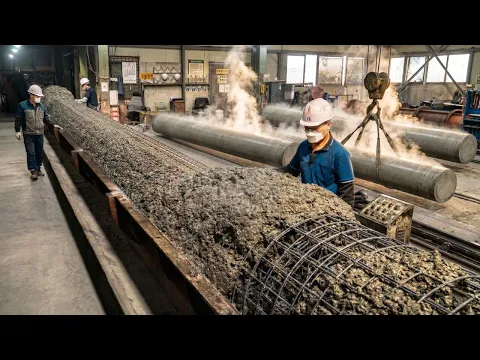

The base itself highlights an important comparison: molding on-site requires more machines, more labor, and higher costs, while precasting reduces work on-site and suffers less interference from the weather.
This helps to understand why pieces like PHC piles, tubes, and other concrete elements gain so much space in civil construction.
In practice, production shifts part of the effort from the site to within a controlled line. The gain is not only in speed but also in standardization, compaction, and the repetition of a process that can deliver similar pieces in sequence.
Factory transforms steel and concrete into finished pieces with heavy industrial rhythm
At the end of the line, what becomes most evident is the combination of metal reinforcement, prepared mold, well-compacted concrete, and accelerated curing.
In PHC piles, the steel becomes a welded cage, the high-strength concrete enters the mold, the piece spins in centrifugation, cures in steam, and comes out ready in a few hours. In precast tubes, the path goes through vibration, finishing roller, quick demolding, and short curing until the product is released.
The video shows a line where almost everything depends on sequence and fit between stages. When one phase ends, the next is already prepared to receive the piece, maintaining a continuous flow that helps explain why this type of production impresses so much those who observe it closely.
And for you, what impresses you the most about this factory: the centrifugation of PHC piles, the steam curing, or the speed with which the precast tubes come out ready?







Seja o primeiro a reagir!