





 Portuguese
  English
  Spanish
  6 min of reading
  0 comments



The space economy exceeds US$ 613 billion, with 78% in the hands of the private sector and growth driven by satellite services operating daily on Earth.
In 2025, reports and analyses published by the Space Foundation, McKinsey & Company, and Novaspace began to more clearly describe a profound structural change in the global space economy. The Space Foundation reported that the sector reached US$ 613 billion in 2024, while McKinsey estimated that this ecosystem could reach US$ 1.8 trillion by 2035, showing the speed at which space activity has shifted from being a state niche to consolidating as a global market.
The most relevant data, however, is not just in the size of this market, but in its composition. According to the Space Foundation, the commercial sector already accounted for 78% of the space economy, while governments concentrated the remaining 22%, with public spending on space totaling about US$ 132 billion. The most recent snapshot of the sector shows, therefore, a center of gravity increasingly shifted towards private initiative.
This scenario represents a historic inversion in the space sector, which for decades was almost exclusively led by government agencies. Today, with the advancement of private companies in launches, satellites, connectivity, Earth observation, and data-based services, space is treated not only as a scientific and strategic frontier but also as an economic platform of industrial scale.
-
A lake in Antarctica hides water with rare chemistry, a depth of nearly 170 meters, and microbial structures that help scientists search for signs of life on Mars.

-
Elon Musk is trying to transform Starlink into the new standard for in-flight Wi-Fi, and the orbital war between giants is changing the sky of commercial aviation.

-
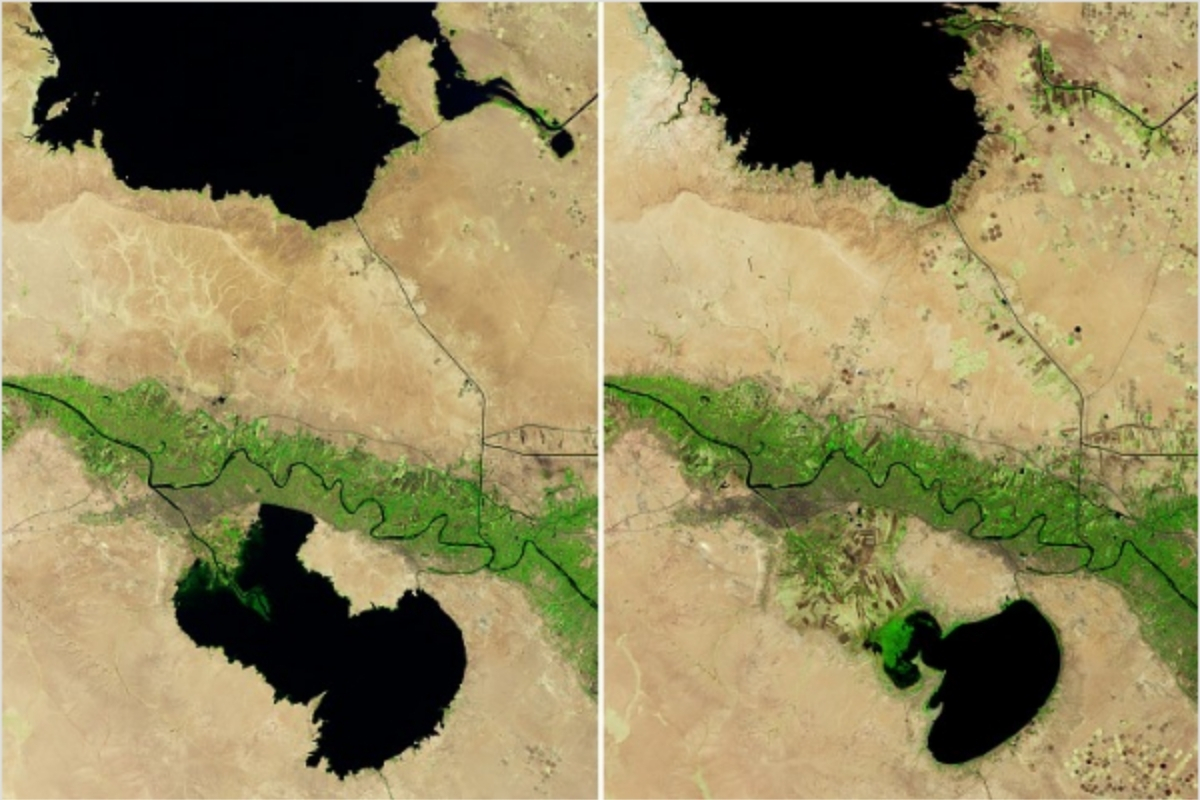
Collapse in sight in Iraq: satellite images captured by NASA show the country’s largest reservoir dramatically drying up.
-
Archaeologists open a tomb in Luxor and find 3,000-year-old papyri still sealed in a ceramic vessel, alongside colorful coffins stacked in 10 rows and linked to the mysterious singers of Amon.

Satellite services lead growth and generate continuous revenue in the space economy
Contrary to what many imagine, the main engine of the current space economy is not rockets or interplanetary missions. The accelerated growth comes from services enabled by satellites that operate continuously around the Earth.
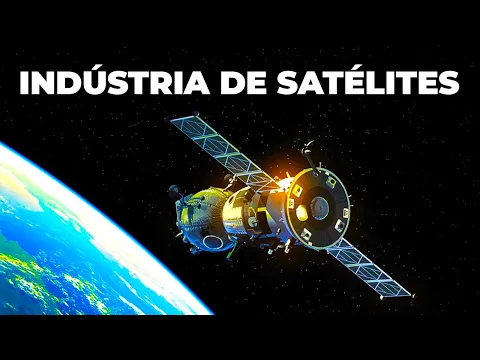

These services include internet connectivity, satellite navigation systems (like GPS), climate monitoring, precision agriculture, logistics, telecommunications, and defense applications.
Unlike space launches, which occur at specific events, these services generate daily and predictable revenue, creating a solid and scalable economic base.
This model transforms space into an invisible infrastructure that supports essential activities of the modern global economy. The expansion of low Earth orbit satellite constellations has further accelerated this process, expanding coverage and reducing costs.
Orbital launches accelerate and occur every 28 hours on average in 2025
Although they are not the main revenue generator, launches continue to be an essential component of the space chain. In 2025, the pace of launches reached historic levels.
In the first half of the year, there was an average of one orbital launch every 28 hours, reflecting the growing demand for placing satellites in orbit.
This increase is directly linked to the expansion of commercial constellations and the advancement of private companies in the launch sector.
The growth in launch frequency is a direct indicator of the intensification of global space activity. Still, its economic role is more limited compared to derived services.
Government investments remain high, but no longer dominate the sector
Despite the rise of the private sector, governments continue to play a relevant role, especially in strategic areas such as defense, science, and space exploration.
The United States, for example, invests about US$ 77 billion combining civil programs, such as those of NASA, and national security initiatives.
In Europe, the European Space Agency approved a record budget of approximately €26 billion for the period from 2026 to 2028.
These investments ensure technological advancements and support long-term scientific missions, which are often not economically viable for the private sector. Even with a smaller share, governments continue to be fundamental catalysts of innovation in the space sector.
Why rockets and space missions are no longer the center of the economy
For much of the 20th century, space exploration was synonymous with rockets, crewed missions, and geopolitical competition. However, the economic structure of the sector has changed.
Today, launches represent only a fraction of the total value of the space economy. They are essential, but function as the initial step of a much broader chain.

The real value lies in the services that utilize space data and infrastructure for terrestrial applications. This shift redefines how space is perceived: from an exploration arena to a continuous economic platform.
While missions to the Moon or Mars occur sporadically, satellite-based services operate continuously.
Expansion of satellite constellations drives global connectivity
One of the main factors behind the sector’s growth is the expansion of low Earth orbit satellite constellations. These networks are capable of providing high-speed internet in remote areas, improving the accuracy of navigation systems, and increasing Earth monitoring capacity.
The reduction in launch costs and the miniaturization of satellites have made it possible to place thousands of units in orbit.
This model is creating a new global infrastructure based on space, with a direct impact on sectors such as telecommunications, agriculture, and transportation. Additionally, competition among private companies has accelerated innovation and reduced prices.
Earth observation and space data transform entire sectors of the economy
Another rapidly expanding segment is Earth observation. Satellites equipped with advanced sensors provide data on climate, land use, deforestation, agricultural production, and natural disasters.
This information is used by governments, companies, and organizations for near real-time decision-making. The ability to continuously monitor the planet is becoming one of the most valuable assets of the space economy. This type of service has applications ranging from urban planning to natural resource management.
Defense and security reinforce the strategic importance of the space economy
In addition to commercial applications, space has also become a strategic domain for security and defense. Satellite-based communication, surveillance, and navigation systems are essential for modern military operations. Countries are increasingly investing in space infrastructure to ensure autonomy and strategic advantage.
This reinforces the role of space as one of the main fields of geopolitical competition in the 21st century. The integration between the public and private sectors is particularly strong in this segment.
Growth projections for the space economy indicate continuous expansion in the coming decades. Estimates suggest that the sector could exceed US$ 1 trillion and approach US$ 1.8 trillion by 2035, primarily driven by data-based services and connectivity.
New business models, such as space data services, orbital logistics, and manufacturing in microgravity, are beginning to emerge.
This scenario suggests that the space economy is still in the early stages of expansion, with significant growth potential. The trend is that the share of the private sector will continue to increase.
The space economy redefines the relationship between technology, infrastructure, and daily life
The impact of the space economy goes beyond the aerospace sector. Satellite-based services are already part of the daily lives of billions of people, often in an invisible way.
Navigation apps, weather forecasting, global communication, and financial systems directly depend on space infrastructure.
This means that space has ceased to be merely an exploration environment and has become an extension of terrestrial infrastructure. This transformation redefines the strategic importance of the sector for the global economy.
Space is now a continuous economy and no longer an occasional event
The main change brought by recent data is conceptual. Space has ceased to be a set of isolated events and has begun to function as a continuous economic system.
While launches and missions attract public attention, the real growth happens silently, through services that operate every day.
This new reality places the space sector on a level similar to that of other critical infrastructures, such as energy and telecommunications. The space economy, therefore, is no longer about reaching space, but about what is done from it.
Have you noticed how much your routine depends on the space economy without realizing it
With the continuous expansion of satellite-based services, society’s dependence on space is likely to increase. Technologies that today seem invisible may become even more essential in the coming years.
In light of this, an inevitable reflection arises: to what extent does the global economy already depend on a system that operates outside of Earth but directly influences almost everything that happens within it?







Seja o primeiro a reagir!