






 Portuguese
  Spanish


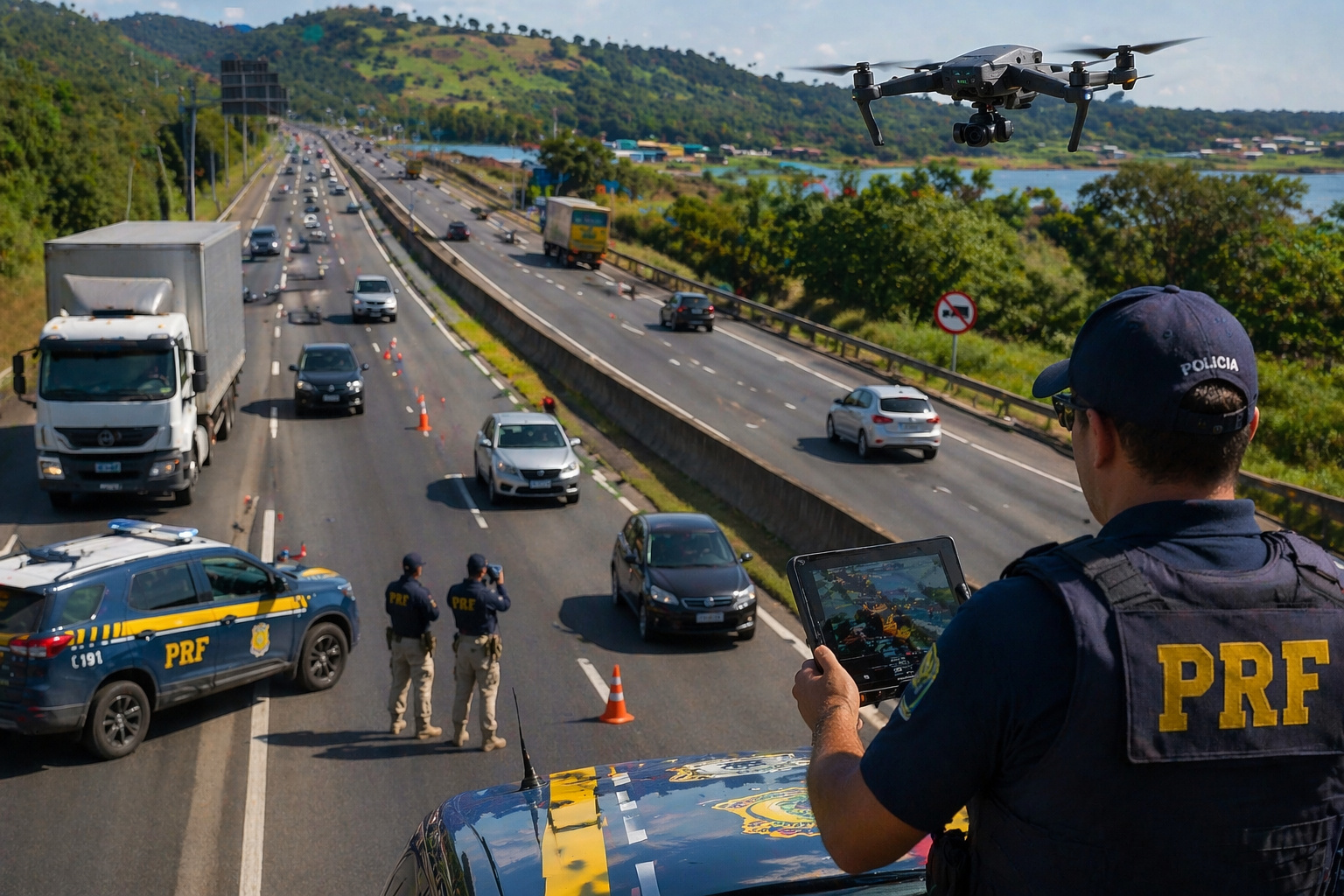

Use of drones by the PRF since 2023 allows for flagging violations without immediate approach and reinforces road safety in strategic sections
Monitoring on Brazilian federal highways has undergone an important transformation since 2023, when the Federal Highway Police (PRF) began using drones.
These devices function as a “modern binocular”, expanding the agents’ field of vision and allowing for more precise monitoring.
Moreover, the technology has been applied in specific sections, especially where traditional monitoring is more difficult.
-
2027 Toyota Corolla Cross Unveiled: New Design, Enhanced Fuel Efficiency, Reduced Maintenance Costs, Advanced Technology, Connected Services, and Up to 10-Year Warranty

-
Fiat Cronos Precision 2018: Affordable Sedan with Spacious Trunk and Reliable Maintenance
-
Volkswagen to Cut Production by 1 Million Cars by 2030, Reducing Jobs and Platforms, Focusing on More Profitable Models

-
Toyota Launches First 100% Electric Car in Brazil: bZ4X with 343 HP, All-Wheel Drive, 361 km Range, Priced at $419,990 BRL, Limited to 99 Units




According to information released by Quatro Rodas magazine and the PRF itself, the use follows strict technical and operational criteria.
Drone monitoring expands the PRF’s reach on highways
Initially, drones are used for remote monitoring.
This way, agents can identify violations without the need for immediate approach.
Subsequently, irregularities are recorded through video monitoring.

Additionally, in specific situations, a patrol car may be dispatched.
Thus, the driver can be approached further down the highway.
Among the main points of the operation, the following stand out:
- Recording violations by video
- Absence of immediate approach in many cases
- Coordinated action with teams in the field
According to Jeferson Almeida, the general coordinator of road safety at the PRF, the technology is already present in several states.
Furthermore, he highlighted that Minas Gerais and Santa Catarina concentrate significant operations.
Technical rules ensure regulated use of technology
First of all, drones must meet legal requirements.
That is, registration with the National Civil Aviation Agency (Anac) is mandatory.
Additionally, operators must be trained.
Therefore, police officers receive technical training and specific certification.
Among the requirements are:
- Mandatory registration with Anac
- Technical training of agents
- Certification for drone operation
Thus, the use occurs within standards of safety and legality.

Strategic sections concentrate drone operations
In general, the PRF uses drones in locations where traditional monitoring would be less efficient.
This way, the technology avoids interference in vehicle flow.
Primarily, drones are used in:
- Sections with high traffic volume
- Points where patrol cars would impact traffic
- Areas with curves or low visibility
Additionally, complex urban areas also receive special attention.
According to the PRF, the metropolitan region of Florianópolis is one example.
Flagged violations include use of the shoulder and cell phone while driving
Frequently, drones identify serious violations.
Among them, improper use of the shoulder is the most common.
For example:
- Driving on the shoulder
- Overtaking on the shoulder
These violations are considered very serious.
Therefore, they generate a fine of R$ 880.41 and seven points on the driver’s license.
Additionally, other irregularities are also recorded:
- Use of a cell phone while driving
- Failure to wear a seatbelt
- Trucks in the left lane
Thus, monitoring becomes broader and more efficient.
Thermal monitoring helps prevent accidents
In addition to conventional imaging, drones are equipped with thermal sensors.
This way, it is possible to identify mechanical risks.
According to Jeferson Almeida, the cameras detect overheating in truck brakes.
As a result, the PRF can act preventively.
That is, the driver can be advised to stop before a potential accident.
Contran resolution authorizes violations recorded by video monitoring
Drone monitoring has legal backing.
This is the Resolution 909 of the National Traffic Council (Contran).
This regulation authorizes:
- Recording violations by video monitoring
- Issuing fines without direct approach
However, the rule requires signage.
That is, the roads must inform about the presence of monitoring by cameras.
Thus, the use of technology occurs transparently and within the law.
In light of this technological advancement in monitoring, the reflection remains: are drivers prepared for increasingly intelligent surveillance on Brazilian highways?








