





 Portuguese
  English
  Spanish
  4 min of reading
  0 comments


Satellite images highlight Israel greener than its neighbors as the Dead Sea recedes, craters appear, and the debate on biblical prophecies grows
The satellite images are showing a contrast that seems impossible: a field of flowers in the middle of the Judean desert, just a few meters from the Dead Sea, a place that is normally dry and almost devoid of vegetation. And, according to reports, it is neither farming nor artificial irrigation, it is natural growth.
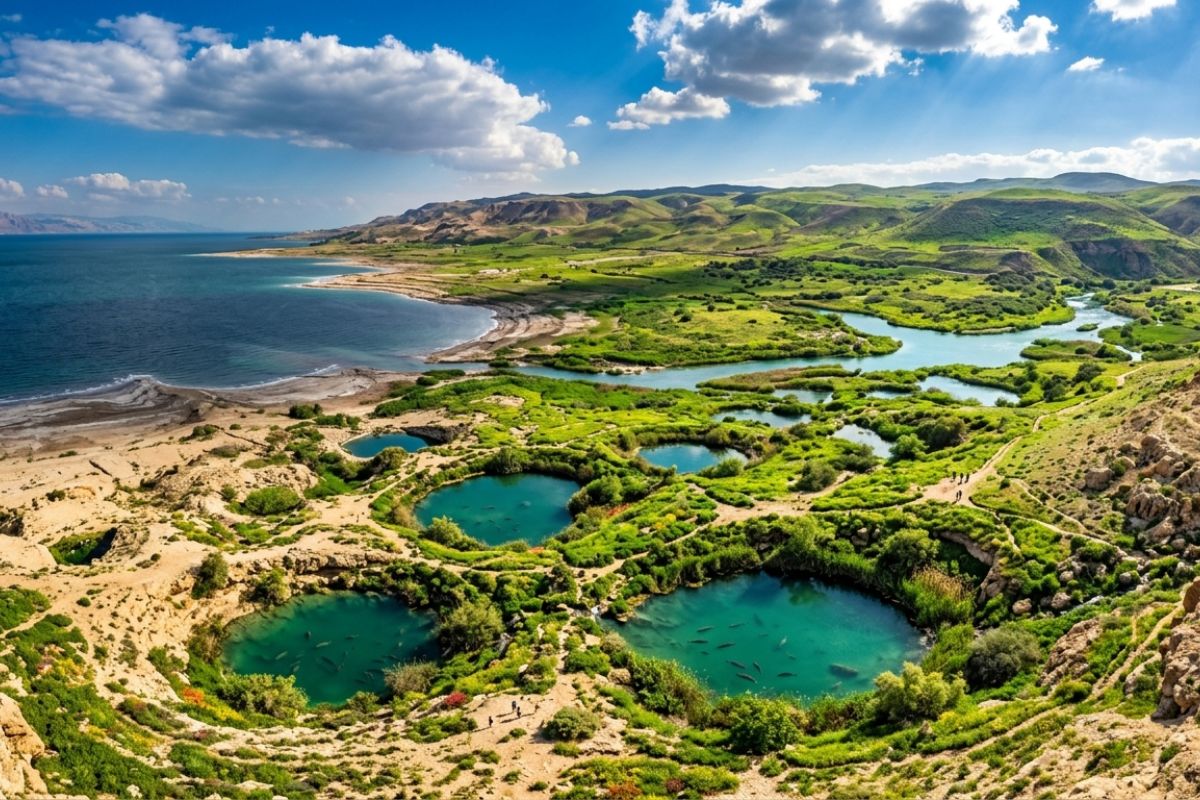
At the same time, another phenomenon draws attention in the same region: the Dead Sea is receding and opening giant craters, and some of them are starting to accumulate fresh water, with vegetation and even fish, which fuels a debate that mixes geography, climate, and interpretations of biblical prophecies.
What changed in the Judean desert next to the Dead Sea

Those who visit the region frequently describe a pattern: there is usually “not a single leaf”, everything is dry. That’s why the impact is so great when the scene appears green and blooming in the desert, next to the Dead Sea.
-
‘Artificial island of Dubai in Brazil’: construction of R$ 65 million inspired by a mega maritime structure, plans for complete urbanization, duplication of 2.2 km of a strategic road, and delivery in 2026, but is ultimately halted by Fepam.
-
The generation that grew up alone at home in the 80s reveals how an unsupervised childhood shaped adults with high adaptability, resilience, and emotional control, according to scientific studies that indicate a significant increase in tolerance for uncertainty.
-
Adolescents who regularly participate in household tasks develop up to 40% more sense of self-efficacy, according to studies in psychology, impacting autonomy, academic performance, emotional health, and the ability to cope with challenges in adulthood.

-
Children who played in the street without rules developed up to 5 essential emotional skills, such as resilience, self-control, and empathy, according to psychology, and may today have greater mental balance in the face of frustrations and challenges of adult life.

The explanation presented in the report goes through a basic condition: it rained. The recent rain is said to have brought fresh water to the soil, triggering the sprouting and blooming that had not been seen in previous years.
The craters that appear when the Dead Sea recedes

In addition to the flowers, the text describes the phenomenon of craters opening where there was once water. The logic is straightforward: the Dead Sea lowers in level every year, and with this recession, large “holes” appear in the landscape.
The most impressive detail is that a good portion of these craters begins to fill with water, and some even accumulate fresh water. Inside them, life appears in layers: vegetation first, then animals, particularly fish.
When the two phenomena meet in the same place
The report shows a point where the two things coexist side by side: a crater from the recession of the Dead Sea and, just behind, the desert area starting to bloom. The idea is that the scenario is not an “isolated change,” but a set of simultaneous signs in the same region.
Even when a crater is dry on the surface, vegetation can still be seen inside it, while the surroundings become greener.
Why this happens without irrigation, according to local explanation
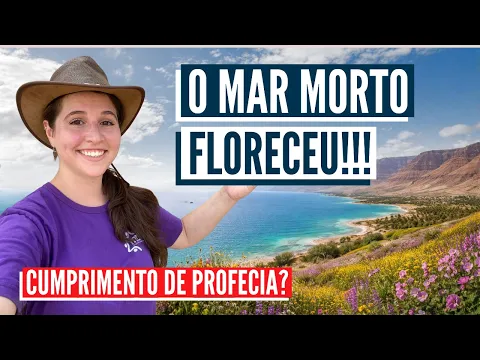

The geographical explanation presented is that, for it to rain there, the clouds need to come loaded from the Mediterranean, cross the Judean mountains, and only then reach the desert up to the edge of the Dead Sea. This would make the event more unusual and, when it occurs, creates the necessary water impulse for blooming.
The text insists on one point: what has been shown would not have been planted or irrigated, but rather “born naturally,” which reinforces the surprise of seeing the green desert in a place where aridity is expected.
The role of satellite images in the debate about greener Israel

After the drone images, the report states that the strongest point comes with the satellite images. They would be used to observe a larger pattern: the borders of Israel appear greener than neighboring areas, raising the question of “why.”
The argument presented is that it cannot all be attributed to agriculture, because neighboring countries also have agriculture.
From there, the text connects this visual contrast to biblical readings about restoration, the desert blooming, and “life” emerging where there was once desolation.
Cited biblical prophecies and the reading of what is happening
The report cites Isaiah 35 when describing the desert blooming and mentions Ezekiel 47 when talking about waters bringing life, trees, and fish. The proposal is not to close a scientific conclusion, but rather to show how many people interpret natural phenomena as signs.
The idea of historical cycles of exile and return linked to “the land drying up” and then becoming fertile again also appears, with readings of passages about cultivation, reconstruction, and restoration.
Quick question for you to comment: do you think these satellite images show only a natural cycle of rain and climate, or is there really some connection to the cited prophecies?





Seja o primeiro a reagir!