





 Portuguese
  English
  Spanish
  4 min of reading
  0 comments



Largest Anglo-Saxon treasure ever found revealed 4,600 pieces with 5 kg of gold in England and changed what was known about medieval warriors.
On July 5, 2009, British metal detectorist Terry Herbert, a resident of Burntwood, England, made one of the most impactful archaeological discoveries in recent history by finding an extraordinary set of metal artifacts in a field in Hammerwich, Staffordshire. The area belongs to farmer Fred Johnson, who had authorized the metal detector scanning. The discovery was later investigated and documented by institutions such as the British Museum and the Portable Antiquities Scheme, being officially recognized as the largest Anglo-Saxon treasure ever found.
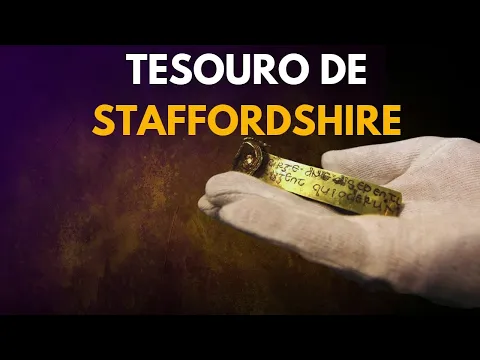
The collection, known as the Staffordshire Hoard, revealed over 4,600 objects, many of which are made of gold, silver, and garnets, dating from the 7th century (approximately between 650 and 675 AD), a period associated with the powerful Kingdom of Mercia, one of the main political entities of Anglo-Saxon England.
More than 4,600 artifacts include 5 kg of gold and 1.4 kg of silver with garnet decoration
The material dimension of the find is one of its most impressive aspects. According to surveys conducted by specialists, the treasure contains about 5.1 kg of gold, between 1.3 and 1.4 kg of silver, and hundreds of pieces decorated with garnets (garnet cloisonné).
-
Man transforms old bus into a house on wheels with wooden furniture, rooftop terrace, and solar power system.

-
Since the Aztecs, farmers in Mexico have built artificial islands surrounded by canals and maintain a highly productive system that still challenges the logic of conventional agriculture today.

-
Scientists are looking for volunteers to live for free for a month in a refuge in the Italian Alps at an altitude of 2,300 meters, with accommodation, food, and a payment of 400 euros to participate in a health study.

-
A 19-year-old is ripped from a mobile home by an F2 tornado, thrown 398 meters, survives with minor injuries, and enters the Guinness World Records in one of the most extreme cases ever recorded in meteorology.



The objects are mostly fragments of high artistic and symbolic value, including pommels (ends of sword grips), decorative plates, weapon accessories, and dismantled ornamental elements.
The absence of complete weapons and the presence of dismembered pieces suggest that the items were deliberately separated before being buried.
Composition reveals strong connection with the warrior elite of the Kingdom of Mercia
The analysis of the material indicates that the treasure is strongly linked to the Anglo-Saxon military elite. Most artifacts have functions or origins associated with war equipment, especially swords, which were symbols of status and power.
Researchers emphasize that the items belonged to high-ranking warriors. Many objects were richly decorated, indicating elevated status, and there is an almost total predominance of male artifacts. This profile led specialists to classify the collection as a warrior treasure, possibly related to military activities, raids, or rituals.

Dating places the treasure in a period of intense political dispute in England
The dating of the material positions the treasure in the 7th century, a period marked by conflicts between Anglo-Saxon kingdoms. The Kingdom of Mercia, to which the objects are associated, was in a process of territorial expansion and power struggle. This historical context includes:
- Frequent wars between neighboring kingdoms;
- Consolidation of regional leaderships;
- Strengthening of military elites.
The presence of a large set of military artifacts reinforces the connection with this scenario of instability and conflict.
Estimated value of £3.285 million reflects material and historical importance
After the discovery, the treasure was officially valued at around £3.285 million, a value used to legally compensate the discoverer and the landowner, according to British law. This value considers the weight of precious metals, the rarity of the pieces, the state of preservation, and historical relevance. However, experts emphasize that the scientific and cultural value of the collection is significantly greater than any monetary estimate.

One of the most intriguing aspects of the Staffordshire Hoard is the absence of human remains, complete weapons, and a clear funerary context. This differentiates the find from traditional burials or known funerary deposits.
Among the hypotheses discussed by archaeologists are the possibility of a war treasure accumulated after battles, the strategic concealment of wealth, and a ritual offering with symbolic significance. So far, there is no definitive consensus on the reason for the burial.
Objects were intentionally dismantled before being buried
A detailed analysis of the pieces revealed that many artifacts were dismantled before being deposited. Parts of swords, for example, appear separated from their blades and organized in specific sets.
This pattern suggests intentional selection of items, possible reuse of materials, or ritual or symbolic disposal. This behavior reinforces the complexity of the find and indicates that the burial was not random.

Discovery changed the understanding of wealth and power in Anglo-Saxon England
Before the discovery of the Staffordshire Hoard, the understanding of the material wealth of the Anglo-Saxon elites was based on more limited finds, such as the famous Sutton Hoo burial. The new collection significantly broadened this understanding by demonstrating greater circulation of precious metals, a high level of craftsmanship, and symbolic complexity in the objects.
The discovery also evidenced that the warrior elite had access to sophisticated production resources and techniques.
Excavation involved large-scale archaeological operation
After notifying the authorities, a specialized team conducted a complete excavation of the area, involving professional archaeologists, the use of additional detectors, and a stratigraphic analysis of the soil.
The process allowed for the recovery of hundreds of additional pieces and ensured the preservation of the archaeological context. The material was later transferred to institutions responsible for its conservation and study.

Treasure continues to be studied and reveals new details over the years
Even more than a decade after the discovery, the Staffordshire Hoard continues to be the subject of study. New analyses are being conducted to understand:
- Manufacturing techniques;
- Origin of materials;
- Possible connections with other finds.
This ongoing process demonstrates the complexity of the collection and its potential to generate new historical interpretations.







Seja o primeiro a reagir!