





 Portuguese
  English
  Spanish
  4 min of reading
  0 comments


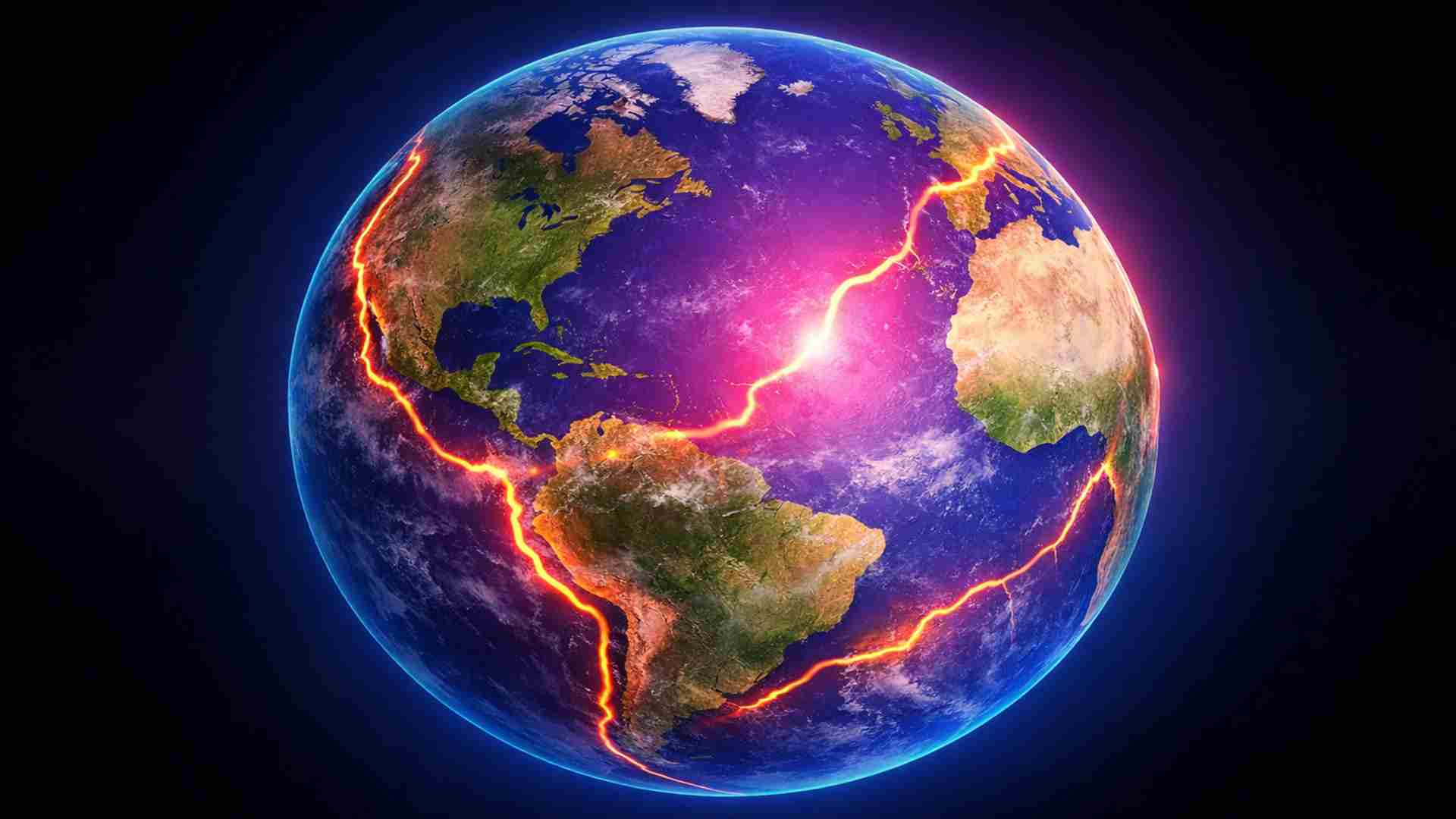
A study with seismic waves revealed that the largest volcanic event in Earth’s history not only formed the Ontong Java Plateau in the Pacific about 110 to 120 million years ago, but also deeply remodeled the oceanic plate beneath the region with physical and chemical changes
The largest volcanic event in Earth’s history profoundly transformed the oceanic plate beneath the Ontong Java Plateau in the Pacific Ocean and left structural marks identified by a team of researchers from Japan. The discovery shows that the formation of this gigantic plateau involved physical and chemical changes in the oceanic lithosphere during a large-scale volcanism episode.
The study was conducted by a team led by Professor Azusa Shito from Okayama University of Science, in collaboration with Associate Professor Akira Ishikawa from the Tokyo Institute of Science, and Professor Masako Yoshikawa from Hiroshima University. The results were published in the journal Geophysical Research Letters and indicate that the oceanic plate beneath the Ontong Java Plateau was strongly modified during its formation.
Formation of the largest oceanic plateau on Earth
The Ontong Java Plateau is the largest oceanic plateau on the planet and formed about 110 to 120 million years ago through large-magnitude submarine volcanic eruptions. This episode is regarded as the most extensive volcanic event in Earth’s history.
-
The world’s largest acid geyser awakens in Yellowstone and reaches record heights after years of dormancy.
-
Tiny robots reveal the hidden chemistry of the depths and uncover secrets of low-oxygen dead zones in the ocean.
-
Scientists use a nearly 10-kilometer fiber optic cable to monitor and record the detachment of 56,000 icebergs in real time.
-
Scientists develop innovative method using sunlight and food dye that allows for clean water to be obtained in just 28 minutes.
The scale of this process would have caused significant environmental disruption on a global scale, with the possibility of contributing to mass extinction events. Previous research had already indicated that an ascending thermochemical plume from the depths of the mantle was the likely cause of this large-scale volcanism.
Still, the way in which the magma generated in such deep regions interacted with the existing oceanic plates remained unanswered. It was also unclear how this material altered the internal structure of the plate beneath the plateau.
Seismic waves reveal unusual internal structure
To investigate this issue, the researchers analyzed high-frequency seismic signals known as Po and So waves. These records were obtained with seismographs installed on the ocean floor around the oceanic plate of the Ontong Java Plateau, as well as instruments positioned on nearby oceanic islands.
As these waves propagate through the oceanic plates, their behavior provides detailed information about the internal structure of the material traversed. Under normal conditions, Po and So waves arise when P and S waves repeatedly scatter through layered structures within the tectonic plate, thus managing to travel long distances.
However, around the Ontong Java Plateau, the team found an unusual pattern. The Po waves traveled efficiently through the plate, while the So waves significantly weakened along the propagation.
Magma intrusions remodeled the plate
To understand this contrast, the researchers turned to modeling seismic waveforms. The reconstruction obtained showed that the oceanic plate beneath the plateau has a mixed structure, formed by horizontal layers intersected by swarms of vertical dikes produced by magma intrusions.
The study also found that the Po and So waves travel more slowly in this plate than in typical oceanic plates. This behavior reinforces the interpretation that the interior of the plate was significantly altered during the volcanic event that originated the plateau.
Based on the observations, the team proposes that the ascending magma from a thermochemical plume penetrated the oceanic plate, forming swarms of dikes and promoting chemical alteration in the surrounding rock. This process is described as refertilization of the oceanic lithosphere, associating structural transformation and chemical modification in the same evolutionary framework.
New model for the evolution of oceanic plates
The model presented in the study offers a new interpretative structure to understand how oceanic plates can be altered by combined physical and chemical processes. The proposal expands the understanding of the formation and evolution of these plates over time, based on the preserved record beneath the Ontong Java Plateau.
The schematic illustration inferred from the seismic analyses shows a plate with horizontally stratified formations, crossed by vertically intruded dikes. This arrangement would have formed as the magma derived from a thermochemical mantle plume ascended through the plate and remodeled its internal structure.
The work was published on September 30, 2025, titled “Swarms of dikes in the oceanic lithosphere beneath the Ontong Java Plateau.” The research includes Azusa Shito, Daisuke Suetsugu, Akira Ishikawa, Masako Yoshikawa, Takehi Isse, Hajime Shiobara, Hiroko Sugioka, Aki Ito, Yasushi Ishihara, Satoru Tanaka, Masayuki Obayashi, Takashi Tonegawa, and Junko Yoshimitsu, detailing how this ancient volcanic episode remodeled a vast oceanic plate beneath the largest oceanic plateau on Earth.






Seja o primeiro a reagir!