





 Portuguese
  English
  Spanish
  3 min of reading
  0 comments


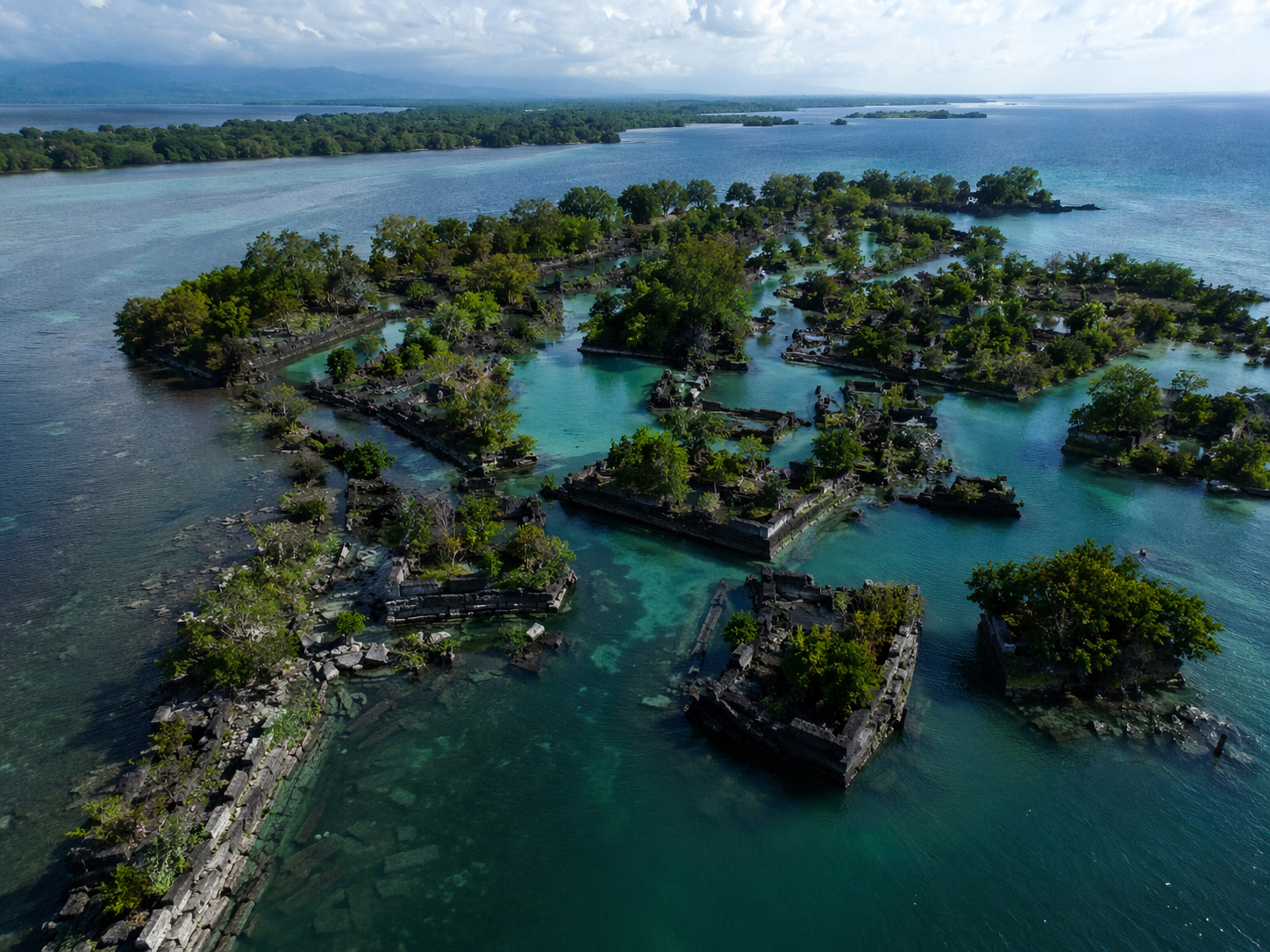
Basalt structures, artificial islets, and historical mysteries reveal why Nan Madol is considered one of the greatest archaeological enigmas in the world
In a remote area of the western Pacific Ocean, the enigmatic Nan Madol emerges, alongside the eastern coast of the island of Pohnpei, in Micronesia.
The complex comprises nearly 100 artificial islets, which ancient peoples built with basalt blocks on a coral reef, something unique in history.
This feature transforms the site into one of the most impressive constructions ever recorded, especially given the hostile environment and distance from natural resources.
-
Few know, but China has a ghost fleet of up to 2,000 boats near Japan and turns fishing into silent strategic pressure in the East China Sea.

-
A man found a children’s book at his parents’ house in Greece that should have been returned to a library in the United States in 1989 and decided to take it back 36 years later because he felt it was the right thing to do.

-
The Federal Revenue Service raises a warning signal for heirs.

-
Rubberized paint made with four inexpensive ingredients creates a rubberized paint that waterproofs exterior walls, withstands sun and rain, and also covers small cracks.

Unusual structure and location
The ruins form 92 interconnected islets by channels, which led to the nickname “Venice of the Pacific”.
The name Nan Madol means “the space in the middle” and directly describes the network of channels and urban organization.
The isolated location raises relevant historical questions, as there are no natural sources of water or food nearby.

Advanced engineering for the time
Ancient peoples built the city with huge basalt blocks, even without modern tools, as noted by the Science Channel.
The structures impress with walls that reach 7.6 meters in height and up to 5 meters in thickness.
Carbon dating indicates that some constructions are about 900 years old, while the islets emerged between the 8th and 9th centuries AD.
Older records indicate human presence since the 1st or 2nd century BC, according to Atlas Obscura.
Origin of the stones and logistical challenges
Local inhabitants likely extracted the basalt from the opposite side of Pohnpei, where magma solidified after volcanic activity.
Still, archaeologists cannot explain how these peoples transported such heavy stones with limited technology.
The total volume amounts to about 750,000 tons of rock, a figure comparable to the effort of the pyramids of Egypt, according to Oddity.
Some experts suggest the use of rafts, but this hypothesis does not clarify the entire process.
Organization and function of the city
The islets have similar geometric shapes, although no one has explained the reason for this standardization.
Nan Madol served as a political and religious center, where chiefs, priests, and subordinate populations lived.
The Saudeleur dynasty ruled the region until around 1628, consolidating the site as a power hub.
The rulers forced local leaders to reside in the city, ensuring direct control over their activities.
Mythology and cultural explanations
The lack of scientific answers has led to the emergence of various local legends.
According to tradition, the twin brothers Olisihpa and Olosohpa built the city with supernatural powers.
Reports claim that they used a flying dragon to move the stones and raise the islets.
Many inhabitants still believe that the construction resulted from sorcery, given the absence of definitive explanations.
Historical and cultural significance
Nan Madol is recognized as a sacred site, linked to the Saudeleur dynasty and the spiritual practices of the region.
The complex remains one of the greatest archaeological enigmas on the planet, uniting advanced engineering, geographical isolation, and cultural tradition.
In light of this scenario, how did an ancient civilization manage to build a monumental city on a coral reef without modern technology?







Seja o primeiro a reagir!