





 Portuguese
  English
  Spanish
  6 min of reading
  1 comment


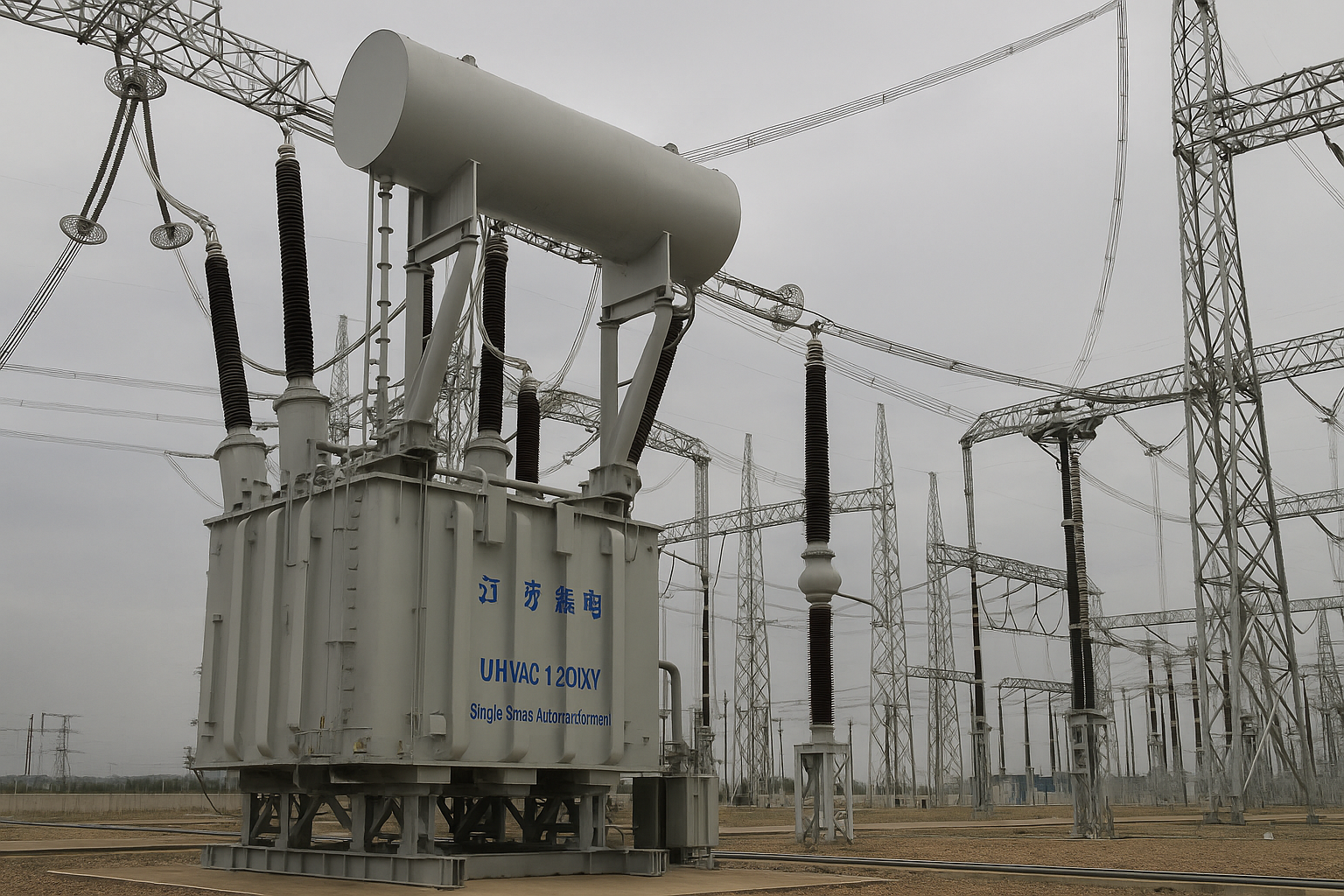


Meet The Most Powerful Electric Transformer In The World: It Weighs 800 Tons, Costs 10 Million Dollars And Is The Height Of A 5-Story Building. Understand How It Works And Why It’s Essential For Energy Transmission.
When we think of the largest engineering feats on the planet, gigantic bridges, glass skyscrapers, immense container ships, and wind turbines that seem to scrape the sky come to mind. But there is a colossal piece of engineering that is practically invisible to the general public: the ultra-high voltage electric transformer. Without it, no modern city would have power. Transmission lines spanning thousands of kilometers simply wouldn’t exist, and electricity would be confined to locations near power plants. Behind the simplicity of flipping a switch are gigantic machines like the most powerful transformer in the world, installed in China, weighing around 800 tons, with a height equivalent to a five-story building and a cost of 10 million dollars.
The Role Of The Transformer In The Global Electric Grid
The transformer is responsible for stepping up and stepping down the voltage of electric current. Without this function, the energy generated at power plants could not be transmitted over long distances without excessive losses.
Basically, electricity leaves power plants at high voltage, travels across the entire country through transmission cables, and is then lowered to safe levels when it reaches neighborhoods, industries, and homes.
-
He started running at 66 years old, broke records at 82, and is now a subject of study for having a metabolic age comparable to that of a 20-year-old, in a case that is intriguing scientists and inspiring the world.

-
Oldest tree on the planet reappears after 130 years of searches: Wattieza, 385 million years old, was 10 meters tall and had no leaves or seeds; Gilboa fossils in New York solved the mystery in 2007.

-
A 48-square-meter house assembled in hours with 4,000 bricks made of recycled plastic that does not absorb moisture, has natural thermal insulation, and costs less than 90,000 reais in a complete kit.

-
Luciano Hang revealed that Havan’s air fleet has already accumulated more than 20,000 landings, 10,000 flight hours, and 6 million kilometers traveled, and he says that without the planes, the company would never have grown so quickly.


The greater the distance, the higher the voltage needed to avoid waste. This is where ultra-high voltage transformers come into play, capable of operating with millions of volts, allowing for the efficient transport of energy from one end of continental countries to the other.
The Largest Transformer In The World Is In China
The largest electric transformer ever built belongs to China’s ultra-high voltage transmission system, currently the most advanced on the planet. This model, known as UHVAC 1200 kV, was manufactured by XD Group, a subsidiary of State Grid Corporation Of China, a state-owned company responsible for a large part of the Chinese electrical grid.
This specific transformer is part of the Jinbei–Nanjing 1200 kV UHVAC transmission line, which connects different regions of the country with impressive safety and efficiency. It can operate at an impressive voltage of 1,200,000 volts, something practically unimaginable compared to the 110 or 220 volts of household outlets.
In addition to its colossal size, the transformer weighs around 800 tons, occupies an area equivalent to a multi-story house, and costs approximately 10 million dollars per unit, considering only manufacturing, not including transportation and installation.
Why Does China Build Such Large Transformers?
China faces a unique geographical and economic challenge. Its main sources of energy generation are located thousands of kilometers from major urban centers. Hydroelectric Plants like the Three Gorges, inland, generate giant volumes of energy that need to be transported to coastal megacities such as Shanghai, Shenzhen, and Beijing.
To solve this monumental logistical problem, the Chinese government has invested in UHV (Ultra High Voltage) transmission technology, which allows energy to be sent over distances exceeding 3,000 kilometers with extremely high efficiency.


The result is an electrical mesh that already exceeds 40,000 kilometers of UHVAC and UHVDC lines, with dozens of colossal transformers spread across the territory.
Without these giant transformers, China’s economic and industrial expansion would be unfeasible. They are the backbone that powers the factories, offices, and homes of nearly 1.5 billion people.
How Is An 800-Ton Transformer Built?
Designing and manufacturing an ultra-high voltage transformer is an extreme challenge in electrical engineering. Each piece is custom-made, with safety margins calculated at the limits of physics.
Production begins with the magnetic core, made from hundreds of tons of special steel, cut and assembled with extreme precision.
Around this core, kilometers of copper or aluminum wire are wound, forming the high and low voltage coils. The total length of these wires can easily exceed 150 kilometers within a single transformer.
Due to the extremely high voltages, the internal insulation requires special materials. High-purity insulating oils and dielectric papers are used to prevent internal electrical discharges, maintaining stability even under extreme stresses. The entire assembly is housed within a reinforced metal casing, capable of withstanding high temperatures and the gigantic magnetic field generated during operation.
Transportation Is A Challenge In Itself
Moving an 800-ton transformer is no simple task. The journey between the factory and the installation site can take weeks, requiring a true military logistics operation.
The special trailers used have dozens of axles to distribute the weight and prevent sinking into the asphalt. Often, roads need to be adapted, viaducts temporarily dismantled, and bridges reinforced. Additionally, special permits, police escorts, and continuous monitoring are required throughout the entire route.
In some cases, water or maritime transport is the only viable option, requiring heavy-lift ships and floating cranes capable of safely moving the transformer.
How Does Cooling Work For Such A Colossus?
During operation, the transformer generates intense heat, which needs to be dissipated efficiently to prevent catastrophic failures. Therefore, the entire system features a sophisticated cooling system.
The insulating oil, in addition to protecting against internal electrical discharges, also circulates continuously, removing heat generated in the core and coils. This oil passes through external radiators, where heat is dissipated into the environment. In transformers of this size, the volume of oil used can reach hundreds of tons.
Smart sensors monitor the temperature, pressure, and flow of the oil in real time. If any anomaly is detected, automatic systems kick in to shut down the equipment, protecting both the transformer and the electrical grid connected to it.
Few Companies In The World Master This Technology – The Most Powerful Electric Transformer In The World
The manufacturing of ultra-high voltage transformers demands advanced technology and decades of accumulated experience. Few companies on the planet can produce this equipment with the necessary reliability.
In addition to XD Group, responsible for the largest transformer in the world in China, companies like Siemens Energy (Germany), GE Grid Solutions (France and the United States), Hitachi Energy (Japan and Switzerland), and TBEA (China) also operate in this highly specialized segment.
Each contract involves millions of dollars, long manufacturing timelines, and strict performance and safety clauses.
The Billion-Dollar Risk Of A Failure In The Most Powerful Electric Transformer In The World
If a common transformer fails, the loss is already considerable. Now imagine the impact of the failure of an ultra-high voltage transformer like the UHVAC 1200 kV.
A failure of this magnitude can cause regional blackouts, billions of dollars in industrial production losses, as well as days or weeks of work to repair or replace the equipment. Therefore, preventive maintenance is conducted continuously and monitored 24 hours a day.
Even with these precautions, there have been cases where giant transformers needed to be replaced after internal short circuits, requiring replacement operations as complex as their original manufacture.
The Future Of Giant Transformers
The demand for ultra-high voltage transformers is expected to continue growing in the coming decades, especially with the advancement of renewable energies and the interconnection of large international electrical systems.
Some projects are already studying to operate at voltages exceeding 1,500 kV, which will require new insulating materials, better electric arc control, and even more sophisticated cooling technologies.
Additionally, so-called “digital transformers” are becoming a trend. Equipped with artificial intelligence and advanced sensors, they will be able to predict failures in advance and optimize their own operation in real time.
While skyscrapers and bridges impress visually, it is discreet machines like the UHVAC 1200 kV transformer from China that truly sustain the functioning of entire cities. These 800-ton colossuses are responsible for connecting distant power plants to large urban centers, ensuring that billions of people can use electricity with stability and security.
Little do people know that behind every lightbulb, there is a chain of gigantic equipment operating silently—and the largest transformer in the world is undoubtedly one of the protagonists of this story.








也不知道用什么材料造的,10万美元能造出800吨来,1吨成本不到1000元人民币,每斤不到5毛钱,拿水造的吗?