





 English
  Francês
  Alemão
  Italiano
  Japonês
  Norueguês
  Portuguese
  Spanish
  5 min of reading
  0 comments


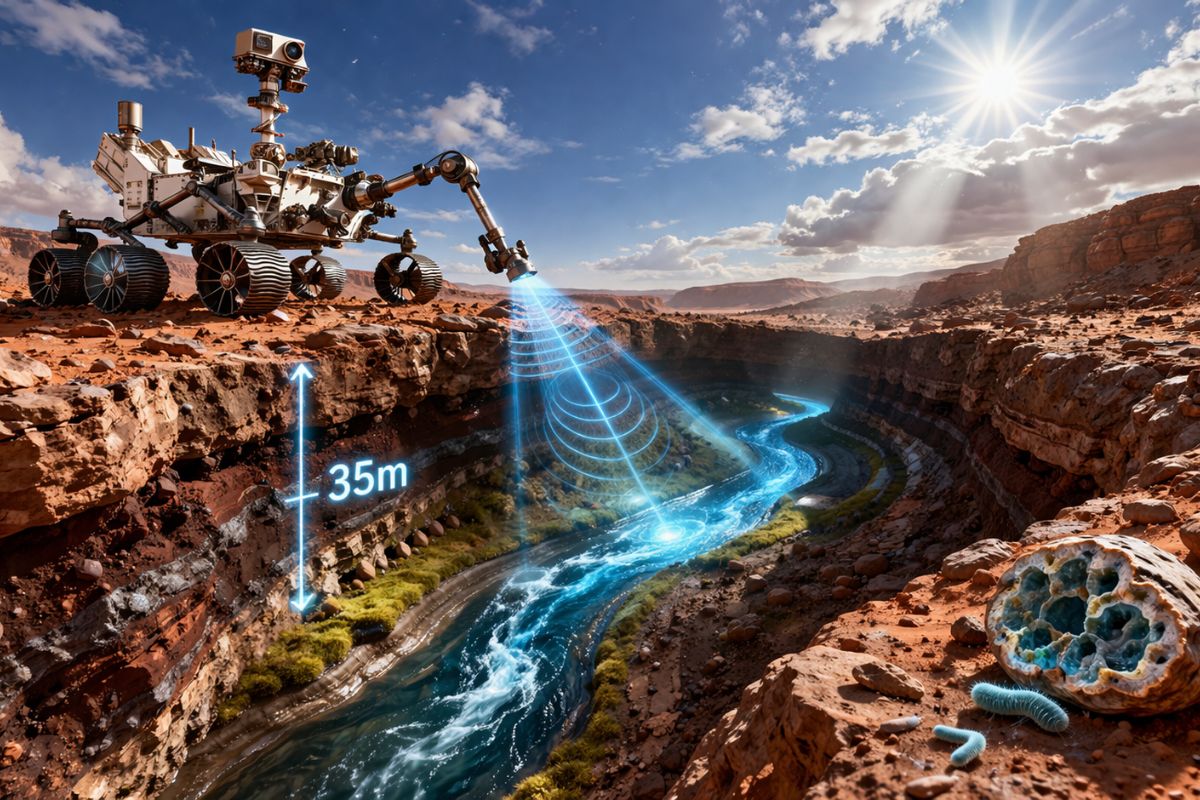
On Mars, the radar of the Perseverance rover identified a buried river in the subsurface of the Jezero crater and extended the timeline of liquid water on the planet
Mars has returned to the center of scientific attention with a discovery that deepens the mystery about the past of the red planet. Using ground-penetrating radar, the Perseverance rover detected buried structures over 35 meters deep that indicate the presence of an ancient river system buried beneath layers accumulated over billions of years.
The finding is significant because it not only expands the geological map of Mars, but also extends the presence of liquid water to about 4.2 billion years ago. This suggests that the planet had habitable conditions for a longer period than previously thought, increasing interest in possible preserved records of ancient biological activity.
The Jezero crater continues to change the history of Mars
The Jezero crater was already considered one of the most promising regions of Mars for concentrating clear signs of past water activity.
-
The climate in 2026 may surprise with extremes even more intense than in 2025, with heatwaves, out-of-season cold, and irregular rainfall in Brazil.

-
Astronomers identify 45 rocky planets that could harbor life, and one of them is just 4.2 light-years from Earth, making it the closest neighbor with the potential to have liquid water on its surface.

-
Archaeologists discover 43,000 ostraca in Egypt with tax lists, drawings, religious texts, and everyday notes that reveal what life was like in ancient Athribis before Cleopatra.
-
China showcases laser defense systems that target drones flying very low and attempts to address a flaw that has been concerning armies worldwide.

Ancient channels, preserved deltas, and hydrated minerals already indicated that the area had received liquid water for an extended period during a very different phase than the one the planet experiences today.
The new discovery deepens this scenario. Instead of only showing structures already visible on the surface, the radar revealed much older formations hidden underground.
It’s as if Mars has been keeping layers of its own geological memory beneath the dust and sediments.
The Perseverance radar found a hidden river
The instrument used in the discovery was a radar capable of penetrating the ground and returning information about different underground layers.
By interpreting these echoes, scientists were able to reconstruct buried structures that could not be seen directly from the surface.
That’s how evidence of a hidden river system over 35 meters deep emerged. On Mars, this type of record functions almost like a geological fossil, preserving the mark of rivers and sediment deposits that ceased to exist billions of years ago.
The most impressive thing is that this past has remained protected long enough to still be identifiable today.
Water on Mars may be older than previously thought


Before this revelation, the visible channels on the surface of the crater already indicated intense water activity around 3.7 billion years ago. Now, radar data pushes this presence back to approximately 4.2 billion years.
This difference shifts the weight of the scientific discussion. If Mars maintained stable liquid water in an even more remote period, then the planet may have gathered conditions favorable to habitability much earlier than previously thought. This also reinforces the idea that Martian climatic history was longer and more complex.
How Mars lost its surface water
The most accepted explanation for the disappearance of liquid water on Mars involves the gradual loss of its atmosphere.
In the past, the planet would have had a denser atmosphere, capable of sustaining enough pressure to keep water stable on the surface.
With the weakening and loss of the global magnetic field, solar wind began to strike the atmosphere directly, stripping particles into space over time.
The consequence was a drop in atmospheric pressure and the collapse of the conditions necessary for liquid water to remain exposed for long periods. Without this protection, Mars became colder, drier, and much more hostile.
Salts and subsurface keep the debate open
Even with this severe scenario, the history of water on Mars does not seem to be entirely linear. Compounds found in the soil, such as perchlorates, can lower the freezing point of water and allow for liquid saline solutions at very low temperatures.
Moreover, the subsurface increasingly appears as a crucial archive. The Perseverance radar shows that, beneath the surface of Mars, there are still preserved records of environments where water circulated intensely.
This significantly increases scientific interest in everything hidden out of direct visual observation reach.
Multiple water cycles may have existed on the planet
The new reading of the terrain indicates that Mars may not have experienced just a short wet period followed by a definitive collapse.
The data suggest distinct phases, with rivers appearing, disappearing, and reappearing over long intervals.
These cycles may relate to climate changes, volcanic activity, or variations in the tilt of the planet’s axis.
The effect of this hypothesis is enormous: instead of a planet that lost water simply and quickly, Mars now appears to be a world with a much richer and more unstable environmental dynamic.
What this changes in the search for signs of life
From a habitability perspective, the discovery is especially important. Riverine environments and delta regions are seen as favorable locations for the emergence and preservation of biosignatures, because fine sediments can trap organic matter and microscopic records for long periods.
On Earth, this type of environment preserves fossils and delicate chemical marks. On Mars, the existence of multiple buried deltas and rivers increases the chance that ancient traces have been protected underground.
The longer and more diverse the presence of liquid water, the greater the possibility that the planet has preserved clues of a chemistry favorable to life.
Mars functions as an almost intact geological museum
Another fascinating point is the level of preservation. Unlike Earth, where erosion, tectonism, and constant renewal erase part of the past, Mars preserves ancient geological layers with much less interference.
This makes the planet a kind of natural museum of its own history. Structures that would have been destroyed on other worlds can remain almost intact for billions of years.
This is precisely one of the reasons why the discovery of the buried river is so relevant: it may be just a small sample of what is still hidden beneath the Martian surface.
The past of Mars may be even more vast than it seems
If such an ancient river system has been found in a specific region like Jezero, the possibility of many other buried records existing in different parts of Mars gains even more strength.
The planet’s subsurface may be holding an enormous amount of information about rivers, deltas, lakes, and profound environmental changes.
Therefore, the discovery goes beyond a buried river. It reinforces the idea that Mars was once a much more dynamic, wet, and potentially habitable planet than the cold and dry landscape we see today suggests.
Do you think Mars may still hide concrete signs of ancient life beneath its surface?









Seja o primeiro a reagir!