





 Portuguese
  English
  Spanish
  5 min of reading
  0 comments


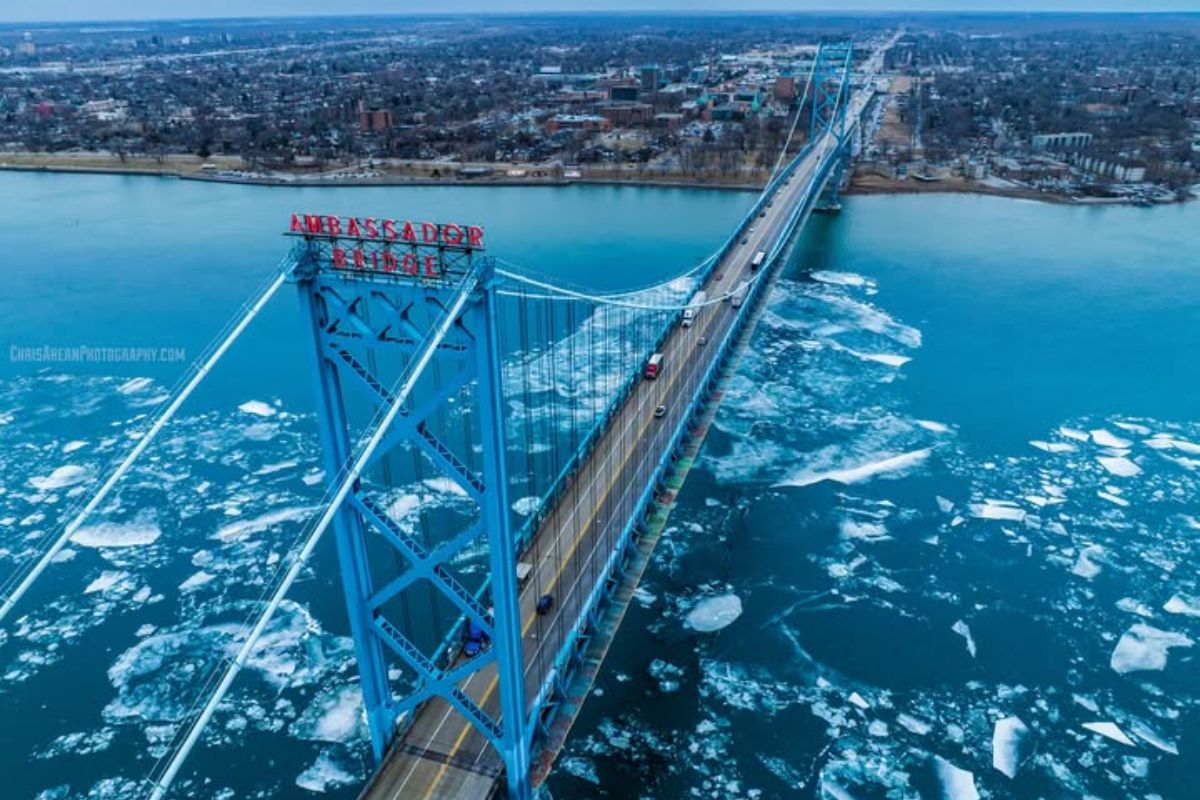
The Ambassador Bridge is a suspension bridge of 2,286 meters inaugurated in 1929 that connects Detroit (USA) to Windsor (Canada), through which more than 25% of all goods trade between the two countries passes, being the largest commercial border in North America and one of the few privately owned.
Between Detroit, in the United States, and Windsor, in Canada, there is a bridge that carries over its 2,286 meters of length more than a quarter of all bilateral trade between the two largest economies in North America. The Ambassador Bridge is the most important international bridge on the continent and has remained the largest commercial border between the USA and Canada since it was inaugurated in 1929. More than 25% of all goods crossing the border between the two countries pass through the lanes of this suspension bridge over the Detroit River.
What makes this bridge even more unique is that it is one of the few large international infrastructures owned by a private owner. The Ambassador Bridge is not state-owned. It is privately owned, a fact that surprises those who discover that such a strategic connection for the economy of two countries is not controlled by any government. Its classic silhouette, with steel lattice details reminiscent of the pre-Great Depression period, is both a symbol of engineering from nearly a century ago and a vital artery of the automotive industry connecting factories in Michigan to plants in Ontario.
Why this bridge concentrates more than 25% of trade between two countries

The answer lies in the geography and industrial history of the region. The bridge connects the I-75 highway in the United States to Highway 401 in Canada, creating a direct corridor between the automotive production centers of both countries.
-
Australia is on alert for a potential shortage of up to 300,000 workers in construction by 2027, as a surge in energy, housing, and infrastructure projects pressures the country and exposes a historical bottleneck that could stall ongoing billion-dollar projects.
-
How much does it cost to build a simple 2-bedroom house in the countryside in 2026? Look at real values and what drives up the project’s costs.

-
From discarded waste to completed constructions: startup creates modular blocks with recycled plastic that reduce construction costs, eliminate the need for specialized labor, and accelerate projects in Brazil.
-
Recycled plastic house is completed in 4 hours and becomes an attraction at Feicon: facade with cement board and “nano rock” texture with a 10-year warranty, 100% plastic furniture, minimalist doors, and a promise of thermal and acoustic resistance.

Detroit and Windsor are twin cities separated only by the Detroit River, and the automotive industry has built over decades an integrated supply chain that relies on the constant passage of parts, components, and vehicles back and forth.
Millions of vehicles cross the bridge annually, with most being heavy trucks transporting products to the automakers and suppliers in the region. The efficiency in processing thousands of trucks daily at the customs checkpoints on both sides of the bridge is what keeps the supply chains functioning.
Any interruption in the flow over the bridge has an immediate impact on factories that operate with minimal stock and rely on continuous deliveries.
How the crossing and border control over the bridge works
Crossing the bridge requires passing through rigorous customs checkpoints operated by the CBP (Customs and Border Protection) on the American side and by the CBSA (Canada Border Services Agency) on the Canadian side. The driver must carry a valid passport or trusted traveler cards such as NEXUS, which expedite processing and reduce wait times.
Tolls can be paid in either US or Canadian dollars, and electronic toll systems facilitate passage during peak hours.
Checking the wait time at the border before starting the trip is essential advice, especially on national holidays in either country, when traffic volume increases significantly.
The bridge operates 24 hours a day, seven days a week, because the commercial flow between the United States and Canada does not stop. For truck drivers who regularly make the route, knowing the off-peak hours and customs procedures is a fundamental part of their professional routine.
The engineering features that have kept the bridge functioning for almost a century
The Ambassador Bridge was inaugurated on November 11, 1929, just days after the start of the Great Depression, and continues to operate with the same basic structure. The bridge is 2,286 meters long and has a main span of 564 meters of pure suspension over the Detroit River, dimensions that at the time of construction represented an impressive engineering feat.
The steel cables, towers, and metal lattice were designed to withstand loads that engineers in 1929 estimated would last for decades to come.
The architecture of the bridge harks back to the American industrial period, with steel lattice details that delight design and engineering enthusiasts. According to official portals of the Government of Canada, the bridge is considered a national historic site of interest.
Continuous maintenance over nearly a century has allowed the structure to adapt to the progressive increase in traffic volume, although the bridge’s capacity has become a topic of debate as binational trade has grown.
The Gordie Howe Bridge and the future of the crossing alongside the original bridge
The discussion about the capacity of the Ambassador Bridge has led to the construction of a new crossing in the same region. The Gordie Howe International Bridge, a high-capacity cable-stayed bridge, is under construction to complement the crossing infrastructure between Detroit and Windsor.
Unlike the Ambassador Bridge, the new bridge is a binational government project aimed at providing an additional route to alleviate congestion and ensure redundancy for the most important commercial corridor in North America.
The Ambassador Bridge will not be replaced by the new construction, but will share traffic with it. The coexistence between the privately owned bridge from 1929 and the new public bridge represents two different models of international infrastructure operating side by side.
The Detroit-Windsor region also features the Detroit-Windsor Tunnel, an underwater tunnel designed for light vehicles and passengers, completing a set of three international connections over and under the Detroit River.
The viewpoints and the experience of seeing the bridge up close
For those visiting the region, the bridge offers more than just a functional crossing. The Detroit Riverwalk, on the American side, and Dieppe Gardens, on the Canadian side, provide unobstructed views of the structure, and photographing the bridge at sunset with the lights of Windsor in the background is a classic itinerary for visitors and photographers.
The scale of the construction is only truly perceived when standing on the riverbanks looking up.
The bridge that moves billions of dollars in products every month is also a postcard that connects two cities, two countries, and two economies in a way that few structures in the world can.
Privately owned, built during an economic crisis, and functioning uninterrupted for almost a century, the Ambassador Bridge is proof that some infrastructures transcend their original function and become symbols of something much greater than concrete and steel.
Did you know that more than 25% of trade between the USA and Canada passes through a single privately owned bridge? What surprised you the most: the commercial scale or the fact that it is not state-owned? Share in the comments. Infrastructures that support entire economies deserve to be better known than they are.










Seja o primeiro a reagir!