





 Portuguese
  English
  Spanish
  4 min of reading
  0 comments


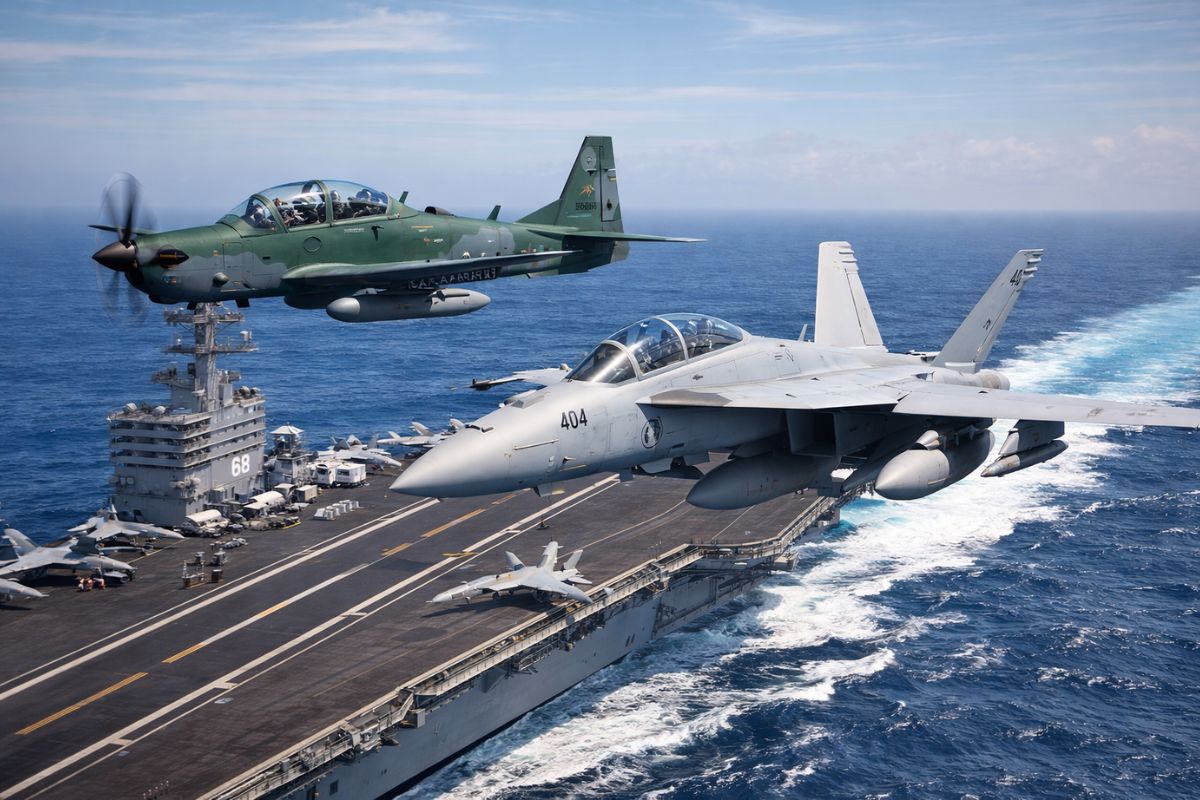
In the Southern Seas 2026 operation, the A-29 Tucano of the Ecuadorian Air Force conducted a joint air patrol with fighters that cost five times more while the Super Hornets dropped real bombs in the Pacific Ocean during the last operational mission of the world’s oldest aircraft carrier
On April 8, 2026, an image captured by the United States Navy in the Pacific Ocean showed something that summarizes decades of Brazilian engineering in a single scene. An A-29 Super Tucano from Embraer, a turboprop aircraft, was flying in formation with an F/A-18E Super Hornet, a supersonic jet fighter, over the deck of the nuclear aircraft carrier USS Nimitz.
On one side, a plane designed in São José dos Campos that costs about US$ 14 million. On the other, a war machine worth US$ 70 million capable of exceeding the speed of sound. And both were there, on the same mission, in the same sky, over the same aircraft carrier.
This was not a demonstration. It was a real war exercise.
-
Support during childbirth advances in Brazil and strengthens the role of doulas: expectant mothers gain more comfort, guidance, and support from the beginning to the postpartum period.

-
In Italy, archaeologists analyzed a dental prosthesis from the 16th or 17th century made with five human teeth held together by a gold band, revealing a level of dentistry much more advanced than previously thought.

-
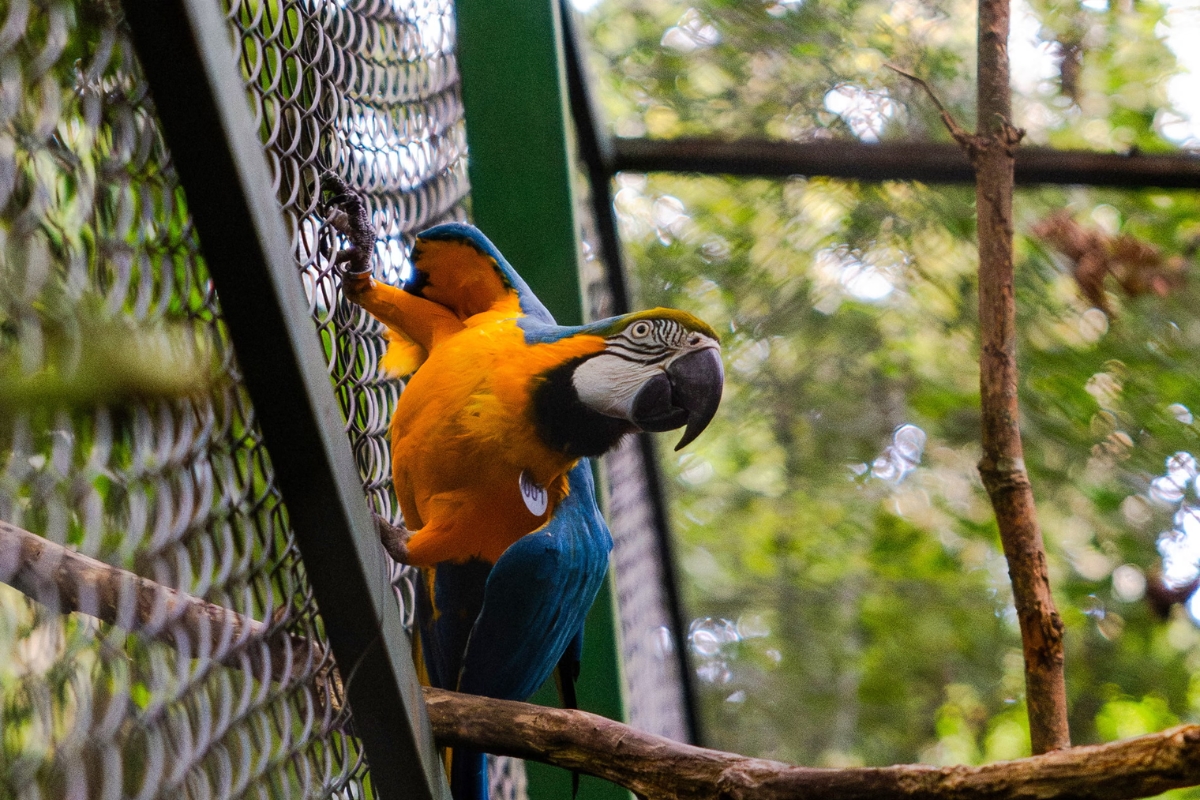
After 200 years, blue and yellow macaws return to Rio with the release of 4 birds in Tijuca Park.
-
The glaciers of the Himalayas are melting faster than any previous forecasts indicated, and scientists warn that changes in the monsoons could leave millions of people without drinking water, irrigation, and energy in India, Nepal, and Bangladesh.

What happened on April 7 and 8 over the Pacific

The scene was part of the Southern Seas 2026 operation, a multinational exercise conducted by the U.S. 4th Fleet that is circumnavigating South America with the USS Nimitz strike group. In the stage with Ecuador, the Ecuadorian Air Force sent its Super Tucano to fly alongside the American fighters.
The Ecuadorian Tucano, piloted by Lieutenant Diego Morán and Major Antonio Pavón, conducted combined air patrol with the F/A-18Es of the VFA-137 “Kestrels” squadron over the aircraft carrier. Meanwhile, in the same operation, the Nimitz crew loaded real bombs on the Super Hornets, which carried out simulated attacks by dropping munitions in an open area of the ocean.
The exercises included simulated air combat between fighters, maritime interdiction, live fire with naval artillery, and air defense. The Ecuadorian corvettes BAE Manabi and BAE Loja maneuvered alongside the American destroyer USS Gridley.
Why does a propeller plane fly with a jet fighter?
The question seems obvious. The F/A-18 Super Hornet flies at Mach 1.8. The Super Tucano reaches 590 km/h. One is supersonic. The other has a propeller. One costs five times more than the other. Why does the U.S. Navy accept putting both in the same exercise?
The answer lies in modern warfare.
Current conflicts are not fought only by $70 million fighters. The proliferation of cheap drones, autonomous attack munitions, and asymmetric threats has created a scenario where using a Super Hornet to take down a $500 drone is economically unsustainable. It’s like using a cannon to kill a mosquito.
The Super Tucano was designed exactly for this space. It can fly for hours over a region, consumes a fraction of the fuel of a jet, carries guided bombs, machine guns, and rockets, and executes patrol, light attack, and armed reconnaissance missions with surgical precision. More than 600,000 flight hours accumulated by the global fleet, of which 60,000 in real combat operations in Afghanistan, Colombia, Nigeria, and other war theaters.
The Tucano does not compete with the Hornet. It complements it. One does what the other cannot do efficiently. And this complementarity is exactly what Southern Seas 2026 is testing.
The stage: the last mission of the world’s oldest aircraft carrier
The USS Nimitz is not just any ship. Launched in 1972, commissioned in 1975, it is the oldest nuclear aircraft carrier in operation on the planet. It participated in Operation Desert Storm, the Iraq War, and Afghanistan. It has crossed all oceans. It has served as a floating base for over 4,000 people for five decades.
Southern Seas 2026 is the last major operational mission of the Nimitz before its retirement. After this circumnavigation of South America, with scheduled stops in Brazil, Chile, Panama, and Jamaica, the aircraft carrier will head to the Newport News shipyard for deactivation, removal of nuclear fuel, and dismantling.
The Embraer Super Tucano, therefore, flew over the deck of a ship that is closing half a century of history. The Brazilian turboprop is part of the last chapter of one of the largest war machines ever built.
What this means for Embraer and Brazil
Every time a Super Tucano appears in an operation alongside the U.S. armed forces, the value of Embraer’s platform rises. It’s not just prestige. It’s a sales argument.
Embraer has already delivered more than 260 units of the A-29 to 15 countries. In March 2026, it announced a partnership with Valkyrie Aero, a company linked to the Pentagon, to integrate artificial intelligence into the Tucano and turn it into a drone hunter. Portugal ordered 12 units of the NATO-compatible variant. Uruguay signed a $100 million contract for 6 aircraft.
And now, the photo of a Tucano flying over the USS Nimitz alongside a Super Hornet is circulating the world. For a plane that was born in a hangar in São José dos Campos, this is the kind of image that no marketing campaign can buy.
The best-selling turboprop on the planet does not need a jet engine. It needs modern warfare. And modern warfare, apparently, needs it.
With information from Stars and Stripes, Zona Militar, and the US Navy.








Seja o primeiro a reagir!