





 Portuguese
  English
  Spanish
  4 min of reading
  4 comments


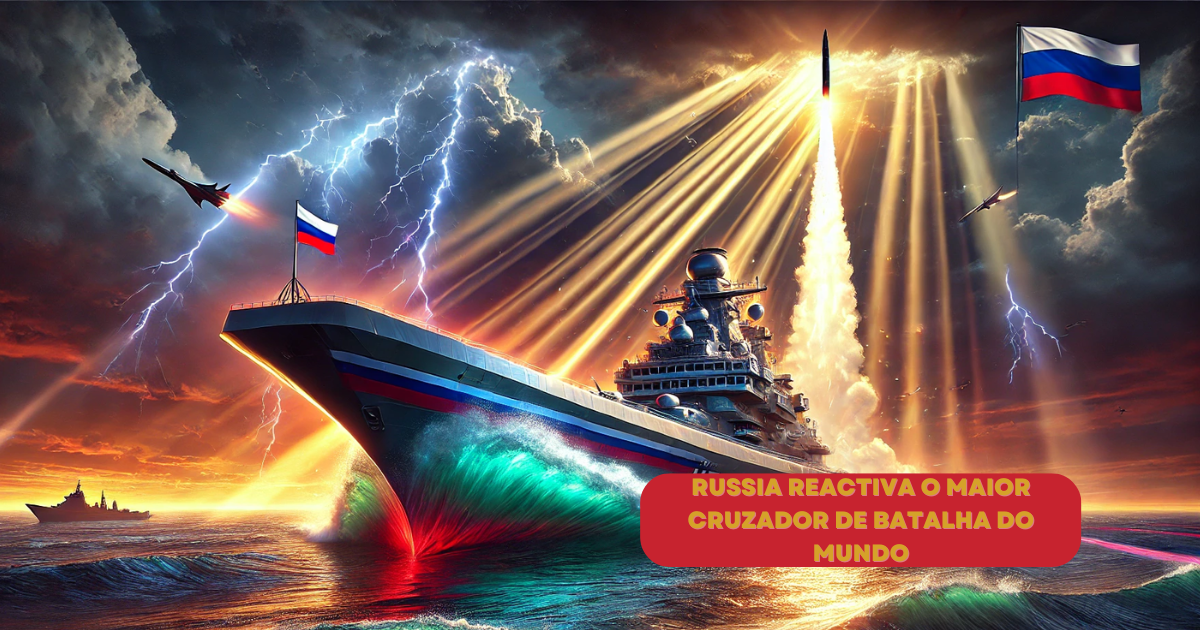


The Largest Battle Cruiser in the World Is Back! After 25 Years, Russia Reactivates Admiral Nakhimov, Now Equipped with Hypersonic Missiles and State-of-the-Art Technology. With Its Nuclear Reactor Operational, This Naval Colossus Promises to Change the Balance of Power in the Oceans.
In an era where naval supremacy defines the military might of nations, Russia surprises the world by resurrecting one of its most formidable war machines.
After a quarter of a century in maintenance, the imposing battle cruiser Admiral Nakhimov is about to cut through the waters again, bringing with it an arsenal capable of redefining the balance of power in the oceans.
But what motivated Moscow to invest in the revitalization of this colossus of the seas? What are the true capabilities of this vessel that was once the pride of the Soviet fleet?
-
He started running at 66 years old, broke records at 82, and is now a subject of study for having a metabolic age comparable to that of a 20-year-old, in a case that is intriguing scientists and inspiring the world.

-
Oldest tree on the planet reappears after 130 years of searches: Wattieza, 385 million years old, was 10 meters tall and had no leaves or seeds; Gilboa fossils in New York solved the mystery in 2007.

-
A 48-square-meter house assembled in hours with 4,000 bricks made of recycled plastic that does not absorb moisture, has natural thermal insulation, and costs less than 90,000 reais in a complete kit.

-
Luciano Hang revealed that Havan’s air fleet has already accumulated more than 20,000 landings, 10,000 flight hours, and 6 million kilometers traveled, and he says that without the planes, the company would never have grown so quickly.


The Triumphant Return of Admiral Nakhimov
Admiral Nakhimov, one of the four Kirov-class battle cruisers built by the Soviet Union in the 1980s, has always been synonymous with power and grandeur.
With a displacement of 28,000 tons, it surpasses the size of American Arleigh Burke-class destroyers and any other surface combat vessel.
Furthermore, it stands out as one of the only surface combat vessels to utilize nuclear propulsion, allowing it to maintain high speeds and operate energy-intensive weapons and sensor systems for extended periods.
After a long modernization period that began in 1999, Admiral Nakhimov recently had its two nuclear reactors reactivated.
The first was brought online at the end of January, and the second on February 2, 2025, according to reports from Russian defense industry sources.
This reactivation confirms that the ship’s nuclear power plant is fully operational, preparing it to return to the sea later this summer.
Modernization: A Floating Fortress
The modernization of Admiral Nakhimov has transformed it into a true floating fortress, equipped with the latest Russian naval technologies.
Key upgrades include the installation of up to 60 hypersonic anti-ship missiles Zircon, Kalibr cruise missiles, and a naval variant of the S-400 air defense system.
This formidable arsenal, combined with upgraded sensors and electronic warfare systems, positions Admiral Nakhimov as one of the most powerful warships in the world.
Strategic Implications: Why Resurrect a Giant?
The decision to invest in the revitalization of Admiral Nakhimov, after 25 years, reflects Russia’s strategic objectives. Despite its age, the Kirov class remains one of the most powerful ever built.
The modernization ensures that the ship can effectively participate in modern naval operations, serving as a mobile platform for a devastating array of weapons.
Economically, renewing an existing vessel is more feasible than building a new one from scratch. This allows Russia to deploy a strategically important warship at a lower cost.
The return of Admiral Nakhimov will significantly enhance the capabilities of the Northern Fleet, extending Russia’s reach into the Arctic and beyond, symbolizing the country’s commitment to maintaining its naval power amid rising global tensions.
Challenges and Future Prospects
While the return of Admiral Nakhimov is a milestone, Russia faces significant challenges in its shipbuilding industry.
Over the past 15 years, the country has tried to modernize its navy, developing advanced technologies, including Severodvinsk-class nuclear submarines and Zircon hypersonic missiles.
However, the invasion of Ukraine in 2022 disrupted these efforts due to economic and logistical challenges, redirecting resources to the land conflict. Shipbuilding has been slow, and many projects are experiencing delays.
The war has exacerbated these issues, even affecting the jewels of the Russian navy, such as the aircraft carrier Admiral Kuznetsov and the nuclear submarine Khabarovsk.
The lack of investment and rising economic hurdles threaten the future of the Russian fleet, which may face a historic setback similar to that experienced after the collapse of the Soviet Union.
Despite this, the successful modernization of Admiral Nakhimov demonstrates Russia’s ability to revitalize strategic assets, serving as a powerful reminder of its commitment to maintaining a significant naval presence.
Admiral Nakhimov and the Future of the Russian Navy
The return of the Admiral Nakhimov to active service represents more than the reactivation of a warship; it symbolizes Russia’s resilience and determination to maintain its influence in the seas.
As the world watches, the question remains: how will global powers respond to this Russian naval renaissance? Are we on the brink of a new arms race in the oceans? Only time will tell, but one thing is certain: Admiral Nakhimov will sail again, and its shadow will be felt in international waters.








Mais uma **** velha para poluir o mar assim que encontrar um drone Ucraniano!
A pergunta que não quer calar: qual seria o papel desse navio se ele não tiver um esquadrão de apoio nem um PA como elemento de dissuasão contra ataques aéreos?
Esse navio de guerra gigantesco mostra a capacidade e força militar naval Russa , que apesar de sancionada ao máximo, demonstra capacidades inalcançáveis pelos seus adversários falidos do ocidente.