





 Portuguese
  English
  Spanish
  5 min of reading
  2 comments


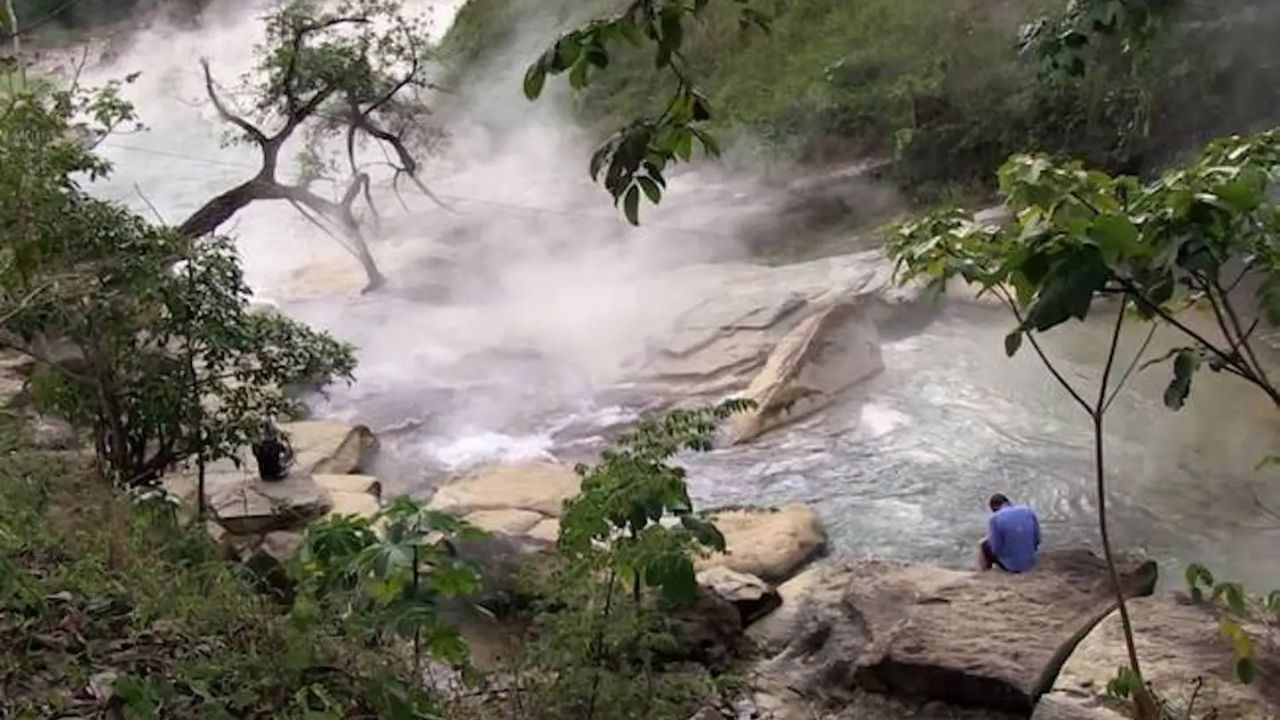


Known as Shanay-timpishka, the river that boils in the Peruvian Amazon reaches temperatures of up to 86 °C, being a geothermal phenomenon that for centuries was considered just a myth.
In the depths of the Peruvian Amazon, where legend and geography meet, flows a body of water that defies logic: the boiling river in the Amazon. For centuries, its existence has been whispered in tales of the Incas and accounts of Spanish conquerors, but dismissed by modern science as a geological impossibility. It is a natural anomaly that cooks any animal that falls into its waters, a mystery that has only recently begun to be deciphered, revealing a complex interaction between geological faults and the Earth’s internal heat.
The journey to validate this legend was led by geoscientist Andrés Ruzo, whose curiosity, sparked by childhood stories, led him on an expedition that would change scientific understanding of geothermal systems. What he found was not just a hot river, but an ecosystem of extremes, a sacred site for the Asháninka indigenous community and a natural laboratory offering clues about the future of the rainforest on a warming planet.
Ruzo’s Journey: From Myth to Scientific Confirmation
The saga of Shanay-timpishka, as it is known by locals, is inseparable from the perseverance of Andrés Ruzo. According to the portal Observador, the story began with a legend that his grandfather told about a boiling river in the Amazon jungle. Years later, as a geoscientist, Ruzo was met with skepticism by the scientific community. The logic was clear: thermal rivers of this magnitude are almost always associated with active volcanoes, and there are no volcanoes in the Amazon basin. The idea of a boiling river, therefore, seemed geologically impossible.
-
These living root bridges and ladders are over 700 years old and help indigenous people survive in one of the rainiest regions in the world.

-
From sertanejo star to international investor: Ana Castela invests millions in a mansion in the USA, creates a themed accommodation in Orlando, and shows that the “boiadeira” also wants to grow away from the stage.

-
The 10 most stunning motorhomes in the world: a $3 million trailer with a rooftop nightclub and garage for a Ferrari, “palaces on wheels” with Italian marble, private cinema, and five-star hotel luxury for billionaires.

-
Trump wanted to spend $400 million on the White House, but the courts prohibited the million-dollar construction.


It was a family revelation that changed the course of history. When sharing his frustration, his aunt casually claimed to have swum in the river. This confirmation, coming from a reliable source, prompted Ruzo to organize an expedition. Guided by his aunt, he entered the Peruvian jungle and found the improbable: columns of steam rising among the trees and a river whose waters, when measured, recorded an average temperature of 86 °C. The legend, as detailed by Observador, was real, transforming a folktale into a documented scientific fact.
The Geological Mystery: How Is the River Heated?
The primary scientific question was: where does the heat come from? Without the presence of a volcano, the explanation for the boiling river in the Amazon lies in a complex underground geothermal system. The hypothesis, supported by sources like Observador and Biotá do Futuro, points to a phenomenon “fed by faults”. The water, possibly stemming from glacier melt in the Andes, seeps deep into the Earth’s crust through geological fractures. At great depths, this water is superheated by the Earth’s natural geothermal gradient.
This hot, pressurized water rises rapidly back to the surface through another network of faults, emerging as hot springs that directly feed the riverbed. Biotá do Futuro emphasizes that this process does not have a volcanic origin, but rather stems from unique geothermal characteristics of the Amazon subsoil. A crucial piece of evidence supporting this theory is the purity of the water. If the water spent too much time underground, it would become saturated with minerals. Its purity suggests an extremely rapid transit, like a geological “expressway” that heats it without contaminating it.
Yacumama: The Spiritual Domain and Daily Life
For the Asháninka indigenous community, the river transcends geology, being a site of profound spiritual power. The portal Brasil 247 explores this cultural dimension, highlighting the legend of “Yacumama” or “Mother of Waters”. According to tradition, a spirit of a giant serpent inhabits the river, giving birth to both hot and cold waters. The river’s source, where a rock resembles a serpent’s head, is the most sacred point, symbolizing the place where Yacumama protects and originates the phenomenon.
This myth, far from being just a fantasy, serves as a precise metaphorical model of the observable geological process, encoding and transmitting complex hydrological knowledge across generations. The river and the forest are protected by a local shaman who uses its waters in healing rituals. As detailed by Brasil 247, the Asháninka community integrates the river into their daily life, using its waters for cooking, cleaning, and medicinal practices, demonstrating a deep respect for the lethal and vital power of Shanay-timpishka.
An Ecosystem of Extremes: Life and Death in the Boiling Waters
The boiling river in the Amazon is an environment of dualities. For most animals, a fall into its waters means a quick and brutal death, cooked from the inside out in a matter of minutes. Vegetation along its banks also shows signs of thermal stress, offering scientists a glimpse of how the Amazon rainforest may respond to rising global temperatures. Plant diversity decreases dramatically the closer one gets to the hot waters, creating a natural laboratory for the study of climate change.
Despite its lethality, the river is not barren. As pointed out by Biotá do Futuro, its waters are home to extremophilic organisms, microbes that not only survive but thrive in extreme temperatures. Scientists have discovered new species of these organisms, whose unique enzymes and compounds hold enormous potential for biotechnology and medicine. The same heat that kills a mammal is the essential condition that allows a colony of thermophiles to flourish, demonstrating that extreme environments do not eliminate life, but reshape it.
Preserve a Living Legend
Shanay-timpishka is proof that there are still wonders in the world that challenge our understanding. It is a legend confirmed by science, a sacred site that anchors Asháninka culture, and a fragile ecosystem that holds secrets about the resilience of life. However, this geological and cultural gem is threatened by deforestation, illegal mining, and agricultural expansion plaguing the Amazon. The struggle for its preservation, led by initiatives like the “Boiling River Project”, represents the larger battle for the future of the entire Amazon basin, uniting modern science and ancestral wisdom.
The story of the boiling river in the Amazon forces us to question the limits of our knowledge and the importance of protecting places where nature still operates in its most extreme and mysterious form.
What do you think about the importance of protecting places like this? Do you believe that science and indigenous knowledge can work together to ensure the survival of the Amazon? Leave your opinion in the comments; we want to understand your perspective on this challenge.






Bulk commenting service. 100,000 comments on independent websites for $100 or 1000,000 comments for $500. You can read this comment, it means my bulk sending is successful. Payment account-USDT TRC20:【TLRH8hompAphv4YJQa7Jy4xaXfbgbspEFK】。After payment, contact me via email (helloboy1979@gmail.com),tell me your nickname, email, website URL, and comment content. Bulk sending will be completed within 24 hours. I’ll give you links for each comment.Please contact us after payment is made. We do not respond to inquiries prior to payment. Let’s work with integrity for long-term cooperation.
房中秘术、泡妞把妹、丰胸美体、奇淫巧技!价值十万电子书下载网址:https://www.1199.pw/