





 English
  Francês
  Alemão
  Italiano
  Japonês
  Norueguês
  Portuguese
  Spanish
  6 min of reading
  0 comments


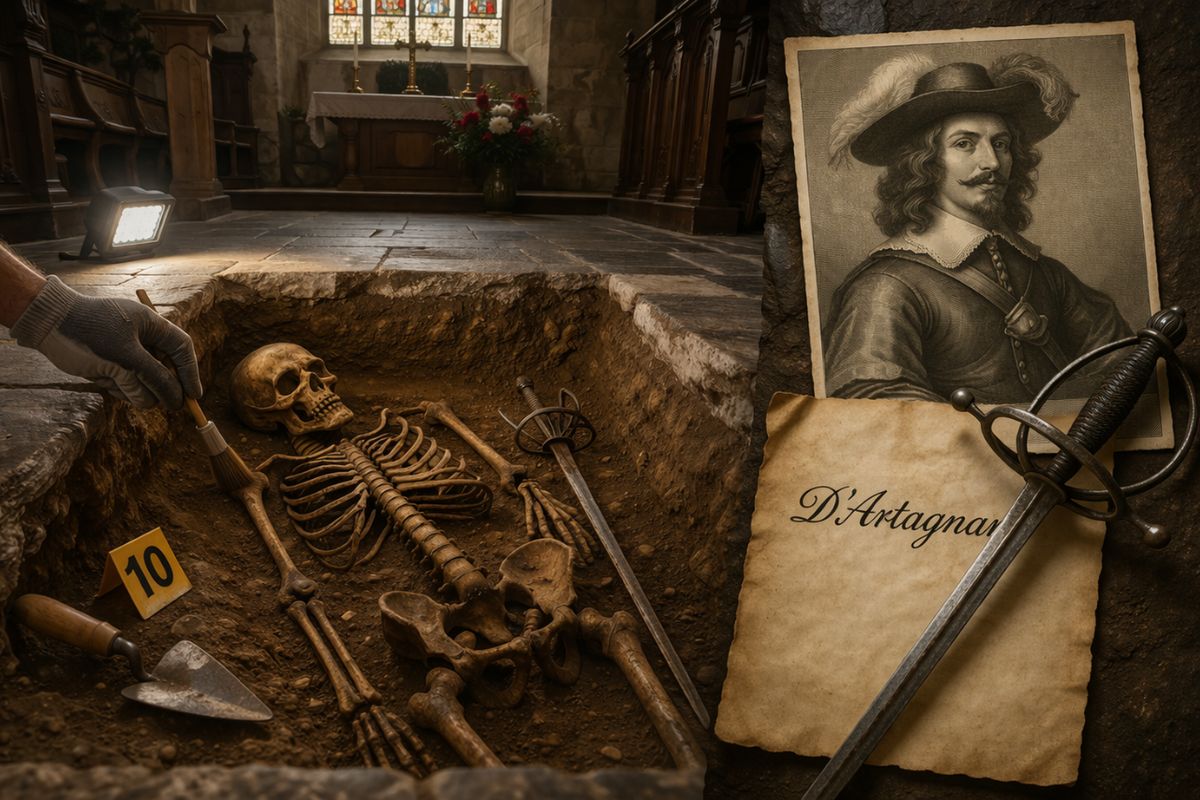
Archeologists investigate if the skeleton of D’Artagnan was found beneath the floor of the Church of Saint Peter and Saint Paul in Maastricht, Netherlands, after workers discovered human bones, a French coin, and preserved dental structures that are now undergoing DNA analysis for comparison with descendants of the musketeer
The skeleton of D’Artagnan, the captain of the musketeers of King Louis XIV who became world-famous for inspiring the central character of Alexandre Dumas’ novel The Three Musketeers, may have been found beneath the floor of a church in the city of Maastricht, Netherlands. The discovery happened accidentally when workers performing repairs on the floor of the Church of Saint Peter and Saint Paul identified a hole beneath damaged tiles and found human bones in the cavity.
According to CNN, along with the bones, a French coin and preserved dental structures were found, objects that reinforce the hypothesis that the skeleton of D’Artagnan has finally been located after centuries of uncertainty about his burial site. The church had already been historically pointed out as a possible tomb of the musketeer, who died in combat in the region in the 17th century. The remains are now undergoing DNA analysis in the Netherlands and abroad, focusing on the extraction of genetic material from a jawbone found at the site.
How maintenance workers found the bones beneath the church floor

The discovery that may lead to the skeleton of D’Artagnan did not come from a planned archaeological excavation. It started from a routine repair. Workers were maintaining the floor of the Church of Saint Peter and Saint Paul in Maastricht when they identified damage to some tiles.
-
The aircraft carrier USS Nimitz is coming to Brazil with F/A-18 Super Hornet fighters, Seahawk helicopters, and a guided missile destroyer in an operation that will circumnavigate the entire South American continent in 2026.

-
The problem has never been the steel, never been the engineering, and never been the safety: the grain silo house that heats itself is blocked by aesthetic laws, banks that don’t know how to evaluate it, and insurers that can’t price it.

-
For 20 years, this man from Ceuta has been collecting used oil from bars, mixing it with chemicals in a machine he built himself, and producing his own diesel at almost no cost while the world struggles with fuel prices.

-
Every butcher asks to have the knife sharpened as soon as they buy it, and this process that changes the geometry of the blade is the real reason why that white-handled knife cuts so well all day long without losing its edge.


Upon removing the damaged pieces, they found a cavity beneath the structure and, inside it, human bones. The work was immediately halted, and archaeologists were called to the site.
Deacon Jos Valke reported that the team stopped as soon as the bones appeared. According to him, there had never been an excavation at that point in the church out of respect for the religious space.
“It has always been said that it was sacred ground and should be left in peace,” Valke explained. The decision to never excavate the site is precisely what preserved the remains for centuries, making it possible for the skeleton of D’Artagnan to have remained intact since the 17th century.
Who was D’Artagnan in real life and why did he die in the Netherlands

Charles de Batz de Castelmore d’Artagnan was a French military officer who served as captain of the musketeers of King Louis XIV, the Sun King. Born in Gascony, in southwestern France, he commanded the personal guard of the monarch and participated in decisive military campaigns in 17th-century Europe.
His historical fame is due both to his military career and to the fact that he inspired the central character of the novel The Three Musketeers, published by Alexandre Dumas in 1844.
D’Artagnan died in combat during the siege of Maastricht in 1673, when French troops were trying to take the city from the Dutch. Historical accounts indicate that he was shot in the throat during the assault on the walls.
The exact location of his burial has never been confirmed with certainty, but the Church of Saint Peter and Saint Paul in Maastricht has always been among the most accepted hypotheses by historians. The possible discovery of the skeleton of D’Artagnan at this exact location reinforces decades of historical research.
The evidence linking the bones to the musketeer of Louis XIV
In addition to the human bones, archaeologists found a French coin and well-preserved dental structures at the site.
The coin is considered a relevant indication because it confirms the French origin of the individual buried in a Dutch church, which would be unusual for a local citizen.
The dental structures will be analyzed to determine the approximate age of the individual at the time of death and the period in which he lived.
The main focus of the investigation is the extraction of genetic material from a jawbone found with the remains. The DNA will be compared to that of possible descendants of the French military officer to confirm whether the skeleton of D’Artagnan truly belongs to him.
Archaeologist Wim Dijkman, who is responsible for the investigation, stated that the case has become a large-scale operation. “We want to be absolutely sure, or as sure as possible, whether this is indeed the famous musketeer who was killed here near Maastricht,” he declared.
The DNA analyses that could confirm the identity of the skeleton of D’Artagnan
The remains are being analyzed by teams in the Netherlands and in laboratories abroad. The jawbone is the centerpiece of the investigation because skull bones tend to preserve genetic material better over the centuries.
If the DNA is successfully extracted, it will be compared to the genetic material of families descending from the lineage of D’Artagnan in the Gascony region of France.
The results of the tests do not yet have a defined timeline for release. The research team indicated that it intends to achieve the highest possible degree of scientific accuracy before any official confirmation.
If the identity is confirmed, the discovery of the skeleton of D’Artagnan will represent a historical and archaeological milestone, ending more than 350 years of uncertainty about the final fate of the man who became one of the most famous characters in world literature.
What changes if science confirms that the bones are of the royal musketeer
The confirmation of the skeleton of D’Artagnan would have repercussions that go beyond archaeology. The Church of Saint Peter and Saint Paul in Maastricht would likely become a pilgrimage site for fans of Alexandre Dumas’ novel and enthusiasts of French military history.
The Dutch city would gain an internationally significant tourist and cultural attraction, forever linking Maastricht to the myth of the musketeers.
For France, the discovery would close a chapter that has been open since 1673. D’Artagnan is a figure of national pride, and the definitive location of his remains would allow for formal tributes and possibly the repatriation of the bones, should the French government and the Dutch authorities reach an agreement.
The story of the royal musketeer, which already transcends Dumas’ fiction, would gain yet another extraordinary episode.
When fiction meets archaeology beneath the floor of a church
The possible discovery of the skeleton of D’Artagnan beneath a church in Maastricht is the kind of story that seems straight out of an adventure novel.
Workers performing a routine repair find human bones and a French coin that may belong to the man who inspired one of the most famous characters in literature.
Now, science has the final word: DNA analyses will determine if this is indeed the musketeer who served Louis XIV and died in battle over 350 years ago.
Have you read The Three Musketeers or seen any adaptations? Do you think science will confirm that this is indeed the skeleton of D’Artagnan, or could the bones belong to someone else? Leave your thoughts in the comments and share this article with anyone who loves history and archaeology.








Seja o primeiro a reagir!