





 Portuguese
  English
  Spanish
  5 min of reading
  0 comments


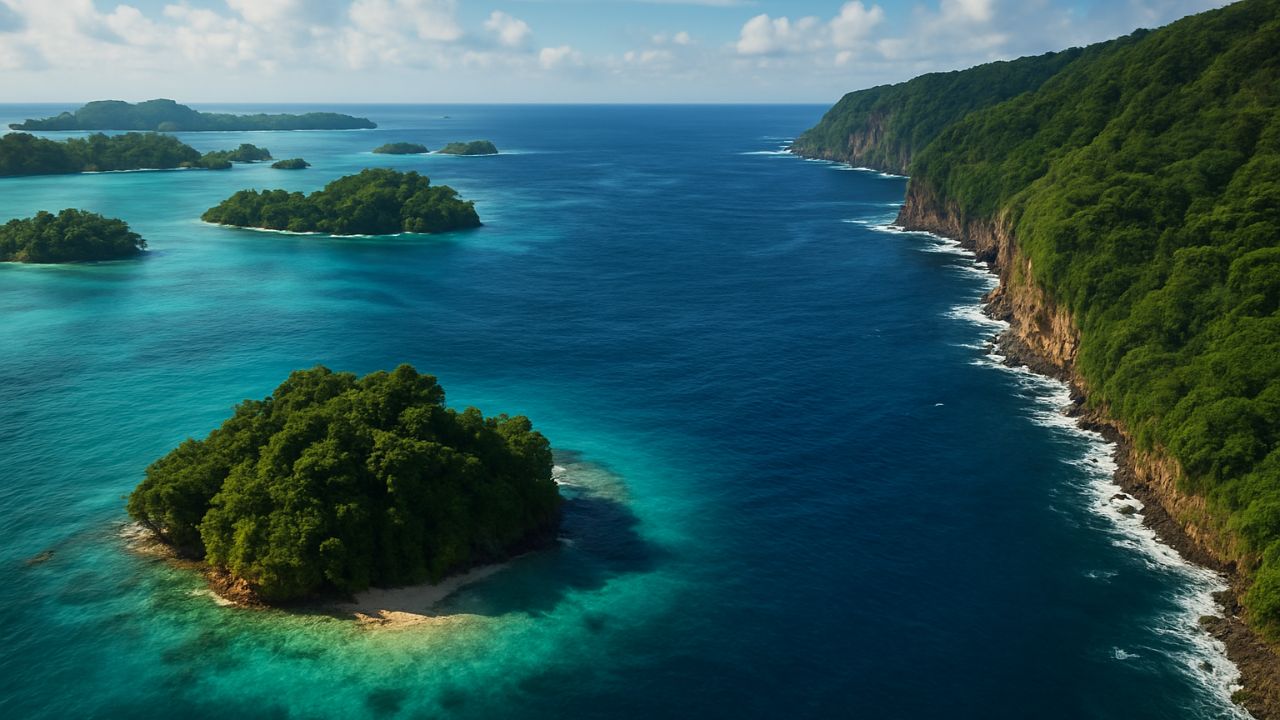
Geology Reveals How the Dance of Tectonic Plates and the Depth of the Oceans Created Thousands of Islands in the Caribbean, a Drastically Different Scenario from the South American Coast.
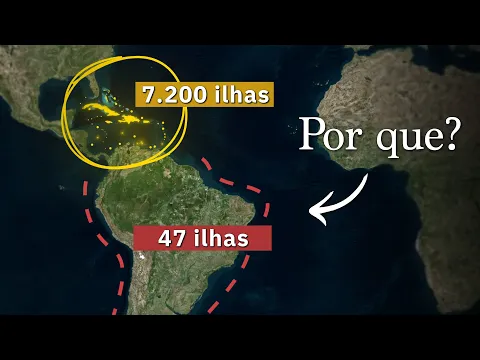
Looking at a map of the American continent, the disparity is evident: while the Caribbean is a mosaic of about 7,200 islands, South America has approximately 50 oceanic islands scattered along its vast Atlantic and Pacific coasts. This monumental difference is not a coincidence, but rather the result of complex and distinct geological processes that shaped each region over millions of years. The explanation, as detailed by Canal Capital Financeiro, lies in the intense activity of tectonic plates and the depth of the seas that wash over each area.
To understand why the islands in the Caribbean are so numerous, one must dive into geology and understand that not all islands are created the same way. The answer lies in the fundamental distinction between continental and oceanic islands, a concept that reveals how the “factory” of Caribbean islands operates uniquely compared to the South American geological formation that favored the creation of mountains rather than archipelagos.
The Crucial Difference: Oceanic Islands vs. Continental Islands

Before analyzing the geology of each region, it is essential to understand the classification of islands. Continental islands are essentially extensions of the continent itself that became separated by some geological event, such as rising sea levels or erosion processes. They are located on the continental shelf, the submerged edge of the continent. Countries like Sweden, with over 260,000 islands, and Chile, with about 5,000, are perfect examples. Their islands are “stuck” to the coast, being geologically part of the continent.
-
These living root bridges and ladders are over 700 years old and help indigenous people survive in one of the rainiest regions in the world.

-
From sertanejo star to international investor: Ana Castela invests millions in a mansion in the USA, creates a themed accommodation in Orlando, and shows that the “boiadeira” also wants to grow away from the stage.

-
The 10 most stunning motorhomes in the world: a $3 million trailer with a rooftop nightclub and garage for a Ferrari, “palaces on wheels” with Italian marble, private cinema, and five-star hotel luxury for billionaires.

-
Trump wanted to spend $400 million on the White House, but the courts prohibited the million-dollar construction.


On the other hand, oceanic islands arise completely independently, in the middle of the ocean. They are formed mainly by processes of submarine volcanism, where volcanoes emerge from the seabed until they break the surface, or by the growth of coral reefs. It is exactly this type of island that proliferates in the Caribbean and is rare in South America. This distinction is the starting point for unraveling the mystery, as the processes that create oceanic islands are extremely active in the Caribbean region and practically absent or ineffective on the South American coast.
The Tectonic Chaos That Gave Rise to the Islands in the Caribbean
The main reason for the abundance of islands in the Caribbean is their location in one of the most geologically complex and active areas on the planet. At the center of this scenario is the Caribbean Plate, an intermediate piece that is pressed, pushed, and sliding over at least 14 other tectonic plates and microplates. This constant interaction is the engine that, over millions of years, built the vast archipelago we see today, a fact well highlighted by Canal Capital Financeiro.
To the east, the Atlantic Plate subducts beneath the Caribbean Plate in a process called subduction. This submergence melts the oceanic crust at depth, generating magma that rises and forms a continuous volcanic arc, giving rise to islands aligned like Dominica, Martinique, and Guadeloupe. To the west, the Cocos Plate slides beneath the Caribbean Plate, creating not only the volcanoes of Central America but also underwater elevations and islands close to the coast. The result of this “dance” of tectonics is a scenario with more than 7,000 islands.
South America: Why Is the Geological Scenario So Different?
While the Caribbean is a battleground of multiple plates, the South American coast is dominated by a simpler interaction, mainly between the Nazca Plate (in the Pacific) and the South American Plate. The crucial point here is that the collision zone between these two gigantic plates is much closer to the continental margin. This proximity completely changed the outcome of the tectonic clash, preventing the formation of a large number of oceanic islands.
The direct consequence of this continental collision was the formation of the imposing Andes Mountain Range, one of the longest and highest mountain chains in the world. Instead of creating volcanic island arcs in the middle of the ocean, the tectonic pressure folded and raised the very edge of the South American continent. The thousands of islands found in southern Chile, for example, are continental, fragments of the coast shaped by this same geological activity and glacial action, and not independent oceanic islands.
The Depth of the Ocean and the Story of the South Atlantic
Another determining factor, as pointed out by Canal Capital Financeiro, is the depth of the ocean. The Caribbean Sea is relatively shallow, with an average depth of only 2,200 meters. In contrast, the South Atlantic and the Pacific reach average depths of over 4,000 meters. This difference is enormous: in the Caribbean, a small underwater elevation does not need to grow as much to emerge and become an island. In the deep oceans off South America, any formation has a much longer and harder path to reach the surface.
Furthermore, the history of the formation of the South Atlantic was different. When South America and Africa separated about 120 million years ago, many temporary islands may have arisen. However, over time, the South American plate moved westward, and many of these formations sank, were eroded by strong ocean currents, or buried by sediments. What remains today are just isolated volcanic points, like Ascension Island and Saint Helena, leaving the vast ocean with very few islands.
The enormous difference in the number of islands in the Caribbean and South America is not a mystery, but a clear demonstration of how different geological forces shape our planet. The Caribbean, with its shallow sea and the frenetic interaction of multiple tectonic plates, has become a nursery of volcanic islands. Meanwhile, South America, with its deep oceans and a plate collision focused on the coast, has channeled that energy to elevate the majestic Andes Mountain Range.
Did you already know the geological reasons behind the formation of these paradises? What other geographical curiosity about our planet intrigues you? Share your thoughts in the comments; we want to hear your perspective!






Seja o primeiro a reagir!