





 Portuguese
  English
  Spanish
  3 min of reading
  0 comments


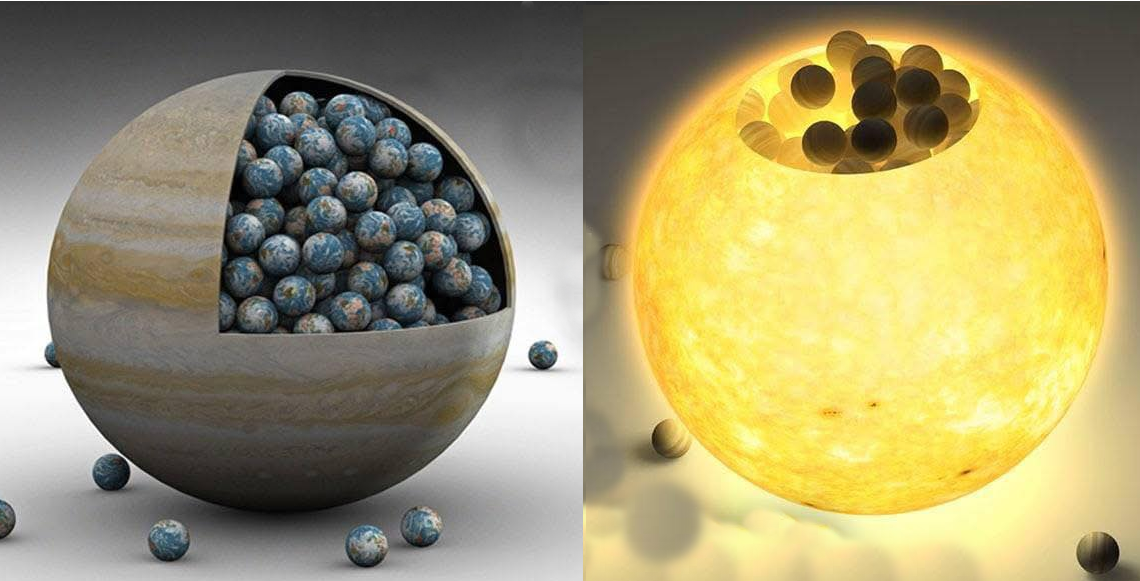
To Understand The Proportions Of Our Solar System, Just Imagine That The Sun Could Hold About A Thousand Planets The Size Of Jupiter — And That Each Jupiter, In Turn, Could Hold About 1,000 Planets The Size Of Earth
The universe is filled with impressive scales that challenge our imagination. Among them, the proportions between the bodies of our own Solar System are enough to cause admiration. Did you know that the Sun can hold about one thousand Jupiter-sized planets, and that Jupiter can hold approximately 1,000 Earth-sized planets within its volume?
These numbers reveal how small our planet is compared to the cosmic structures that surround us.
The Sun — The Giant Of The Solar System
The Sun is the star that keeps the Solar System united. It represents 99.86% of the total mass of the entire system. Its radius is approximately 696,000 kilometers, and its volume is about 1.41 × 10¹⁸ cubic kilometers.
-
China creates hypersonic engine that can make planes and missiles fly more than 6 times the speed of sound with less weight, more range, and without system change.

-
Mysterious object on Mars divides NASA and Harvard after Curiosity image reignites suspicions about what was really found on the planet.
-
Giant structures 14 meters beneath Egypt are revealed by satellites and expose a millennia-old secret buried in Buto.

-
Children have been making clay pieces for 15,000 years in Southwest Asia, and fingerprints preserved on 142 ornaments helped archaeologists prove this.

Jupiter, on the other hand, is the largest planet in the Solar System. Its radius is about 69,911 kilometers, and its volume is approximately 1.43 × 10¹⁵ cubic kilometers.
When we compare these two volumes, we realize that it would be possible to fit about 988 Jupiters inside the Sun. Rounding, we say that the Sun can hold about one thousand Jupiters, which gives a more intuitive idea of the proportion between them.
Jupiter — The King Of The Planets
Jupiter is a gas giant with a mass 318 times greater than that of Earth and a volume about 1,300 times larger.
This means that, in terms of occupied space, approximately 1,000 Earths could fit inside Jupiter, although this does not refer to the number of Earths that could “float” inside — after all, Jupiter is mostly made of gas, and does not have a solid surface like Earth.
This volume comparison is useful for visualizing the grandeur of the planets, although it does not take into account aspects such as mass or density.
For example, Jupiter is much larger than Earth in volume but is much less dense. Earth is a rocky planet, while Jupiter is primarily composed of hydrogen and helium.
Why Do These Comparisons Matter?
Understanding these proportions helps to develop a more realistic perception of our place in the universe. Earth, with all its complexity and life, is just a small bubble amidst an almost incomprehensible vastness. This also reinforces the importance of preserving our planet: to this day, we have not found another world with the same living conditions that we have here.
These comparisons also aid in scientific education, making abstract concepts more concrete and visual.
When we can imagine 1,000 Earths fitting inside Jupiter, or a thousand Jupiters inside the Sun, we start to better comprehend the size and complexity of the cosmos.
With information from NASA.






Seja o primeiro a reagir!