





 Portuguese
  English
  Spanish
  5 min of reading
  0 comments


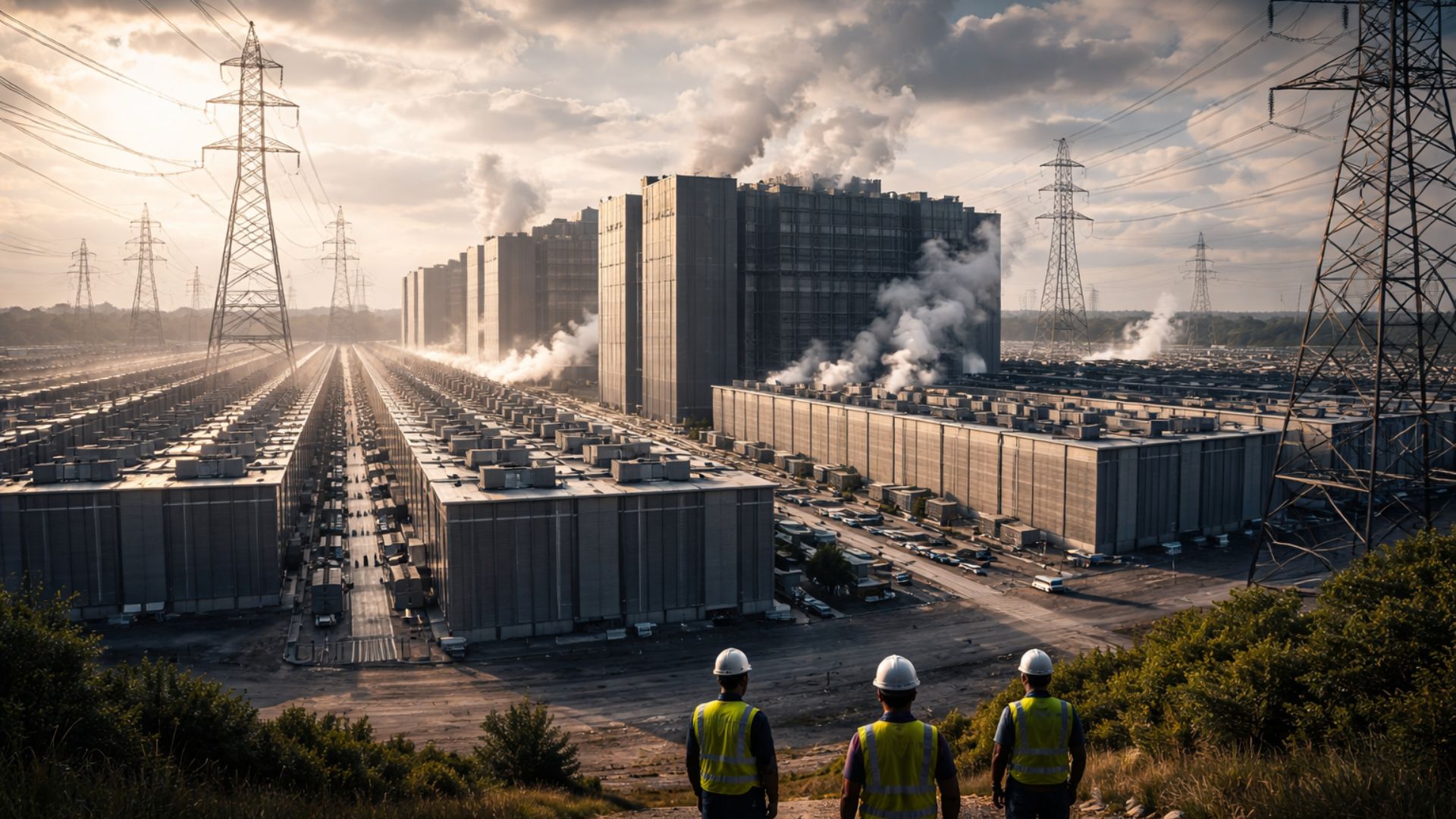
Accelerated expansion of data centers in the United States faces resistance due to energy and water consumption, as states discuss limits for projects related to artificial intelligence and cloud storage.
The rapid advancement of data centers in the United States, driven by the race for cloud computing and artificial intelligence, has begun to face political resistance in various states due to energy consumption, pressure on the electrical grid, and intensive water usage.
The most advanced case is in Maine, where a project approved by the state legislature aims to block, until November 1, 2027, new ventures with a load of 20 megawatts or more, a range considered sufficient to supply between 15,000 and 20,000 households.
Maine leads debate on restrictions on data centers
The proposal turns Maine into a showcase for a debate that is already spreading to other parts of the country.
-
Elon Musk’s Starlink should watch out! Amazon is launching its satellite internet service with over 3,000 authorized satellites, betting on the New Glenn rocket and promising faster connectivity integrated with AWS.

-
What this solid-state nuclear battery does seems like something out of fiction: generating energy for over 100 years in ultra-low consumption devices, without recharging and without replacement, for critical missions in remote and demanding areas.

-
After 80 years at the bottom of the ocean, a Japanese airplane with a 2,000 hp engine and preserved wings is retrieved from the seabed.

-
DARPA surprises by launching a program to create an engine capable of taking off and accelerating to hypersonic speeds above 5,300 km/h (Mach 5), combining turbine and ramjet/scramjet in a unique architecture to finally make reusable flight viable.

The central justification of the measure’s supporters is that the expansion of these processing centers could raise costs for residential consumers, require expensive infrastructure upgrades, and increase competition for natural resources.
At the same time, companies in the sector argue that data centers are a critical part of the digital economy and the expansion of AI, which today relies on increasingly larger and more electricity-intensive facilities.
In the text approved in Augusta, the restriction affects licensing requests, authorizations, and permits for data centers with a minimum load of 20 MW.
In addition to the temporary pause, the project creates the Maine Data Center Coordination Council, an entity responsible for studying the possible effects of these structures on energy, water, land use, and the local economy, with a report expected in 2027.
The central point is to buy time to assess the impact of an industry that is still small in the state but is already raising concerns among residents and lawmakers.
State Representative Melanie Sachs, the author of the proposal, argued in defense of the text that the measure does not represent a rejection of innovation, but an attempt to ensure planning before the arrival of industrial-scale projects.
Critics of the initiative, including Republican Steven Foster, argue that the state already has regulatory tools and that a broad prohibition could deter investments without proven necessity.
The clash summarizes the division between regulatory caution and pressure for economic development.
Electricity becomes central focus of discussion
Maine frequently appears in this debate because it faces high residential rates compared to the national average.
Federal data from the Energy Information Administration and information released by the state government itself show that electricity significantly impacts the local budget, which helps explain the resistance to new large-scale consumers.
In this scenario, lawmakers have begun to treat data centers as potential drivers of new systemic costs, especially if the expansion of the grid is financed, at least in part, by rates paid by the population.
This concern is not limited to Maine.
In other states, bills and regulatory debates have sought to prevent the costs of connection, transmission upgrades, and energy procurement for data centers from being socialized among ordinary consumers.
Recent analyses of the sector’s expansion show that lawmakers in states like Virginia, Georgia, Oklahoma, and Maryland have begun discussing limits, revisions of tax incentives, and mechanisms to avoid indirect costs being passed on to residential bills.
Artificial intelligence increases demand for infrastructure
The dispute has gained traction because the new generation of data centers, focused on artificial intelligence, operates at a scale far superior to traditional centers.
A report by Reuters published in January 2026 indicated that there were plans in progress for more than 150 gigawatts of new energy capacity intended for data centers in the United States, a level far above the current sector base.
The leap reflects the need to train and operate AI models with a large volume of chips, servers, and cooling systems.
In practice, this means that the facilities required by AI can reach consumption comparable to that of entire cities.
The debate has shifted from being merely technological to involving energy planning, land use, and infrastructure investment priorities.
While giants like Amazon, Microsoft, Google, and Meta continue to expand their presence in states already established in this market, the reaction from communities and authorities is growing, questioning whether the economic benefits outweigh the additional pressure on local resources.
Water use enters the environmental account of AI
In addition to electricity, water use has become one of the most cited points by critics of the expansion of this sector.
A study released by the University of California in Riverside estimated that between 20 and 50 queries to systems like ChatGPT could be associated with the consumption of about 500 milliliters of water, considering both the cooling of servers and the water used in the generation of energy that powers these operations.
This data gained traction as it translates, on a daily scale, the water footprint of increasingly popular AI applications.
This type of estimate does not mean that each response consumes water directly at the user’s location, but it helps to gauge the environmental weight of the invisible infrastructure behind digital services.
In regions with water stress or already pressured electrical systems, the discussion about data centers has begun to combine energy and environmental concerns in the same package, which has strengthened proposals for moratoriums, licensing revisions, and additional transparency requirements.
Global expansion and impacts in Brazil enter the radar
Although Maine still has a small share in this market, the numbers help to show why the state fears a sudden change in scale.
The latest survey from the Data Center Map lists 10 data centers in Maine, while Virginia remains the leading American hub, with 582, and Brazil appears with 205.
The concentration in Virginia, especially in the northern part of the state, has become a recurring example of both economic power and the territorial and energy impacts associated with this type of infrastructure.
In Brazil, the discussion is beginning to take on similar contours as larger projects come into view.
A report by Reuters published on April 25, 2025, stated that ByteDance, the parent company of TikTok, was evaluating a large data center project in Ceará, with an initial energy demand of 300 MW and the possibility of expansion to 900 MW.
On another front, proposals announced for AI complexes in states such as Rio de Janeiro, Rio Grande do Sul, Paraná, and Minas Gerais have begun to raise alarms about energy consumption on the scale of millions of households, although part of these numbers still depends on the effective execution of the projects and consolidated confirmation from official sources.
The American reaction, therefore, does not stem from an abstract rejection of technology, but from the attempt to respond to a concrete equation: the more AI advances, the more it demands energy, land, water, and transmission lines.
What is at stake is who bears this cost and at what pace governments are willing to release a new wave of heavy infrastructure to support the digital economy.







Seja o primeiro a reagir!