





 Portuguese
  English
  Spanish
  4 min of reading
  0 comments


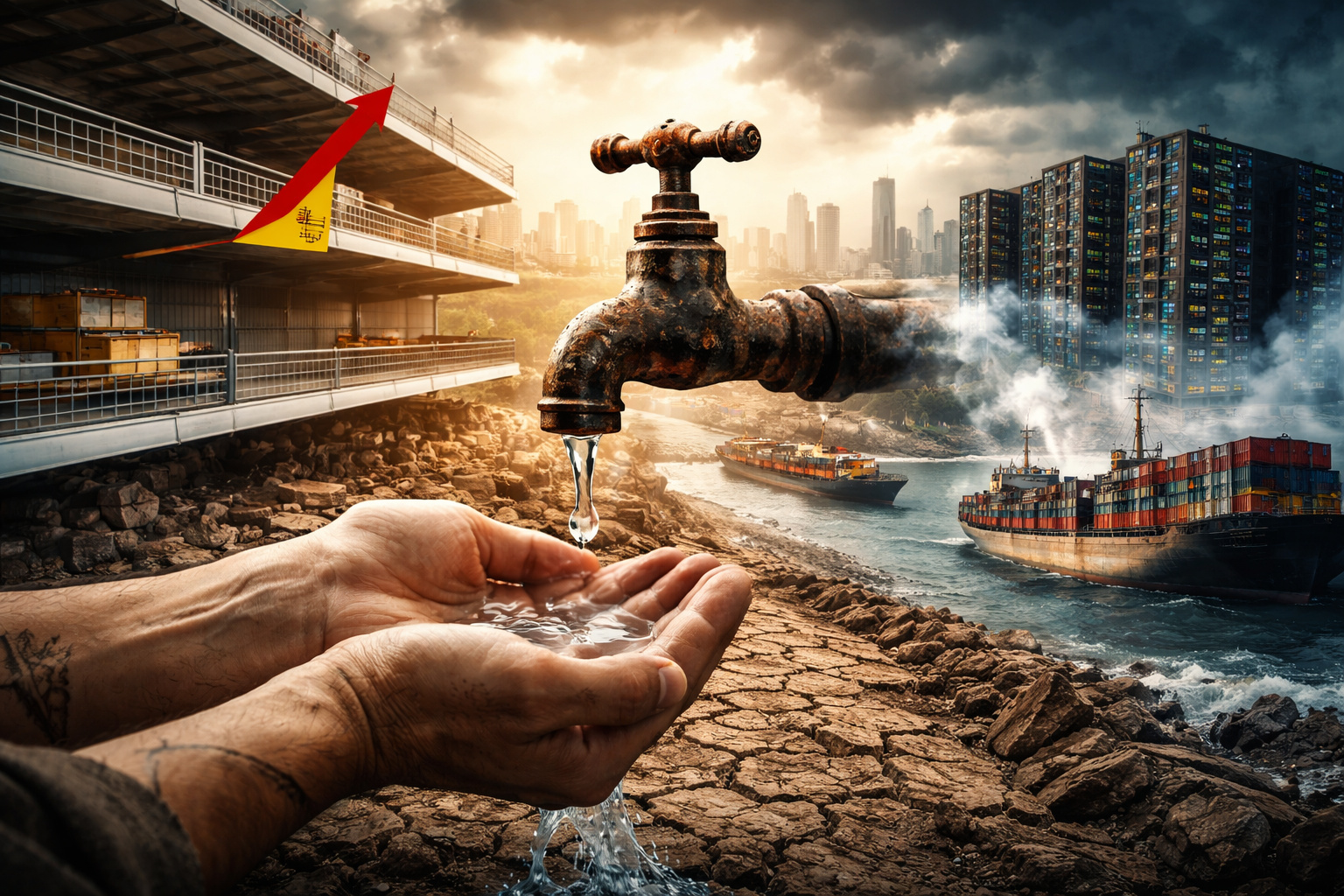
The water crisis advances this year and already causes changes in the economy, technology, and product prices
The water crisis in 2026 has already begun and is no longer just an environmental problem. The current scenario shows that the lack of this resource is already affecting companies, technology, transportation, and even the prices of everyday products.
The impact goes beyond household consumption. Scarcity interferes with production, hampers the functioning of services, and increases costs in various sectors. This happens because water is essential for practically the entire economy, including areas that many people do not imagine, such as technology.
The information was released by the World Economic Forum, an international organization that analyzes global risks and the world economy.
-
A Japanese mason transforms raw granite into small cups and handcrafted utensils, collects giant stones, cuts with precision, and impresses with detailed manufacturing and finishing.

-
With 1,066 acrylic panels, the building known as the friendly alien is supported by a steel skeleton, has a façade that functions as a giant screen, and impresses the world without any internal columns.

-
Scientists warn that a comet about 1 km in size that has started to release gases may actually change direction in space. It was spotted by NASA and surprises with potential impacts near Earth.

-
These living root bridges and ladders are over 700 years old and help indigenous people survive in one of the rainiest regions in the world.

Water shortage is already raising product prices and delaying deliveries in various regions
The reduction in river and canal levels is already affecting the transportation of goods in different parts of the world. This problem generates delivery delays and increased logistical costs.
When transportation becomes more expensive and slower, the effect reaches the consumer. Products may take longer to arrive and also become more expensive.


Additionally, failures in water, energy, and transportation systems cause huge losses every year, especially in places where the infrastructure is not sufficient to support crisis situations.
Technology and the digital economy are also competing for water
The expansion of the digital economy has brought a problem that many people have not yet realized. Large technology systems directly depend on water to function.
Data processing centers, used by digital services and artificial intelligence, need water to keep the equipment running. This means that technology also starts to consume a resource that is becoming increasingly limited.
This scenario increases pressure on supply and can generate conflicts in regions where water is already scarce. The lack of this resource ceases to be just an environmental problem and begins to affect costs, operations, and continuity of services.
Companies are starting to treat water as an essential factor for continued operation
Water has ceased to be a detail within companies. Today it is part of the most important business decisions.
Without guaranteed access to the resource, companies may struggle to maintain production, serve customers, and control costs. This makes water a central point to avoid interruptions.
The World Economic Forum, an international organization that analyzes global risks and the world economy, shows that this risk is already affecting different sectors, including technology, industry, and logistics.
Lack of investment hinders solutions to the water problem
Solving the water crisis requires very high investments. The global need reaches US$ 6.7 trillion by 2030 and could reach US$ 22 trillion by 2050.
Even with these amounts, many projects do not advance. Organizational problems, lack of structure, and execution difficulties prevent solutions from being implemented.
This maintains the risk scenario and causes scarcity to continue affecting the economy directly.
More rules and regulations increase pressure on companies and governments
The trend is towards more control over water use. Stricter rules should require better quality, less pollution, and more efficient use of resources.

This change increases the responsibility of companies and governments. At the same time, it opens up space for solutions that help save and treat water more efficiently. The challenge is not only to create rules but to implement solutions in a real way.
Growth of cities and technology may worsen the scenario
The growth of cities, climate change, and technological advancement create an even more challenging scenario. These factors together make the economy more vulnerable to failures. The lack of water can cause service interruptions, increased costs, and production difficulties.
Pressure is expected to grow in the coming years, especially in regions where the system is already operating close to its limits.
Water becomes a decisive factor for costs, production, and competitiveness
Water has begun to directly influence the functioning of companies and the economy. It impacts costs, production, licenses, and even market confidence.
Those who can prepare to deal with scarcity gain an advantage. Meanwhile, those who ignore the problem may face more difficulties in maintaining their activities. The water crisis in 2026 shows that this resource has ceased to be invisible and has begun to define the course of businesses, services, and the economy itself.
The situation demands immediate attention and planning. The lack of water is already affecting the present and could bring even greater consequences in the coming years.
And you, do you believe that Brazil is prepared to face this scenario? Leave your comment and share this information with others.






Seja o primeiro a reagir!