





 Portuguese
  English
  Spanish
  5 min of reading
  0 comments


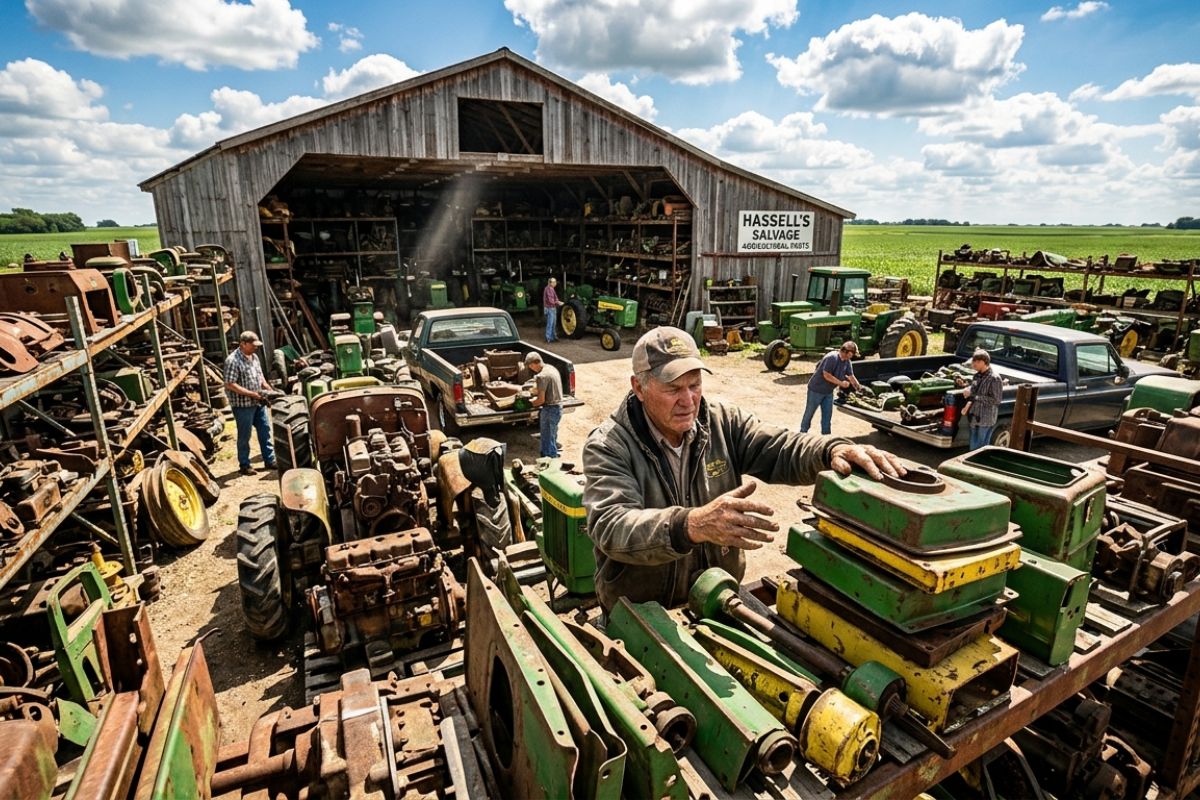
In Harden County, the junkyard stopped being “machine trash” and became strategic stock: when the John Deere dealership closed, old parts saved harvests and urgent repairs
The junkyard has always been the silent shame of many farms: the corner of the fence, the back of the barn, the ravine where the weeds grow tall enough to hide what has completely broken down. In Harden County, Iowa, this accumulation of failure had a name and a fate: to rust slowly until it became a memory.
But one farmer did the opposite of what everyone expected. Roy Hassell did not hate dead equipment. He collected, organized, and labeled parts with an almost obsessive precision, while the rest of the region laughed at the “junkyard” that took over his property.
The ravine that became a machine graveyard and the decision that changed everything

The Hassell farm had a ravine too steep to plant and too rocky to graze. Roy’s father had already used it as a storage area, and when Roy took over, there were a dozen dead machines down there.
-
Archaeologists find possible lost temple of Zeus in the ancient city of Limyra after decades of searching; the millennia-old structure buried under historical layers could redefine the religious map of Anatolia and reveal how the Greeks worshipped their gods outside the classical axis.
-
BYD presents an absurd charging speed of 1,500 kW that adds 500 km of range in just five minutes, but BMW warns that this extreme speed could be costly for the battery of your electric car.

-
Helicopters transport “artificial islands” with soil, trees, and shrubs into a waterlogged and nearly inaccessible swamp in the USA.
-
The lost city of Nan Madol challenges logic by emerging in the middle of the Pacific with canals, geometric islands, and tons of stone that were moved without known technology.

Most would have called the junkyard that paid by the ton and ended the matter. Roy chose another logic. He began to add. And what seemed like stubbornness became method.
The first “junk” tractor and the birth of a system
In 1966, a neighbor named Carl Hinton had bought a new John Deere 420 and wanted to get rid of an old, broken Farmall 460, useless as a tractor. Carl was going to pay the junkyard to take it. Roy interrupted with a simple phrase: don’t scrap it, bring it here.
Carl thought it was absurd. Roy explained what he saw where others saw scrap: a cracked block did not make 100% of the tractor useless, it made 90% of the tractor worth saving.
Hydraulic pump, PTO shaft, differential, gauges, seat, steering column, injector, water pump. Good parts.
When the Farmall arrived, Roy did not dismantle it with a sledgehammer. He took it apart carefully, with a wrench and a service manual.
He cleaned, tested, labeled with tape and grease pencil, separating by brand, model, part name, and condition. What was left went to the ravine, already organized in rows.
The junkyard that became a parts library
The news spread the way it does in the countryside: effortlessly. In two years, people from the region began bringing broken machines to the farm.
Header platform with a bent tooth, tractor with a blown joint, baler forgotten for over a decade. Roy accepted everything.
He spent nights and weekends dismantling, cleaning, labeling, and storing. By 1970, the barn already had hundreds of organized parts and cross-referenced in a notebook that he updated whenever a part came in or out. It was a farm stock with warehouse discipline.
Mockery, complaint, and the nickname that stuck
Not everyone saw it as care. The local dealer, Merl Gustifson, advocated the idea that the only good equipment was new. At the cooperative, he attacked Roy: he said it was shameful, that using used parts was “cheating the system”.
In 1973, an anonymous complaint came in about an unlicensed dismantling operation. An inspector came to check. Roy calmly responded: it was not a commercial operation, it was a neighborhood.
If someone needed it and he had it, he gave or traded it. The case was filed with no violation found. The junkyard remained, and the nickname stuck.
The agricultural crisis changes what is worth money and what is worth harvest
Until the early 80s, it was still possible to buy parts for old models at the dealer’s counter. This changed in 1982, when the agricultural crisis hit hard.
Interest rates at extreme levels, corn prices plummeting, land losing value, farms going to auction due to foreclosure.
When the crisis tightened, the first thing many farmers cut was new equipment. Those who survived stretched each machine to the limit. And when repairing became the norm, parts became a necessity.
The day the John Deere closed and the barn became the last option
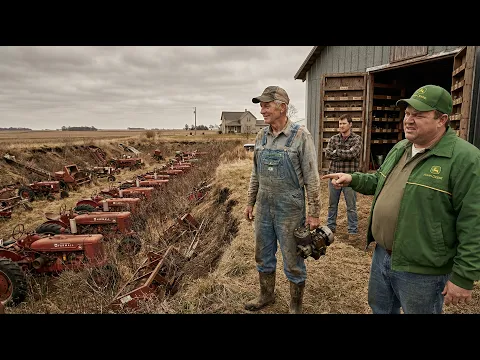

The John Deere dealership in the county dwindled until it reached the impossible: in 1985, it sold not a single new tractor in Harden County.
In August, Merl Gustifson closed the doors. Empty showroom, locked services, and a practical hole appeared in the region’s routine: those who needed parts for 10, 15, 20-year-old tractors had nowhere else to go.
The first farmer appeared at Roy’s barn one September morning in 1985. The Farmall 706 had lost an injector.
The nearest dealer didn’t have it, and the wait would be weeks. Roy went straight to the right shelf and pulled a coffee can labeled with what was inside. Clean, tested injectors. Choose one.
How much does it cost? Roy’s answer became the signature of that period: how much do you have. The farmer paid what he could, installed it quickly, and the tractor was back up and running in time for the harvest.
By Christmas that year, Roy had already supplied parts to dozens of farmers, including items that no one stocked within miles. The junkyard became the emergency pharmacy of the local agriculture.
When the dealer asked for help from the junkyard

In March 1986, a pickup truck appeared at the farm with a faded logo on the door. It was Merl Gustifson himself.
The man who had mocked for 20 years entered the barn and asked for a steering cylinder for a John Deere 4020. He needed it to cultivate his own land and didn’t have the money to look far.
Roy did not smile, did not humiliate. He took the clean, tested, ready part. Merl paid and left. And Roy said the phrase that sums it all up: the thing with junk is that it’s only junk until you need it.
Peak, trades, and an operation based on knowledge
Between 1986 and 1988, the peak came. Roy distributed over 200 parts a year. Farmers arrived with numbers written on paper, with broken parts in hand, or just with a description. Roy, who memorized the inventory, would find the exact shelf.
When someone couldn’t pay, trades came in: labor, grain, fencing service, even laying hens. The junkyard operated on knowledge, not cash.
Legacy: three generations and a file that went from notebook to computer
The inventory grew to thousands of cataloged parts, the ravine became an organized row by manufacturer, and the notebooks became volumes.
Roy Hassell passed away in 2003, with decades of farming and decades of collecting. His son took over, and then the third generation entered the business.
The notebooks were transferred to the computer, but the originals were kept. Labeled coffee cans remained in place, waiting for the day someone needed a part that no one else could supply.
And now tell me: if you saw a junkyard growing on your neighbor’s farm, would you see it as waste or a strategy for when the crunch came?






Seja o primeiro a reagir!